OpenAI Launches New Image Classifier and ChatGPT Warning Mechanism to Combat CSAM Content

OpenAI launches a new image classifier and implements a 24-hour ban warning in ChatGPT to step up CSAM content governance.
OpenAI announced a new image classifier and a warning mechanism in ChatGPT to combat child sexual abuse material (CSAM). ChatGPT will impose 24-hour bans on accounts attempting to access CSAM content as a warning. The classifier aims to improve detection accuracy and reduce false positives. The article argues that combining technical and operational measures builds multi-layered content safety protection, reflecting the trend of AI platforms strengthening content governance, though challenges remain regarding evasion, false positives, and privacy balance.
OpenAI recently announced the launch of a new image classifier and introduced a warning mechanism in ChatGPT to combat the spread of child sexual abuse material (CSAM). According to RSS sources, ChatGPT will impose a 24-hour ban on accounts attempting to access CSAM content as a warning. This move reflects AI platforms' continued efforts to strengthen content safety governance.
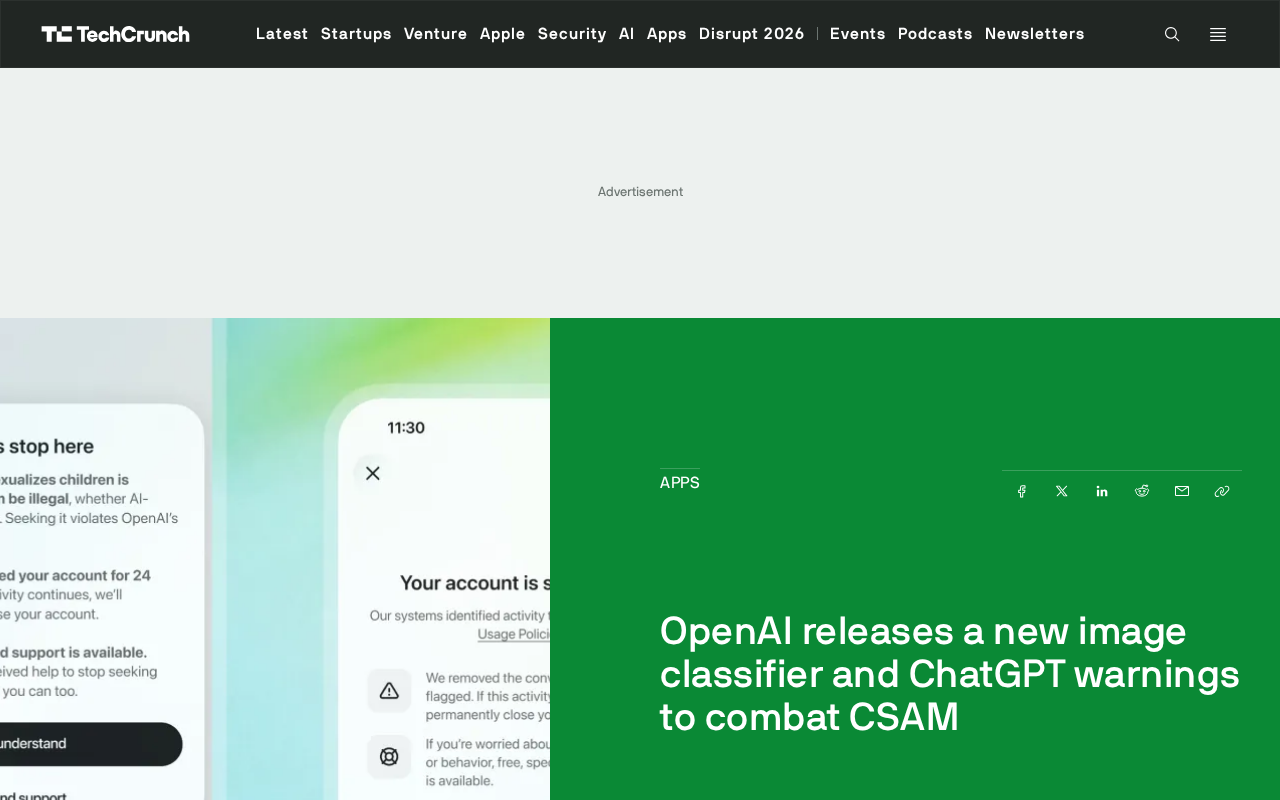
New Image Classifier: More Accurate CSAM Detection
OpenAI's new image classifier aims to improve the detection of CSAM content. Although specific technical details have not been disclosed, it can be inferred that the classifier is based on deep learning models capable of more accurately identifying and blocking violating images. For platforms, image classifiers serve as the first line of defense in content moderation, and their performance directly affects whether CSAM content will be spread. OpenAI's move is expected to reduce the miss rate while minimizing disruption to normal users caused by false positives.
CSAM (Child Sexual Abuse Material) is an internationally recognized legal and law enforcement term referring to images, videos, and other materials that depict minors engaged in sexual acts or nudity in any medium. It is strictly prohibited illegal content in most countries, and platforms may face criminal liability once they host or disseminate it. Unlike general violating content, CSAM detection requires an extremely high recall rate—a missed detection means children continue to be harmed. Therefore, platforms typically combine hash matching (such as PhotoDNA) with machine learning classifiers: the former compares fingerprints of known illegal material, while the latter generalizes to identify newly emerging images. OpenAI's emphasis on the detection capabilities of its new classifier is essentially addressing the shortcoming that pure hash matching cannot cover unknown variants.
ChatGPT Warning Mechanism: 24-Hour Ban as a Deterrent
In addition to the image classifier, OpenAI has also added a warning mechanism to ChatGPT. According to reports, ChatGPT will ban accounts attempting to access CSAM content for 24 hours as a warning. This approach of short-term rather than permanent banning demonstrates zero tolerance for violations while giving users an opportunity to correct their behavior. However, the effectiveness of this mechanism remains to be seen, as a 24-hour ban may not be sufficient to deter malicious users.
Graduated enforcement is a common governance strategy for content platforms: warnings and short-term restrictions for first-time or minor violations, escalating to permanent bans for repeated or serious violations. OpenAI's 24-hour ban for CSAM access attempts is a typical "warning-style penalty," with the logic of distinguishing unintentional triggers from malicious probing, reducing collateral damage while retaining accountability records. However, the legal sensitivity of CSAM is far higher than that of ordinary violating content. Most platforms adopt the practice of immediately and permanently banning accounts confirmed to be involved with CSAM and reporting to organizations such as NCMEC (National Center for Missing & Exploited Children). Therefore, whether a 24-hour ban is sufficient may depend on whether OpenAI simultaneously conducts manual review and law enforcement reporting in the background.
Industry Impact: New Trends in AI Platform Content Safety Governance
OpenAI's series of actions reflects new trends in AI platform content safety governance. With the proliferation of generative AI, platforms face increasing abuse risks, and illegal content such as CSAM has become a key target. By combining technical means (such as image classifiers) with operational measures (such as warning mechanisms), OpenAI is attempting to build a multi-layered protection system. Other AI platforms may follow suit with similar measures, driving the formation of industry standards.
Challenges and Outlook
Despite OpenAI's proactive measures, combating CSAM still faces challenges. For example, malicious users may evade detection through transformation, encryption, and other methods, while classifier false positives may also affect normal users. In the future, OpenAI needs to continuously optimize its models and strengthen cooperation with law enforcement agencies. At the same time, how to effectively identify violating content while protecting privacy is also a difficult balance to strike.
Overall, OpenAI's new measures are an important step in the field of AI content safety, but their actual effectiveness remains to be tested over time.
Adversarial evasion refers to malicious users using image cropping, noise addition, rotation, format conversion, or steganography to make violating content bypass classifier detection. Such attacks have been extensively studied in the computer vision field, indicating that a single classifier is difficult to remain effective over time. Industry response approaches include multi-model ensembles, adversarial training, perceptual hashing linked with content fingerprint databases, and comprehensive judgment combining user behavior signals (such as abnormally high-frequency probing and specific prompt patterns). In addition, end-to-end encryption and privacy protection requirements mean platforms can only detect within a limited visible scope. How to identify violating content while minimizing data access is the core tension between classifier design and compliance.
One-line Summary
OpenAI launches a new image classifier and implements a 24-hour ban warning in ChatGPT, stepping up CSAM content governance.
Paragraph Summary
OpenAI announced the launch of a new image classifier and introduced a warning mechanism in ChatGPT to combat the spread of child sexual abuse material (CSAM). According to reports, ChatGPT will impose a 24-hour ban on accounts attempting to access CSAM content as a warning. The new classifier aims to improve detection accuracy, reduce miss rates, and minimize false positives affecting normal users. The article argues that combining technical and operational measures can build a multi-layered content safety protection system, reflecting the trend of AI platforms strengthening content governance, with other platforms likely to follow. However, combating CSAM still faces challenges such as malicious users evading detection through transformation and encryption, classifier false positives, and balancing privacy protection with content identification, with actual effectiveness awaiting the test of time.
Related articles

Snapchat Opens AI Assistant Lens Building: Supports Claude Code and Cursor
Snapchat lets Lens creators describe AR filters in natural language, with AI assistants like Claude Code and Cursor handling the full build process, greatly lowering the AR creation barrier.

Is the Planck Length the Smallest Distance? Why Physicists Are Skeptical
The Planck length is often called the smallest distance in the universe, but science videos point out this claim has never been experimentally confirmed. This article explains the origins of the Planck length, the obstacles of microscope thought experiments, and what it really tells us—the scale at which quantum gravity becomes unavoidable, not spacetime pixels.

AI Agents Drive Spend Management: Payhawk Raises $280M
Payhawk raises $280M at a $2B valuation. The 2018-founded enterprise finance platform uses AI agents to track and manage expenses and procurement. This article analyzes its product evolution, valuation signals, and impact on the spend management space.