OpenAI Open-Sources Codex Security: An In-Depth Review of the AI Security Scanning Tool's Strengths and Limitations

OpenAI's Codex Security promises AI-driven vulnerability verification but remains a limited beta with cost and guardrail issues.
OpenAI's Codex Security aims to replace rule-based code scanning with an AI Agent that performs contextual threat modeling and sandbox-based vulnerability verification. While its 74% true positive rate in limited testing beats Snyk and Semgrep on precision, the tool currently suffers from high costs, small language coverage, safety guardrail conflicts, and cloud-only dependence despite its Apache 2.0 license.
What Is Codex Security: A Scanning Tool That Wants to Be an "AI Security Researcher"
In late July 2026, OpenAI open-sourced a code security scanning tool — Codex Security. It comes in two forms: a command-line tool and a TypeScript SDK, both published on npm under the package name @openai/codex-security with an Apache 2.0 license.
At first glance, this looks like yet another static code scanner. Snyk and Semgrep have been doing this for years, and GitHub has CodeQL. What could OpenAI possibly bring to the table at this point?
To understand this, you need some context about the current state of SAST (Static Application Security Testing) as an industry. SAST has over 20 years of history, with early representative tools including Fortify (founded in 2002, later acquired by HP) and Coverity. The core challenge in this field has always been balancing precision and recall: loose rules find more vulnerabilities but produce more false positives; strict rules reduce false positives but miss real vulnerabilities. The industry generally acknowledges that traditional SAST tools have false positive rates between 30%-70%, and security engineers spend enormous amounts of time sifting through noise — "alert fatigue" has become a chronic industry pain point.
Codex Security's answer can be summed up in one sentence: traditional scanning tools use rules to match code, like an intern who can only memorize vulnerability signatures; what Codex Security aims to be is an AI security researcher that can think for itself, verify for itself, and even write its own patches.
This positioning difference is the soul of the entire tool. The official definition calls it an "application security Agent" that helps security teams and engineering teams discover, confirm, and fix vulnerabilities in code. These three verbs correspond precisely to its three core commands.
One easily confused point worth clarifying upfront: it's a completely different product from OpenAI's code-writing Codex CLI — they live in different GitHub repositories. The security scanner borrows the code-writing tool's engine, but the product is independent. Under the hood, it runs on OpenAI's own Codex programming Agent runtime, with the default model at GPT-5.6 level and inference intensity cranked to maximum.
From "Memorizing Rules" to "Understanding Systems": Codex Security's Core Technical Approach
Traditional tools (like Semgrep and Snyk's code scanning) are essentially doing pattern matching: you pre-write a bunch of rules describing what code patterns are dangerous — like directly concatenating SQL statements, or calling a known-vulnerable function — and then the tool checks the code against each rule looking for matches.
This approach is fast, covers many languages, and rules are customizable, but it has an inescapable flaw: high false positives. It can tell you "this code looks like it has a vulnerability," but it can't determine whether, within your entire system, this code can actually be exploited by an attacker.
Here's an example: some code does concatenate SQL, which looks dangerous; but if the input to this code is never user-controlled and an attacker can never inject anything, then it's a false alarm. Traditional tools can't see this context, so they report everything indiscriminately. The result is that security engineers face hundreds of alerts daily, with the majority being noise.
Codex Security takes a different approach — it doesn't rely on rules, but on contextual reasoning. It first builds a threat model of the entire project: figuring out where data enters, what processing it goes through, where trust boundaries are, how authentication mechanisms are designed, and then judges whether a piece of code actually poses risk within this system based on this global understanding. This is the leap from "memorizing rules" to "understanding systems."
Threat Modeling mentioned here is a structured methodology in the security domain used to identify security threats, attack surfaces, and potential vulnerabilities in systems. Classic frameworks include Microsoft's STRIDE (identifying six threat categories: Spoofing, Tampering, Repudiation, Information Disclosure, Denial of Service, and Elevation of Privilege) and PASTA (a seven-step attack simulation methodology). Traditionally, this is highly specialized work done manually by security architects, requiring understanding of system data flow diagrams, trust boundaries, authentication mechanisms, and other global information. Codex Security attempts to automate this process — letting AI automatically build an understanding of the system's data flow, identify trust boundaries, and then judge whether specific code is truly exploitable based on the global view.
Sandbox Verification: The Key Move That Actually Reduces False Positives
Codex Security's most critical differentiator is in the verification step. Traditional tools finish their job after reporting suspicious code — whether it's actually a vulnerability is yours to confirm.
Codex Security goes one step further: it claims to actually attempt to exploit the vulnerability in a sandbox environment, simulating an attacker's techniques with real attack attempts to see if it can be reproduced. If reproduction succeeds, it's a real vulnerability and gets retained; if exploitation fails no matter what, it's likely a false positive and gets downgraded or discarded entirely.
Sandbox verification is essentially dynamic security testing in a controlled environment. In the security field, this methodology of "actually attempting to exploit vulnerabilities" isn't entirely new — penetration testing and DAST (Dynamic Application Security Testing) tools like OWASP ZAP and Burp Suite have long been doing similar work. The difference is: traditional DAST requires the application to be actually running, typically sending malicious requests to HTTP endpoints in test environments; whereas Codex Security's sandbox verification is closer to "automated penetration testing" — it simulates an attacker's complete exploitation chain in an isolated environment, including crafting malicious inputs, triggering code paths, and verifying whether the intended attack effect (such as data leakage or privilege escalation) can be achieved. This approach of combining SAST findings with dynamic verification is known in the industry as an evolution toward IAST (Interactive Application Security Testing).
This is the fundamental reason it claims to dramatically reduce false positives — not through smarter rules, but through actual verification. Logically, this approach makes sense: the most reliable way to determine whether an alert is real or fake is to see whether it can actually be exploited. In the past, this kind of work was done by senior security researchers; now it wants AI to do it.
The complete loop works like this:
- Scan: Scan the repository, identify candidate vulnerabilities, produce a Findings file
- Validate: Verify each finding in an isolated environment, filter out false positives
- Patch: Generate fix patches for confirmed real vulnerabilities
- Rerun + Compare: Re-scan and compare results before and after fixes, see what's been fixed, what's new, and what's regressed
However, to be clear: in CI pipelines, this workflow is currently read-only — CI only handles scanning and reporting; the fix step requires developers to manually trigger it locally or in a PR.
Installation Guide and Current Limitations
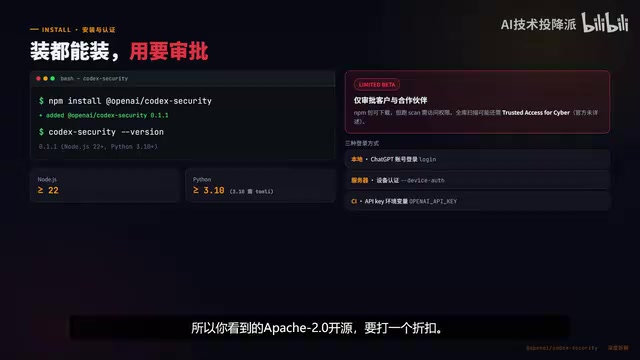
Installation is simple: npm install @openai/codex-security. There are hard environment requirements — Node.js must be 22 or higher, Python must be 3.10 or higher (used during scanning and result export). Mac, Linux, and Windows are all supported.
But there's a key prerequisite for actual use: it's currently not available to everyone. The official documentation explicitly states it's in Limited Beta, open only to approved customers and partners. You can download the npm package, but actually running scans requires access permissions, and certain full-repository scans need an additional authorization called Trusted Access for Cyber.
So the Apache 2.0 open source label needs to be taken with a grain of salt: the code is indeed open-sourced, but the scanning capability is tied to OpenAI's cloud, tied to their models, and requires approval.
Scans generate a results directory containing Findings (issue details, severity level, confidence, location, evidence, remediation suggestions) and Coverage. OpenAI specifically designed exit codes: 0 for complete runs; 1 when issues above threshold are found (used for CI blocking); 2 when the scan itself errors or coverage is incomplete. This design is deliberate — it would rather report an error than give you a green pass it's not confident about.
There's also a practical pre-commit hook (codex-security install-hook) that automatically scans changes before each commit, blocking the commit if high-severity vulnerabilities are found, with a default threshold of HIGH. It won't replace your existing pre-commit scripts and respects Git's core.hooksPath setting.
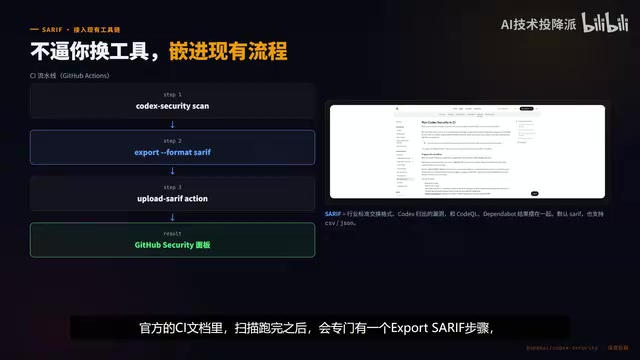
Results integrate with existing toolchains through the SARIF format. SARIF (Static Analysis Results Interchange Format) is a JSON format specification standardized by the OASIS standards organization, specifically designed to represent static analysis tool output, and became an official standard in 2020. It solves a long-standing pain point: in the past, every security scanning tool had a different output format, requiring custom adapters for each tool when integrating into CI/CD pipelines or security dashboards. GitHub began natively supporting SARIF uploads in 2019, with Azure DevOps and GitLab following suit. Through SARIF, results from different tools can be displayed uniformly, deduplicated, and have fix status tracked. After export, results can be uploaded to the GitHub Security dashboard and displayed alongside CodeQL and Dependabot results. It doesn't force you to switch tools — it just feeds high-quality results into your existing workflow.
Performance Data Analysis: Official Claims vs. Third-Party Testing Reality
When looking at data, you must distinguish what OpenAI self-reported, what was tested by third parties, and what simply cannot be verified.
OpenAI Official Data (Self-Reported, Not Independently Verified)
From the March 2026 product research preview announcement: over the past 30 days, the test user group scanned over 1.2 million commits, finding 792 critical vulnerabilities and 10,561 high-severity vulnerabilities, with critical vulnerabilities appearing in less than one in a thousand commits. On quality, the official claims state false positive rates dropped by over 50% and severity over-reporting decreased by over 90%.
One frequently cited figure of "84% noise reduction" needs special clarification: the official text states very clearly that this was in one case (a specific instance), not a general performance level. Many third-party blogs present it as universal performance — this is inaccurate.
The company also published a batch of real CVE numbers that were fixed, involving open-source projects like GnuTLS, GnuPG, and Gogs — 15 in total. These CVE numbers can be found in public vulnerability databases — but the claim that "Codex Security discovered them" currently only has OpenAI's unilateral assertion.
(Worth noting, this product has a predecessor: it launched private beta under the name Aardvark in October 2025, and was renamed Codex Security in March 2026.)
Third-Party Testing: The Reference Value of a 74% True Positive Rate
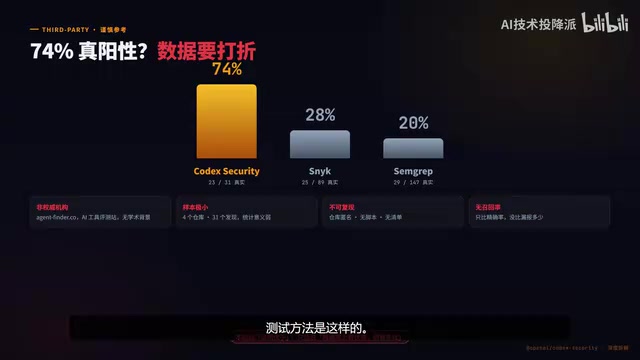
One widely cited data point: a true positive rate of 74% in 162,000 lines of production code, higher than Snyk and Semgrep. It comes from a March 2026 review by a website called Agent Finder: testing 4 production-grade repositories (Django backend, React frontend, Go microservice, Spring Boot service), with manual verification after three tools scanned them.
Results: Codex Security reported 31 findings with 23 true (74%); Snyk reported 89 with 25 true (28%); Semgrep reported 147 with 29 true (20%).
At first glance, Codex Security wins decisively, but this review has several unavoidable issues:
- Agent Finder is not an authoritative security research institution — it's just an AI tool review website;
- Sample size is too small — Codex Security only had 31 findings, making statistical persuasion weak;
- Not reproducible — repositories are anonymized, with no public links or test scripts;
- Only compares true positive rates, not recall — a high true positive rate only means most of what was reported is real, not that it didn't miss real vulnerabilities. In the extreme case, a tool that reports only 1 finding that happens to be real has a 100% true positive rate, but is far less valuable than a tool that reported 30.
So this data can be cited, but with clear caveats: single test, small sample, methodology not disclosed, no peer review. It hints at a precision advantage but absolutely cannot support the claim "testing proves it's better than Snyk and Semgrep."
Codex Security vs Snyk vs Semgrep vs CodeQL: Four Technical Approaches Compared
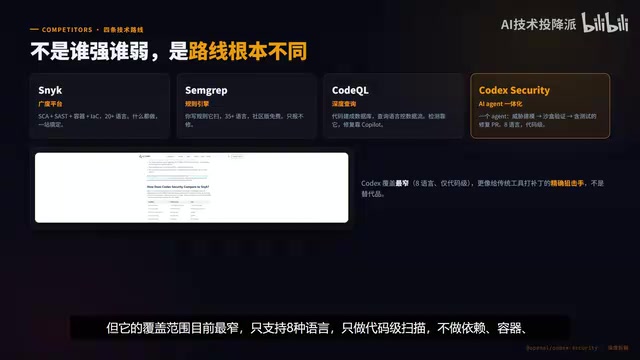
The interesting comparison isn't about who's stronger or weaker, but that their technical approaches are fundamentally different:
- Snyk: Platform approach — does everything (dependencies, code, containers, infrastructure), covers 20+ languages, strong in ecosystem integration, suitable for responsive teams. Snyk's core advantage is the real-time update capability of its vulnerability database and developer-friendly integration experience. Its valuation reached $7.4 billion in 2023, making it a representative unicorn in the security tools space.
- Semgrep: Rules engine approach — uses a custom rule language (a simplified pattern-matching DSL with syntax resembling the target language itself), covers 30+ languages, community edition is free, and is developers' favorite lightweight tool. But it's fundamentally still pattern matching — it reports but doesn't fix. Semgrep was developed by r2c (now renamed Semgrep Inc.), and its rule registry contains thousands of community-contributed detection rules covering the vast majority of OWASP Top 10 scenarios.
- CodeQL: Deep analysis approach — compiles the codebase into a relational database, then uses a SQL-like query language (QL) to perform semantic-level analysis on code. It can trace data flow from "sources" (like user input) to "sinks" (like SQL execution functions), determining whether effective sanitization occurs in between. This taint analysis capability makes its precision among the best in the industry, but the tradeoff is long database-building times, steep learning curves, and separation between detection (CodeQL) and remediation (Copilot Autofix). CodeQL is free for open-source projects; commercial use requires a GitHub Advanced Security license.
- Codex Security: AI Agent integrated approach — uses threat modeling for contextual reasoning, validates findings in sandboxes, then generates complete fix PRs with test cases.
One-sentence summary: Snyk is a breadth platform, Semgrep is a rules engine, CodeQL is a deep query tool, and Codex Security wants an AI researcher to handle threat modeling, verification, and remediation all at once.
But its coverage is currently the narrowest: only supports eight languages, only does code-level scanning, and doesn't handle dependencies, containers, or infrastructure. Positioning-wise, it's more like a "precision sniper" that supplements traditional tools, not a replacement.
Real Developer Feedback: Advanced Thinking, Bumpy Implementation
A Hacker News discussion thread (536 upvotes, nearly 200 comments) paints a realistic usage picture.
What's praised: Most recognized is response speed — team members reply individually to every user question, bug, rate limit issue, and error report, with solid community responsiveness. Next is the open-sourced security skill definitions (written in TypeScript, Apache 2.0), which the team says cost massive token budgets to fine-tune, and some users consider this the core value. The engineering design (cross-repository scanning, history tracking, deduplication, budget controls) is also recognized.
Criticism is more prominent:
-
Cost spiraling out of control: Multiple users reported single scans costing $13 to $100. Someone set a $100 budget and ran out of money before the scan finished; another ran a small repository for nearly an hour, with the scan failing due to code updates, burning through half a week's quota. For comparison, Semgrep's community edition is completely free, Snyk's free tier allows 200 scans per month, and CodeQL is free for public repositories — Codex Security's cost structure stands out as particularly jarring in the industry.
-
The biggest paradox: This is a security scanning tool whose job is to analyze exploitable vulnerabilities, yet multiple users reported scans being blocked midway by the model's own safety guardrails, citing "potential cybersecurity risk detected." The team acknowledged that the CLI version does not bypass safety guardrails, and reducing these refusals requires applying for the additional authorization. A security tool being prevented by its own safety mechanisms from performing security tasks — this constitutes an awkward product reality.
This problem reflects a deeper technical dilemma: LLM safety guardrails are multi-layer protection mechanisms implemented through RLHF (Reinforcement Learning from Human Feedback) and rule filters, designed to prevent models from being used to generate malicious code or attack scripts. But security research (whether conducted by humans or AI) inherently requires understanding and simulating attack behavior — penetration testers need to write exploits, security researchers need to analyze malware — and these legitimate defensive security activities are formally indistinguishable from attack behavior. The industry calls this the "Dual-Use Dilemma," and there's currently no perfect solution.
-
Open source needs an asterisk: While the code is Apache 2.0, scanning must use OpenAI's models, must transmit to OpenAI's cloud, and is subject to safety guardrail constraints. Local model support is still in development.
Conclusion: The Direction Is Promising, But Real-World Readiness Needs More Time
Codex Security represents a paradigm shift in code security scanning: from predefined rule matching to AI Agent contextual reasoning and actual verification, handing discovery, confirmation, and remediation to an AI researcher. If it truly delivers on this promise, the false positive problem that has plagued the SAST industry for decades would have a fundamental solution.
But at the current stage, it's still a half-finished product: official data is self-reported, third-party tests have small non-reproducible samples, costs can spiral out of control, and most ironically, it gets blocked by its own safety guardrails. The word "open-source" needs an asterisk — core capabilities are tied to OpenAI's cloud and models, and still require approval.
So right now, it's more like a precision security research assistant for large teams with budget and approval access. For individual developers and small teams, it's worth watching the direction, but for actual use, Semgrep's free community edition remains the more practical choice. The direction deserves optimism; real-world readiness needs more time.
Related articles

Build an AI Super Employee System at Zero Cost: A Full Breakdown of Automated Agent Workflows
A deep breakdown of the AI super employee system demoed on Bilibili: agent orchestration, digital human voiceovers, map and enterprise lead generation, 24/7 customer service, and legal modules. We analyze the business logic and compliance risks behind zero-cost signup to help entrepreneurs judge the real ROI of this AI digital employee system.

The Essential Difference Between Chatbots and AI Agents: Crossing from Conversation to Execution
What's the difference between a chatbot and an AI agent? Based on the MCP series on the Learn Tech channel, this article uses examples like booking flights and summarizing notes to explain: a chatbot only gives answers, while an agent actually completes tasks through a think-act-observe loop. It breaks down the four core components—model, tools, memory, and goal—as well as MCP's role as a bridge, and discusses agents' applicable boundaries and permission risks.

Free GitHub Repo: 342 Hours of AI Courses, from Math to MCP Servers
A free GitHub repo offers 342 hours of AI courses: 523 lessons across 20 phases, from math fundamentals to agent building and MCP servers. Nearly 100,000 learners have started.