OpenAI Partners with International Organizations to Support Independent Journalism in Ukraine
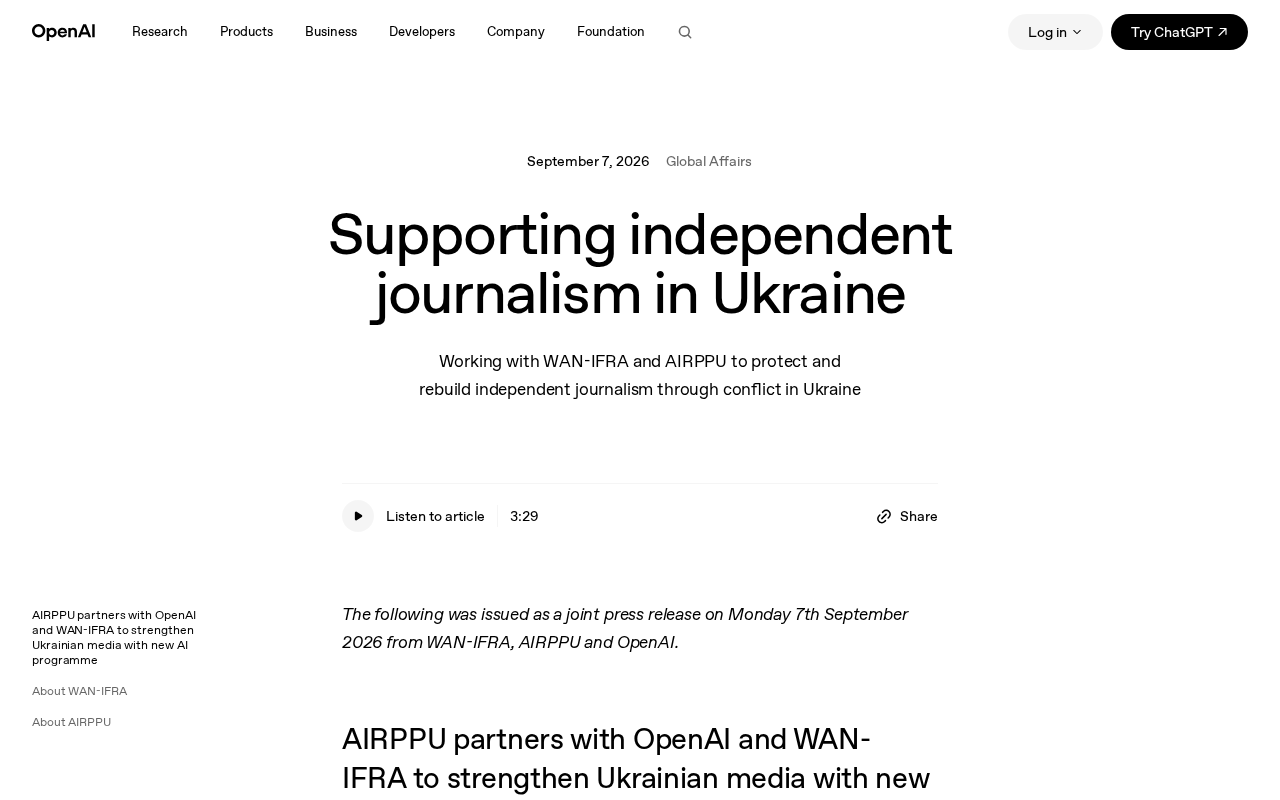
OpenAI partners with AIRPPU and WAN-IFRA to empower Ukrainian journalism with AI tools amid wartime pressures.
OpenAI has joined forces with Ukrainian media organization AIRPPU and global press association WAN-IFRA to launch an AI empowerment project for Ukrainian news institutions. The initiative aims to help local media enhance efficiency, innovation, and organizational resilience under extreme wartime conditions, while safeguarding editorial independence. The three-way partnership combines AI technology, local expertise, and global best practices to address challenges ranging from information warfare to resource shortages.
OpenAI's Strategic Extension into Journalism
At a time when the global news industry faces both digital transformation and existential pressures, OpenAI has announced a partnership with Ukrainian media industry organization AIRPPU and the World Association of News Publishers (WAN-IFRA) to launch an AI empowerment initiative for Ukrainian news organizations. The project aims to help local media institutions enhance their innovation capabilities, organizational resilience, and safeguard the sustainability of independent journalism.
This is more than just a technical assistance program — it represents yet another instance of an AI company intervening in the public information ecosystem. In an environment where information integrity and press freedom face growing challenges, OpenAI's decision to focus on Ukraine — a country grappling with the dual pressures of conflict and transformation — carries clear symbolic significance.
Why the Project Focuses on Ukraine
Media Challenges in an Extreme Environment
Ukrainian news organizations have long operated under extraordinarily complex conditions. Ongoing geopolitical conflict, economic strain, and the impact of information warfare have placed tremendous pressure on local media to maintain editorial independence and sustain operations. Traditional business models have become unsustainable, while talent drain and resource shortages are widespread.
Particularly noteworthy is that since the full-scale war broke out in 2022, Ukraine has become one of the world's most intense information warfare battlegrounds. Russia's information operations apparatus — including state media outlets RT and Sputnik, along with numerous anonymous Telegram channels — continuously generates false narratives in an attempt to undermine Ukraine's public opinion cohesion from the outside. Meanwhile, Ukrainian local media face multiple blows under wartime conditions: physical infrastructure damage, forced evacuation of editorial staff, and plummeting advertising revenue. Against this backdrop, the introduction of AI tools carries strategic significance far beyond ordinary efficiency improvements — they help media maintain information production under severely understaffed conditions and combat disinformation through automated fact-checking assistance tools.
In this context, AI tools are seen as a potential solution — by automating tedious editorial workflows and assisting with content production and distribution, media organizations can concentrate their limited human resources on the most valuable investigative reporting and in-depth content.
Division of Roles in the Three-Way Partnership
This collaboration brings together three parties: OpenAI provides foundational AI technology capabilities and tool support; AIRPPU, as Ukraine's local media industry organization, is responsible for connecting with the actual needs of local news institutions; and WAN-IFRA contributes its experience as a global press association, offering industry best practices and an international perspective.
Founded in 1948, WAN-IFRA currently represents over 3,000 newspapers and news publishers across more than 60 countries, making it an important window into the news industry's digital transformation. Over the past decade, the organization has continuously tracked emerging topics including AI, subscription models, and audience data analytics, publishing its annual World Press Trends report. Its participation signals that this project is not an isolated act of technical assistance but is embedded within a systemic framework for global journalism transformation. Its accumulated best practices — including paywall strategies, reader engagement methodologies, and diversified funding models for journalism — will provide Ukrainian media with reference points, rather than merely serving as a user guide for OpenAI's tools. This triangular structure of "technology provider + local organization + international industry body" represents a relatively mature implementation model for AI public interest projects.
How AI Strengthens Journalism's Resilience
Dual Gains in Efficiency and Innovation
The two keywords emphasized by the project — "innovation" and "resilience" — point to two dimensions of AI application in journalism. On the efficiency front, AI can assist journalists with information retrieval, multilingual translation, initial draft writing, content summarization, and structured data organization, significantly shortening production cycles.
OpenAI's core product, the GPT series, is a Large Language Model (LLM) based on the Transformer architecture. Pre-trained on massive volumes of text, it possesses cross-language comprehension, text summarization, and structured information extraction capabilities, making it particularly suited for the following journalism scenarios: rapid translation between Ukrainian, Russian, and English is critical for wartime reporting; AI can quickly cross-reference official statements against historical records to assist with fact-checking; and in terms of SEO optimization and content distribution, it can help resource-constrained media improve their visibility in algorithm-driven traffic environments. It's worth noting that these applications are currently at the stage of "AI-assisted human work" rather than "AI replacing human work" — journalists' judgment remains the final gatekeeping step. For resource-limited Ukrainian media, this means covering more reporting areas with fewer personnel.
On the innovation front, AI can help media explore new content formats and audience interaction methods — such as personalized recommendations and interactive data journalism — finding differentiated paths in the fierce competition for attention.
Safeguarding and Challenging Independence
You may not have noticed, but the project places "independent journalism" at its core. Behind this lies a critical proposition: the introduction of AI tools should not weaken media's editorial independence but rather serve as a force for resisting external interference and maintaining autonomous operations. However, this also raises a widely discussed industry concern — as media organizations become increasingly reliant on the technical capabilities of a particular AI provider, how can they avoid forming new forms of technological dependency?
Academics refer to this phenomenon as "platform dependency" or "vendor lock-in." When a media organization's core workflows become deeply integrated with a specific AI provider's APIs or tools, migration costs rise rapidly over time. Historically, Facebook's multiple algorithm changes caused dramatic revenue drops for media organizations dependent on its traffic, and deep penetration of AI tools could bring similar or even more severe risks. Mitigation strategies include: prioritizing open-source models (such as Meta's LLaMA series), establishing multi-vendor strategies, and explicitly defining data sovereignty clauses in funding contracts. How to ensure the accuracy and credibility of AI-generated content? These are challenges the project must confront head-on as it progresses.
Industry Significance of AI-Empowered Journalism
Exploring Corporate Social Responsibility for AI Companies
From OpenAI's strategic perspective, projects like this are an important component of its "responsible AI" narrative. Since ChatGPT's explosive growth in 2023, OpenAI has faced increasingly intensive scrutiny from the EU AI Act, U.S. congressional hearings, and regulatory agencies across multiple countries. The public interest project for Ukrainian journalism is part of OpenAI's broader "social impact" strategy — which also includes offering API discounts to nonprofit organizations, funding AI safety research, and establishing partnerships with academic institutions. These types of projects carry substantial significance in regulatory negotiations: they provide OpenAI with concrete cases of "technology for good," helping to advocate for more lenient regulatory frameworks at the legislative level. By directing technological capabilities toward public interest domains, AI companies can accumulate real-world application experience while shaping a positive image in the eyes of regulators and public opinion. This aligns with the broader trend of tech giants increasingly investing in philanthropy and social responsibility in recent years.
Implications for Global Journalism
The Ukraine case may be just the beginning. Globally, countless small and medium-sized media organizations face similar transformation challenges. If AI can prove its value in empowering journalism under extreme conditions, this model could be replicated across more countries and regions, becoming a significant force in reshaping the news production ecosystem.
Of course, technology is never a silver bullet. AI can improve efficiency and expand possibilities, but journalism's core values — truth, independence, and public accountability — still require human guardianship. Whether OpenAI's project can truly strengthen the foundations of independent journalism in Ukraine remains to be tested by time and practice.
Key Takeaways
Related articles

Jensen Huang Declares AGI Has Arrived and Congratulates OpenAI, Sparking Industry Debate
Nvidia CEO Jensen Huang declares AGI has arrived and congratulates OpenAI. Deep analysis of his reasoning, OpenAI's contributions, community pushback, and industry implications.
How Short-Form Video Creators Are Using AI Video Generation Tools
Exploring the real-world application of AI video generation tools in short-form video creation. From Seedance to Runway, how do creators integrate AI assets? Revealing the gap between demos and production use.

Home Data Center Setup Guide: A Complete Self-Hosted Private Cloud Implementation
Deep dive into building a home data center: hardware selection, software architecture, cost analysis, and operational challenges. From data sovereignty to technical implementation, build your private cloud infrastructure and control your digital assets.