OpenAI Python SDK v3.19.2 Released: File Fallback Fix and API Documentation Clarifications

OpenAI Python SDK v3.19.2 patches a single-file fallback bug and clarifies multiple API docs.
OpenAI's official Python SDK v3.19.2 delivers one substantive bug fix and several documentation clarifications. The functional fix addresses data loss in single-file fallback extraction scenarios. Documentation updates clarify the default behavior of the web search location parameter, valid values for the Realtime API modalities array, and Fine-tuning parameter boundaries — with no breaking changes. Developers can upgrade via `pip install --upgrade openai`.
OpenAI Python SDK Releases v3.19.2 Patch
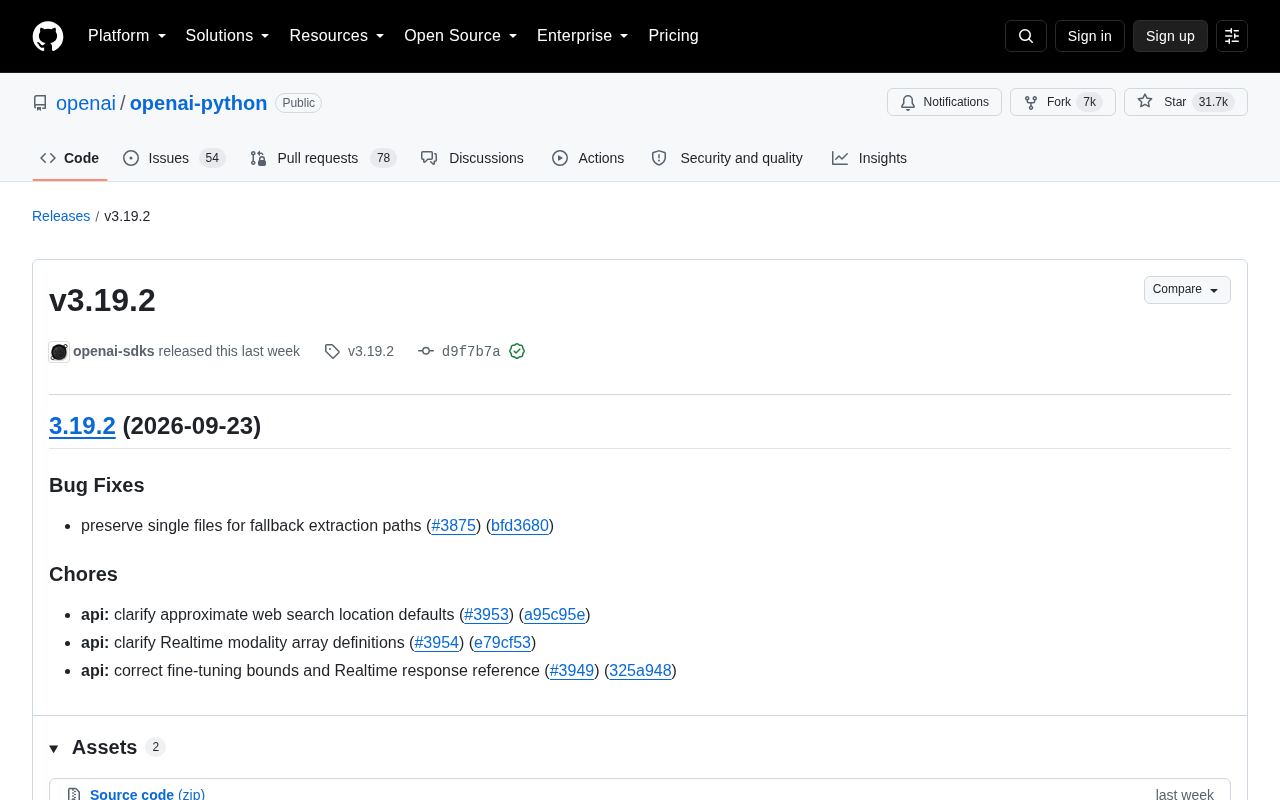
OpenAI's official Python SDK (openai-python) has released version v3.19.2. This is a patch update focused on bug fixes and internal housekeeping, signed by the automated release account openai-sdks and verified through GitHub's verified signature mechanism (GPG key ID: B5690EEEBB952194), ensuring the trustworthiness of the release source.
With over 31,700 stars and 7,000 forks, openai-python is the primary official library developers use to access OpenAI capabilities including GPT, Realtime, and Fine-tuning. Even patch-level updates can directly affect integration code running in countless production environments.
What's New in This Release
Bug Fixes
The only functional fix in this release targets file handling logic: preserving single files in fallback extraction paths (#3875). In practice, when the SDK needs to switch to a backup content extraction flow, the previous implementation could fail when handling single-file scenarios. This fix ensures that a single file is correctly preserved during fallback processing, preventing data loss or processing failures — particularly critical for applications that rely on file upload and parsing capabilities.
A "fallback extraction path" refers to the backup processing logic the SDK automatically switches to when the primary content parsing flow fails. In a file upload scenario, the SDK typically attempts to extract file content via the standard streaming interface first; if that path fails due to network errors or format incompatibility, it falls back to a secondary path. The previous bug stemmed from the fallback path's implementation assuming multi-file input, leaving a gap in handling single-file inputs — causing files to be unexpectedly dropped during fallback. After this fix, the SDK correctly handles single-file inputs on both paths, ensuring data integrity when file upload and parsing features degrade gracefully.
Documentation and Interface Clarifications (Chores)
Beyond the bug fix, this version includes several clarifying adjustments at the API documentation level. These changes don't affect functional behavior, but they help developers better understand interface semantics:
- Clarify the default value for approximate web search location (#3953): Explicitly documents the default behavior of the location parameter in the web search feature when not explicitly specified.
- Clarify the Realtime modalities array definition (#3954): Provides a clearer description of the
modalityarray in the Realtime API, reducing ambiguity for developers building real-time voice and multimodal applications. - Correct Fine-tuning boundary values and Realtime response references (#3949): Fixes the documented value range for fine-tuning parameters and corrects a reference error in the Realtime response documentation.
The OpenAI Realtime API is a low-latency interface designed for real-time interactive use cases, primarily for building real-time voice conversations and streaming multimodal applications. The modalities parameter declares the input/output modality types supported in the current session (such as text or audio). Ambiguous documentation around this array can easily lead developers to pass incorrect combinations when building text-only or audio-only applications, causing the server to return unexpected response formats. This documentation clarification defines the valid values and the actual meaning of each combination, helping reduce debugging costs caused by parameter misuse. The correction to Fine-tuning boundary values is equally important — if developers reference incorrect value ranges for training hyperparameters (such as epoch count or learning rate multiplier), their submitted fine-tuning jobs may be rejected by the server.
What This Means for Developers
While patch releases like this don't introduce new features, they reflect OpenAI's ongoing commitment to SDK quality and documentation accuracy. For teams actively using file extraction, Realtime interaction, or Fine-tuning capabilities, upgrading to v3.19.2 delivers more stable file handling behavior and more accurate interface documentation.
Notably, several of the changes center on newer capabilities like Realtime and web search, indicating these features are still being actively refined. Developers integrating these cutting-edge interfaces should keep their SDK versions up to date to avoid known issues.
How to Upgrade
Upgrading is straightforward via pip:
pip install --upgrade openai
Since this update consists primarily of bug fixes and documentation clarifications with no breaking changes, the compatibility risk to existing code is low. Developers using the affected features are encouraged to upgrade promptly.
Summary
v3.19.2 is a typical maintenance release: one substantive fix for a file fallback path issue, plus several API documentation clarifications covering web search, Realtime, and Fine-tuning. While there are no headline new features, this release delivers real value in stabilizing production environments and reducing the cost of interface misuse.
Related articles

Random Pruning of the DPO Computation Graph: 1.4x Training Speedup and Lower Peak Memory
DPO training too slow and memory-hungry? This paper proposes a random pruning framework for the DPO computation graph, sampling independently across position, sequence, and branch dimensions; branch pruning achieves a 1.426x step-time speedup and cuts training time by about 30%, with in-depth attribution of memory and time gains.

Why Does JEPA Underperform MLM in Longitudinal EHR Representation Learning?
New study compares JEPA and MLM for longitudinal EHR representation learning on MIMIC-IV: three JEPA variants train stably without collapse but underperform MLM; target size, not heterogeneity, drives prediction error.

Transfer Learning + Visible Light Communication: A New Approach to Energy-Efficient Indoor Positioning
A study proposes a transfer learning-based visible light communication indoor positioning method, achieving 47% accuracy improvement on the BOSCH factory dataset, 67.5% model efficiency under high noise, and introducing the ME composite metric for energy-efficient positioning in energy-constrained industrial IoT scenarios.