OpenAI Python SDK v3.20.0 Released: Agents Credentials, Session Options, and WebSocket Enhancements

OpenAI Python SDK v3.20.0 expands Agents capabilities and delivers major WebSocket real-time connection stability fixes.
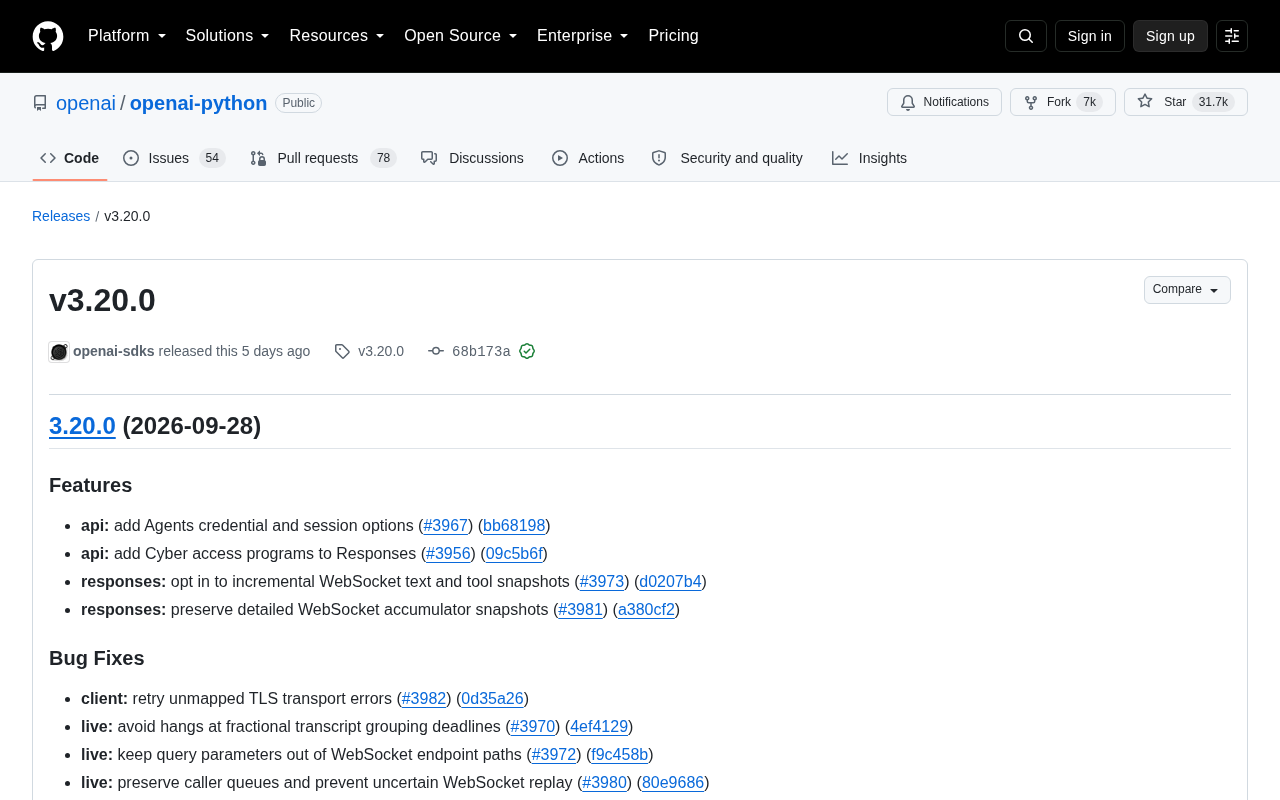
OpenAI's official Python SDK v3.20.0 is a polish-focused engineering release. New features include Agents credential and session configuration options for managing complex multi-turn workflow auth state, plus opt-in incremental WebSocket snapshots and improved accumulator retention in the Responses API for better streaming observability. The headline work is in bug fixes — extensive repairs to Realtime and Live WebSocket queue state management and replay stability directly address intermittent connection, duplicate message, and data loss issues in production. Error response documentation has also been systematically expanded across batch, file upload, fine-tuning, and other interfaces. Teams relying on real-time voice or streaming conversation scenarios should prioritize evaluating this upgrade.
OpenAI's official Python SDK has landed a v3.20.0 update. This release centers on expanding Agents capabilities, real-time WebSocket optimizations for the Responses API, and a focused round of connection stability fixes for Realtime/Live scenarios. For developers building AI applications with this SDK, this is an iteration aimed squarely at engineering reliability and real-time interaction quality.
New Features: Expanded Agents and Responses Capabilities
This release introduces several noteworthy additions at the API level. The SDK adds credential and session configuration options for Agents (#3967), giving developers more flexible control over authentication and session state when building Agent-based workflows. This enables finer-grained management for complex scenarios involving multi-turn conversations and multi-tool calls.
On the Responses API side, Cyber access programs support has been added (#3956), further broadening the interface's feature coverage.
For real-time interactions, Responses gains two WebSocket-related improvements: opt-in support for receiving incremental WebSocket text and tool call snapshots (#3973), and more detailed WebSocket accumulator snapshot retention (#3981). Together, these improvements serve a single goal — making intermediate states in streaming output more complete and observable, helping developers achieve finer-grained real-time rendering and debugging.
The WebSocket accumulator snapshot is a key mechanism in real-time streaming scenarios. During streaming, the server splits responses into incremental delta chunks and pushes them progressively. The accumulator is responsible for assembling these chunks into a complete intermediate state. Retaining more detailed snapshots means developers can read a full view of all content received so far at any point in time — not just the latest delta. This is especially valuable when you need to render, parse, or apply conditional logic mid-stream — for example, detecting tool call intent before the full arguments have arrived, or triggering sentence-by-sentence playback in text-to-speech scenarios.
Bug Fixes: Real-Time Connection Stability Takes Center Stage
If the new features are icing on the cake, the bug fixes in this release are what truly address developer pain points. The fix list is heavily concentrated on connection reliability for both Live and Realtime WebSocket scenarios.
At the client level, the SDK now retries on unmapped TLS transport errors (#3982), reducing the chance of requests failing outright due to underlying network jitter.
Several tricky Live scenario issues were resolved: avoiding hangs near fractional transcription group cutoff times (#3970); stripping query parameters from WebSocket endpoint paths (#3972) to prevent path concatenation errors; and preserving the caller queue to prevent non-deterministic WebSocket replays (#3980).
The Realtime scenario also received hardening, including preserving base URL query parameters during WebSocket upgrades (#3971), and retaining configured queues without replaying previously attempted send requests (#3978). The common theme across these fixes is ensuring deterministic message queue state during connection upgrades, reconnections, and replays — preventing duplicate sends or data loss.
A WebSocket Upgrade is the process by which a client initiates a protocol switch via a standard HTTP request, upgrading the connection from HTTP/HTTPS to a persistent, bidirectional WebSocket channel. This handshake phase is relatively fragile: if query parameters on the upgrade request are mishandled during path construction, or if the queue of unsent messages isn't properly restored after a failed upgrade and reconnect, data loss or duplicate sends can occur. These fixes specifically target such edge cases — ensuring query parameters in the base URL are fully preserved during the upgrade, and that message queue state is deterministic after reconnection. This fundamentally eliminates sporadic message ordering and replay anomalies that are notoriously difficult to reproduce and diagnose in high-concurrency or unstable network production environments.
Documentation: More Systematic Error Response Coverage
The Chores section of this release is almost entirely dedicated to cleaning up API error response documentation. The SDK now provides clearer and more complete error response documentation across multiple interfaces, covering batch errors (#3961), file and upload errors (#3960), fine-tuning and model errors (#3964), Responses not-found errors (#3959), stored chat completion errors (#3963), and a general clarification of API error responses (#3965).
While these changes don't affect code behavior, their practical value to developers shouldn't be underestimated — clear error documentation means faster issue diagnosis and lower debugging overhead.
What This Means for Developers
Taken together, v3.20.0 is a classic "polish" release. There are no earth-shattering new features, but it delivers solid work in two directions: on one hand, Agents credential/session options and new Responses features expand the toolkit for building sophisticated applications; on the other, the large volume of WebSocket and real-time connection fixes directly improve stability for voice and streaming interaction scenarios.
For teams already running this SDK in production — especially developers building real-time voice or conversational applications on top of the Realtime or Live APIs — an upgrade evaluation is recommended. Queue state and replay-related fixes have a way of resolving intermittent, hard-to-reproduce production issues.
Upgrading is straightforward — a pip update to 3.20.0 will get you all the improvements.
Related articles

Random Pruning of the DPO Computation Graph: 1.4x Training Speedup and Lower Peak Memory
DPO training too slow and memory-hungry? This paper proposes a random pruning framework for the DPO computation graph, sampling independently across position, sequence, and branch dimensions; branch pruning achieves a 1.426x step-time speedup and cuts training time by about 30%, with in-depth attribution of memory and time gains.

Why Does JEPA Underperform MLM in Longitudinal EHR Representation Learning?
New study compares JEPA and MLM for longitudinal EHR representation learning on MIMIC-IV: three JEPA variants train stably without collapse but underperform MLM; target size, not heterogeneity, drives prediction error.

Transfer Learning + Visible Light Communication: A New Approach to Energy-Efficient Indoor Positioning
A study proposes a transfer learning-based visible light communication indoor positioning method, achieving 47% accuracy improvement on the BOSCH factory dataset, 67.5% model efficiency under high noise, and introducing the ME composite metric for energy-efficient positioning in energy-constrained industrial IoT scenarios.