OpenAI Python SDK v3.21.0 Released: Adds GPT-6.1 Sol Model Identifier

OpenAI Python SDK v3.21.0 adds the GPT-6.1 Sol model identifier — an early signal of a new model generation.
OpenAI's official Python SDK has released v3.21.0, with a single core change: support for the GPT-6.1 Sol model identifier. Developers can access it immediately via pip upgrade. The "GPT-6.1 Sol" naming suggests OpenAI's model family has reached the 6.x generation, though no capability specs, pricing, or availability details have been disclosed. The backwards-compatible minor version bump means existing code requires no changes. More notably, SDK model identifier additions often precede official announcements, making them a useful early signal — though official documentation should always be the final authority.
OpenAI's official Python SDK (openai-python) has released version v3.21.0. As the most widely used client library for accessing OpenAI services, this repository has accumulated over 31,000 stars and 7,000+ forks on GitHub, making it a true piece of infrastructure within the ecosystem. This update carries a single core change — but it's a meaningful one: the SDK now adds support for the GPT-6.1 Sol model identifier.
Breaking Down the Update
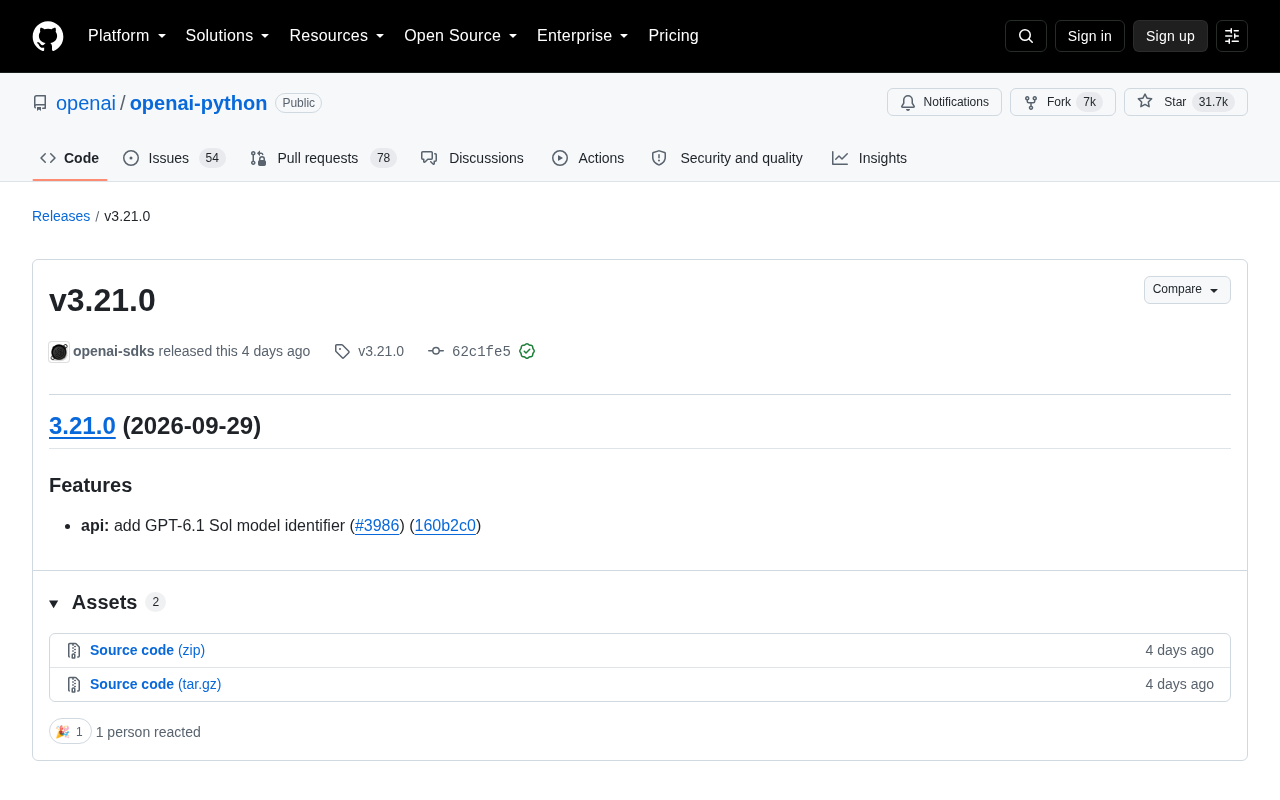
According to the official Release Notes, v3.21.0 falls under the Features category, with the following change:
api: add GPT-6.1 Sol model identifier (#3986)
In plain terms, this version registers a new model identifier called GPT-6.1 Sol at the API level. For developers, this means the SDK can now correctly recognize and invoke this model — no need to manually concatenate strings or wait for library-level compatibility updates.
From a Semantic Versioning (SemVer) perspective, upgrading from 3.20.x to 3.21.0 is a minor version increment, indicating a backwards-compatible feature addition that won't break existing code. Developers can upgrade without worrying about their existing call logic breaking.
What Does GPT-6.1 Sol Signify?
The model name itself is worth paying attention to. OpenAI's flagship models have historically followed naming conventions like GPT-4, GPT-4o, and GPT-5. The appearance of GPT-6.1 Sol suggests that the model family has progressed to the 6.x generation, complete with a sub-designation of "Sol" — reminiscent of past naming conventions like the "o" series or other codenames.
That said, it's important to be clear: this SDK Release Notes entry only discloses the addition of a model identifier. No capability specs, pricing, context window size, or availability details for GPT-6.1 Sol have been published. SDK-level support typically arrives slightly ahead of or in sync with a model's public launch, so this update reads more like an early signal than a full product announcement.
Semantic Versioning (SemVer) is the widely adopted standard for software version management, following the format MAJOR.MINOR.PATCH. A MAJOR increment indicates breaking, incompatible changes; a MINOR increment indicates backwards-compatible new features; a PATCH increment indicates backwards-compatible bug fixes. Libraries that follow SemVer allow downstream developers to make confident upgrade decisions. In this case, the 3.20.x → 3.21.0 bump is a MINOR increment, meaning all code depending on the older version should continue to work after upgrading without interface signature changes or removed enum values causing compatibility issues.
Model Identifiers are the strings used in API calls to specify the target model — for example, gpt-4o or gpt-4-turbo. The OpenAI SDK internally maintains an enum list of known models, mapping strings to type-safe variables for IDE autocompletion and parameter validation. When a new model is deployed on the backend but the SDK hasn't been updated yet, developers must pass the raw string manually, which introduces the risk of typos. Keeping the SDK version in sync with the model catalog exists precisely to eliminate this friction.
Practical Impact for Developers
For engineering teams that use openai-python day-to-day, the operational cost of this update is minimal — simply upgrade to the latest version via pip to gain support for the new model identifier:
pip install --upgrade openai
After upgrading, developers can reference the GPT-6.1 Sol model name in API calls (refer to official documentation for the exact string). For teams tracking cutting-edge models and eager to access new capabilities as soon as they're available, keeping the SDK on the latest version is a sensible practice.
From an engineering maintenance perspective, these "model identifier only" minor updates are part of OpenAI's regular SDK release cadence. The team tends to ship frequent minor releases to keep the library in sync with the backend API's model catalog, while reserving breaking changes for major version bumps.
How to Interpret This Update
Taken at face value, v3.21.0 isn't technically complex — it's essentially a one-line addition to the model catalog. But in a broader context, it offers a valuable observation window: model naming evolutions often surface in SDKs, API schemas, or config files before any large-scale official announcement, making them early signals for anticipating new product directions.
For practitioners tracking OpenAI's model roadmap, here are some recommendations:
- Monitor commits and releases in official repositories like
openai-pythonto catch model identifier changes early. - Rely on official documentation and pricing pages as the source of truth — avoid over-interpreting capabilities of models that haven't been publicly released yet.
- Before upgrading the SDK in production environments, still follow standard regression testing procedures, even for backwards-compatible minor versions.
Overall, this is a low-risk, information-dense routine update. The real point of interest lies in what the GPT-6.1 Sol naming reveals — as for the full picture of this model, we'll need to wait for OpenAI's official disclosure.
In the AI industry, tracking vendor movements through subtle changes in code repositories — SDK commits, API schema diffs, enum additions in config files — has evolved into a semi-professional practice of "technical reconnaissance." This type of information typically surfaces hours to days before formal press announcements, because the SDK release cadence and marketing launch cadence don't always align perfectly. For instance, some of GPT-4o's API parameters appeared in open-source repository pull requests before the official launch event, where they were picked up and widely discussed by community researchers. For practitioners, monitoring openai-python, openai-node, and the OpenAPI schema repositories on GitHub is an effective, low-cost way to access first-hand information. However, it's important to distinguish between "an identifier has been registered at the SDK level" and "the model is now publicly available" — avoid making premature technical decisions or overstating capabilities before the details are officially confirmed.
Related articles

Random Pruning of the DPO Computation Graph: 1.4x Training Speedup and Lower Peak Memory
DPO training too slow and memory-hungry? This paper proposes a random pruning framework for the DPO computation graph, sampling independently across position, sequence, and branch dimensions; branch pruning achieves a 1.426x step-time speedup and cuts training time by about 30%, with in-depth attribution of memory and time gains.

Why Does JEPA Underperform MLM in Longitudinal EHR Representation Learning?
New study compares JEPA and MLM for longitudinal EHR representation learning on MIMIC-IV: three JEPA variants train stably without collapse but underperform MLM; target size, not heterogeneity, drives prediction error.

Transfer Learning + Visible Light Communication: A New Approach to Energy-Efficient Indoor Positioning
A study proposes a transfer learning-based visible light communication indoor positioning method, achieving 47% accuracy improvement on the BOSCH factory dataset, 67.5% model efficiency under high noise, and introducing the ME composite metric for energy-efficient positioning in energy-constrained industrial IoT scenarios.