OpenAI Python SDK v3.25.0 Released: Major Upgrades to Agents Capabilities

OpenAI Python SDK v3.25.0 ships with major Agents enhancements including local tool observability and streaming support.
openai-python SDK v3.25.0 is a feature-focused update centered on the Agents ecosystem, with four of five improvements directly serving agent development. Key changes include observability for local tool failures, local tool execution during streaming session creation, agent turn items with usage source grouping for clearer cost attribution, a `defer_loading=true` tool search mechanism to reduce context overhead at scale, and the public export of `type_to_response_format_param`. No breaking changes are introduced, making this a smooth upgrade — though testing in a staging environment is recommended before production rollout.
OpenAI's official Python SDK (openai-python) has just released version v3.25.0. With over 31,000 stars and 7,200 forks on GitHub, this SDK is the go-to library for Python developers integrating with OpenAI's APIs. This release centers on Agents and tool-calling functionality, delivering stronger foundational support for building AI applications that execute tasks autonomously.
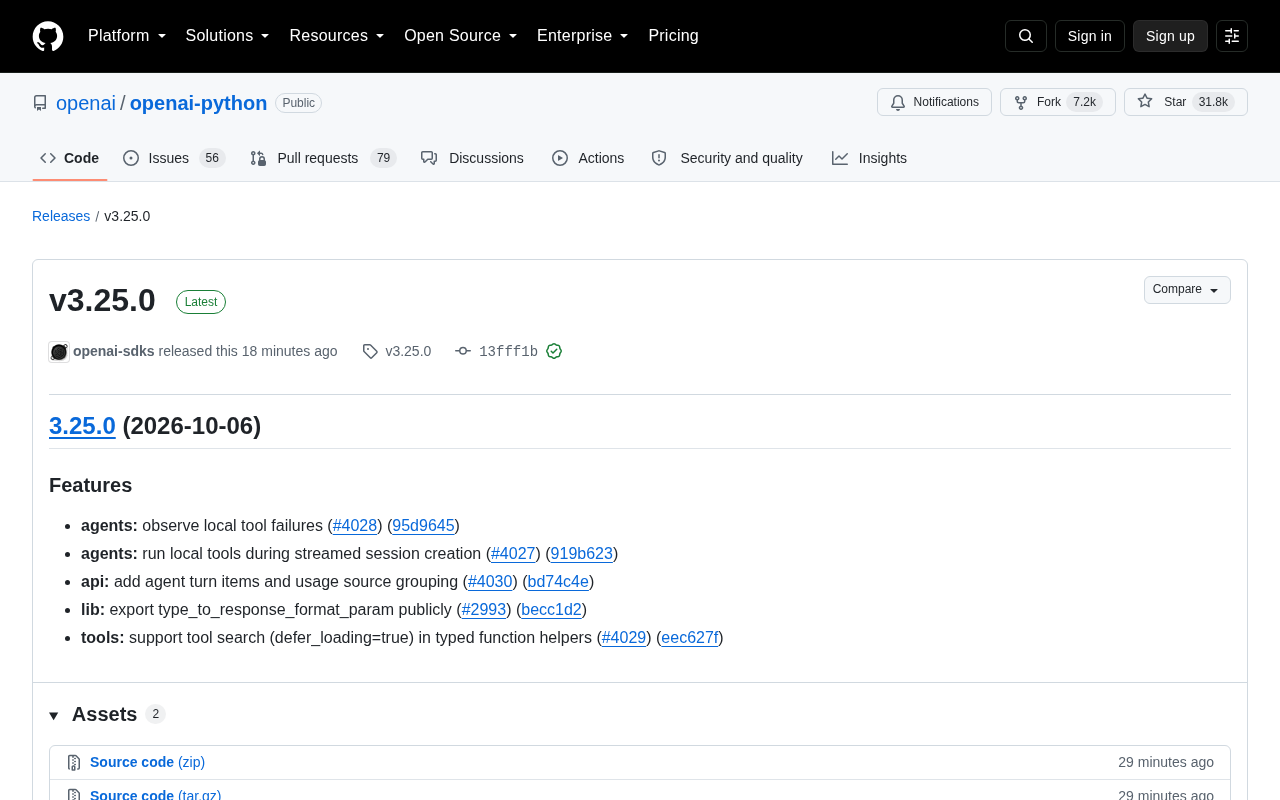
Core Updates: Continued Strengthening of Agents Capabilities
Looking at the Changelog for v3.25.0, the focus clearly falls on Agents-related features. Two improvements targeting local tools are particularly noteworthy.
The first is "observe local tool failures" (#4028) — the SDK can now observe and capture failures that occur during local tool execution. In real-world agent applications, an Agent often needs to call local functions or external tools to complete tasks, and tool call failures are a common pain point. Previously, developers had to handle these exceptions themselves. Now the SDK provides built-in observability for failure states, enabling more granular error tracking and debugging.
The second is "run local tools during streamed session creation" (#4027), which adds support for running local tools while a streaming session is being established. Streaming responses are key to a smooth user experience, and allowing local tools to participate during the streaming session setup phase means Agents can handle task pipelines earlier and more cohesively, reducing wait-time latency.
In OpenAI's architectural context, "local tools" refer to functions or logic running within the developer's own code environment, as opposed to built-in tools hosted and executed server-side by OpenAI (such as
code_interpreterorfile_search). Typical local tools include: calling external REST APIs, reading from or writing to local databases, or executing custom business logic via Python functions. During inference, an Agent outputs a "tool call request," and the client-side SDK is responsible for actually executing it and returning the result to the model. This pipeline spans the boundary between the model and the local runtime environment — any hiccup along the way, whether a network timeout, a permissions error, or a business logic exception, can interrupt the entire Agent task chain. SDK-level observability for local tool failure states is therefore critical infrastructure for building robust Agent applications.
API Layer: New Agent Turn Items and Usage Source Grouping
Beyond runtime improvements for Agents, this update also introduces changes at the API structure level. "add agent turn items and usage source grouping" (#4030) introduces the concept of agent turn items and supports grouping usage statistics by usage source.
The practical significance of this change is clear: when an Agent repeatedly calls models and tools across multiple conversation turns or multi-step tasks, it's often difficult for developers to trace exactly where each step's token consumption is coming from. With grouping by usage source, attribution of usage data becomes much clearer — a valuable addition for teams that need to do cost accounting or performance optimization.
An "Agent Turn" is the basic unit in a multi-step Agent execution model, representing all the interactions that occur during one complete inference-action-observation cycle. Unlike ordinary conversations where turns are defined by "user message / assistant reply," an Agent Turn can include multiple tool calls, intermediate reasoning steps, and observations from different tools. As Agent tasks grow more complex (e.g., chaining multiple tools or dispatching subtasks), a single user request may trigger dozens of model inference calls and tool invocations, generating substantial token consumption. Introducing agent turn items and grouping by usage source lets developers precisely attribute token costs to specific turns and tools, rather than seeing only an aggregate number — this is especially critical for cost management in multi-agent collaboration or long-running task scenarios.
Tool and Type Support: Tool Search and Type Exports
On the tooling side, v3.25.0 adds support for tool search (#4029), introducing a defer_loading=true option in typed function helper utilities. Deferred loading is typically used to give an Agent the ability to retrieve tools on demand, without needing to load all tool definitions upfront. When the number of available tools is large, this mechanism can significantly reduce the overhead on the initial context.
Additionally, type_to_response_format_param is now publicly exported from the lib layer (#2993). This means a type-conversion helper that was previously used internally is now a public API, allowing developers to directly reuse it to construct parameters that conform to response format requirements — eliminating unnecessary boilerplate.
The design philosophy behind
defer_loading=truestems from the "tool explosion" problem in large-scale Agent systems: when the number of available tools reaches dozens or even hundreds, injecting all tool definitions (including names, descriptions, and parameter schemas) into the context at the start of every conversation not only consumes a large number of tokens but can also degrade the model's instruction-following accuracy. Deferred loading allows the SDK to skip fully expanding all tool definitions at initialization, and instead dynamically retrieve and inject the relevant tool descriptions only when the Agent determines it needs a particular type of tool. This aligns with the "tool retrieval" pattern powered by vector databases and is a common engineering practice for building scalable Agent tool ecosystems. The public export oftype_to_response_format_paramsolves the tedious problem developers face when using Structured Outputs — manually converting Pydantic models or Python types into OpenAI response format parameters.
Release Significance and Upgrade Recommendations
Overall, v3.25.0 is a feature update with no major breaking changes listed, meaning most users should be able to upgrade smoothly. Four of the five improvements in this release directly or indirectly serve Agent-building scenarios, continuing OpenAI's recent technical trajectory of doubling down on the agentic ecosystem.
For teams actively developing agent applications with openai-python, upgrading brings more reliable local tool failure observability, smoother streaming tool execution, clearer usage attribution, and more flexible tool retrieval capabilities. We recommend that developers review how their code uses streaming sessions and local tools before upgrading, and consult the official Changelog and the relevant PRs (#4027, #4028, #4029, #4030, #2993) for implementation details.
It's worth noting that the Release Notes themselves are fairly concise, and the full behavior of each feature should be confirmed against the official documentation and source code. For production environments where stability is paramount, it's advisable to validate compatibility in a test environment before rolling out a full upgrade.
Related articles

Random Pruning of the DPO Computation Graph: 1.4x Training Speedup and Lower Peak Memory
DPO training too slow and memory-hungry? This paper proposes a random pruning framework for the DPO computation graph, sampling independently across position, sequence, and branch dimensions; branch pruning achieves a 1.426x step-time speedup and cuts training time by about 30%, with in-depth attribution of memory and time gains.

Why Does JEPA Underperform MLM in Longitudinal EHR Representation Learning?
New study compares JEPA and MLM for longitudinal EHR representation learning on MIMIC-IV: three JEPA variants train stably without collapse but underperform MLM; target size, not heterogeneity, drives prediction error.

Transfer Learning + Visible Light Communication: A New Approach to Energy-Efficient Indoor Positioning
A study proposes a transfer learning-based visible light communication indoor positioning method, achieving 47% accuracy improvement on the BOSCH factory dataset, 67.5% model efficiency under high noise, and introducing the ME composite metric for energy-efficient positioning in energy-constrained industrial IoT scenarios.