OpenAI Reinstates 5-Hour Limit: Usage Caps Tighten Again for Plus Users
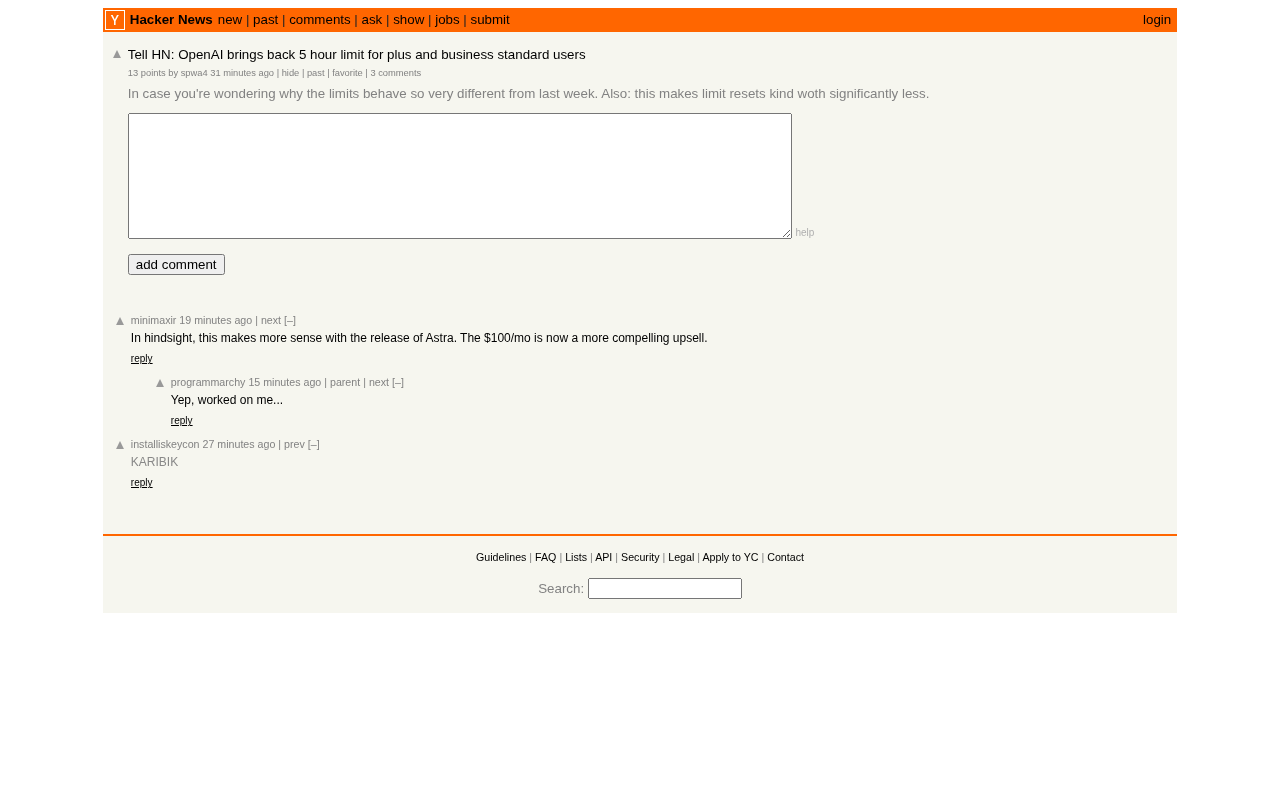
OpenAI reinstates 5-hour usage caps for Plus users, balancing compute costs with tiered pricing strategy.
OpenAI has reintroduced the 5-hour usage limit for Plus and Business Standard subscribers, restricting access to GPT-4 and reasoning models. This reflects ongoing tension between explosive demand, expensive GPU compute costs, and user experience. The policy shift also supports OpenAI's tiered pricing strategy, nudging heavy users toward premium plans like Pro.
Event Overview
Recently, noteworthy news emerged in the OpenAI community: OpenAI has reintroduced the "5-hour usage limit" for Plus and Business Standard subscribers. This change was first disclosed on Hacker News in a "Tell HN" post—Hacker News is a prominent Silicon Valley tech community operated by Y Combinator, with a user base primarily consisting of programmers, entrepreneurs, and tech professionals. "Tell HN" is a post type where users share firsthand observations and important discoveries. While the discussion didn't generate particularly high engagement, it still attracted considerable attention because it affects the core usage rights of paying users.
The "5-hour limit" typically refers to a cap on the number of calls or messages users can make to specific models (such as GPT-4 series or the latest reasoning models) within a rolling 5-hour time window. This rolling time window is a dynamic rate-limiting technique that differs from daily fixed resets—the system continuously tracks all user requests from the past 5 hours, automatically removing the oldest requests from the count once they exceed the 5-hour threshold, thereby releasing new quota. While this mechanism is more flexible, it makes quota recovery times unpredictable. When users engage in intensive usage over short periods, they can easily hit this ceiling, forcing them to wait for the window to refresh or switch to less capable models.
It's worth noting that GPT-4 is OpenAI's multimodal large language model released in March 2023, with a parameter scale that, while not publicly disclosed, is estimated by the industry to exceed trillion-level. Reasoning models specifically refer to variants like the o1 series that are optimized for complex logical reasoning, mathematical proofs, and similar tasks. These models undergo deeper "thinking" processes before generating answers, and the computational cost per inference can be several times or even dozens of times higher than regular conversational models, hence they typically face stricter usage limits.
Why "Reinstated" Rather Than a New Restriction
Interestingly, the key phrase here is "brings back"—meaning the 5-hour limit mechanism isn't appearing for the first time, but rather OpenAI is re-enabling it after a period of relative leniency.
Repeated Adjustments to Restriction Policies
For users who have long followed OpenAI's products, repeated adjustments to usage quotas are nothing new. Since GPT-4's launch, OpenAI has been continuously experimenting across dimensions like message caps, time windows, and model availability:
- Sometimes relaxing the number of messages Plus users can send every 3 hours
- Other times tightening restrictions temporarily due to compute constraints
- Typically setting stricter quotas during new model launches to control demand
This reinstatement of the 5-hour limit is essentially another manifestation of OpenAI's ongoing search for balance between user experience and infrastructure costs.
The Deeper Logic Behind Reinstating Limits
Persistent Computing Supply-Demand Contradiction
Generative AI, especially large language model inference, is extremely costly. Every conversation, every inference call, is backed by expensive GPU computing power. Currently, large language model inference primarily relies on NVIDIA's A100 or H100 series high-end GPUs, with a single H100 costing approximately $30,000-40,000 on the market, and running GPT-4-level models typically requiring dozens or even hundreds of GPUs working in coordination. According to industry estimates, the cost per GPT-4 inference ranges from $0.01-0.05—seemingly small, but when multiplied by the massive requests from hundreds of millions of daily active users, daily costs can reach millions of dollars.
More critically, these GPUs also face supply shortages—NVIDIA's production capacity has been consistently tight, with major tech companies competing for computing power. As ChatGPT's user base continues to expand and new-generation reasoning models consume exponentially more compute, the cost pressure OpenAI faces is considerable.
For the $20/month Plus subscription, the actual usage cost of heavy users likely far exceeds their payment amount. Therefore, by setting usage caps within time windows, OpenAI can effectively curb excessive resource consumption by a small number of ultra-high-frequency users, thereby ensuring overall service stability and availability for most users.
The Push Toward Tiered Pricing
Another factor that cannot be ignored is OpenAI's increasingly clear tiered commercialization strategy. Above Plus ($20/month), OpenAI has already launched higher-priced subscription tiers like Pro ($200/month), offering professional users nearly unlimited model access.
This tiered pricing is standard practice in the SaaS (Software as a Service) industry. Its core logic is to maximize value capture from users with different willingness to pay through combinations of different features, quotas, and service levels. The typical structure includes a free tier (for customer acquisition and trial), standard paid tier (meeting ordinary users' needs), and premium enterprise tier (serving heavy users). This design both expands market coverage through lower-priced tiers and generates higher revenue from core user segments through premium tiers.
From this perspective, tightening quotas for Plus and Business Standard users objectively serves as a means of "product segmentation"—guiding users with higher usage needs to upgrade to more expensive plans. This is common practice in SaaS business models, but for ordinary paying users, it undoubtedly means a degradation in experience.
What the 5-Hour Limit Means for Users
Heavy Users Bear the Brunt
Those most directly affected are users who have deeply integrated ChatGPT into their daily workflows—such as programmers, researchers, and content creators. They often need to conduct large volumes of continuous conversations in short periods, and once they hit the 5-hour window cap, their work rhythm gets disrupted.
User Trust Faces Challenges
More concerning is how frequent policy changes erode user trust. When subscribing, paying users typically expect a relatively stable and predictable service level. When restriction policies change capriciously with insufficient advance communication, users easily develop negative feelings of "paying money only to be downgraded."
These "Tell HN" posts on Hacker News are essentially user-initiated information sharing and mutual alerts in the absence of official transparent explanations. Since HN users are generally early adopters and heavy users of AI technology, the platform often becomes the first warning ground for AI product issues. OpenAI's policy changes are quickly discovered and discussed there, reflecting both this group's sensitivity and indicating that those mainly affected are technical professionals. This also suggests from another angle that OpenAI still has room for improvement in policy communication transparency.
Industry Observation: A Common Dilemma for AI Service Providers
This incident is actually a microcosm of the current stage of the entire AI industry. Nearly all large model service providers—whether OpenAI, Anthropic, or Google—face the same core contradiction: how to balance explosive demand growth, high computing costs, and reasonable user experience.
From a technical perspective, paths to reducing inference costs mainly include model compression (such as knowledge distillation and quantization techniques), architectural innovation (such as Mixture of Experts models or MoE), and hardware specialization (such as Google's TPU). Quantization techniques can reduce model weights from 32-bit floating point to 8-bit or even 4-bit integers, cutting memory usage and computation by over 75%. MoE architectures dramatically improve efficiency by activating only portions of the model's subnetworks to handle requests. However, these optimizations all require time for research and validation, and often involve capability tradeoffs.
Until computing becomes sufficiently cheap and model efficiency achieves a qualitative leap, various usage restrictions will likely persist long-term and will adjust dynamically with supply-demand relationships. For users, rationally viewing these changes and choosing appropriate subscription tiers based on their own needs is perhaps a more pragmatic approach.
Conclusion
OpenAI's reinstatement of the 5-hour limit may seem like just a minor quota adjustment, but it actually reflects many practical dilemmas in the commercialization process of generative AI. For ordinary users, this is an experience restriction; for OpenAI, it's an inevitable choice for cost control and commercial segmentation. Looking ahead, how to find better balance between protecting user rights and maintaining business sustainability will continue to test all AI service providers.
Related articles
Complete Guide to Adding SSO for B2B SaaS: WorkOS AuthKit in Practice and Pitfall Avoidance Strategies
In-depth analysis of the complete path to integrating SSO for B2B SaaS, covering organization model design, self-service configuration system building, JIT Provisioning and SCIM directory sync, combined with WorkOS AuthKit practical experience to help developers avoid common pitfalls after enterprise customer launch.

GPT-6 Astra vs. Claude Fable 5.1: A Full Comparison Across Four Real-World Tests
GPT-6 Astra vs. Claude Fable 5.1: benchmarks, cost, Fortnite clone, UI design, motion graphics, and 3D dashboard — four real-world tests compared.

GPT-6 Astra vs Claude Fable 5.1: Head-to-Head Comparison Across 15 Real-World Work Scenarios
A creator spent thousands testing GPT-6 Astra vs Claude Fable 5.1 across 15 real work scenarios. Astra won 10 rounds and saved $186; Fable excelled in creative copy and visual design.