OpenAI Releases GPT-6.2 Astra and Sol: Long Context and the Dual-Model Strategy Explained

OpenAI releases GPT-6.2 dual models Astra and Sol, applying pressure with long context and lower prices, but not yet the complete form.
On November 17, OpenAI released two GPT-6.2 series models, Astra and Sol, both supporting a 1.05 million token context, with Astra's API unit price 20% lower than the previous flagship. Astra targets complex professional tasks, while Sol focuses on everyday conversation and lightweight creation, splitting the product lines by complexity. Community long tests show the model's knowledge can be traced back to May 2026, it admits when it can't remember uncertain questions, and it has bright spots in creative writing and character explanations, but 3D generation and visual details still look rough. The overall judgment is that this generation is not yet the complete form, and the competitive focus is shifting toward reliability and the practicality of long context.
Title
OpenAI Releases GPT-6.2 Astra and Sol: Long Context and the Dual-Model Strategy Explained
Meta Description
OpenAI releases the GPT-6.2 series Astra and Sol, both supporting a 1.05 million token context window, with Astra's API price cut by 20%. Combining community hands-on tests, we break down the dual-model positioning, knowledge freshness, and how well the model expresses uncertainty in practice.
Article Content
On November 17, OpenAI simultaneously released two models in the GPT-6.2 series—Astra and Sol (also written as Soul in the original text; the official name is used here). According to official information shared by a Bilibili creator, both support a 1.05 million token context window, and Astra's API unit price is 20% lower than the previous flagship. The parameter scale was not disclosed, but the strategic direction is clear: extend context, push prices down, and split complex professional tasks and everyday use cases into two product lines.
Dual-Model Positioning: Astra Takes On the Hard Problems, Sol Guards Everyday Use
From the signals released officially, Astra targets complex professional tasks, while Sol continues on the everyday conversation and lightweight creation track. This kind of split is not new, but combined with the 1.05 million token context capability, it means Astra can swallow ultra-long documents, codebases, or multi-round project materials in one go, while Sol emphasizes response speed and usage cost.
The 20% API price cut is another noteworthy move. In a competitive window where Anthropic is preparing to go public and Claude and Gemini continue to iterate, OpenAI chose to apply pressure through both price and context length at the same time, rather than manufacturing a splash with a single benchmark number.
Token context window is the unit that measures how much text a large model can process in a single pass. 1.05 million tokens roughly equals 1.5 million to 2 million Chinese characters, or about 800 pages of English documents, far exceeding most mainstream models (such as GPT-4 Turbo's 128K and Claude 3.5's 200K). The significance of long context is that the model can read an entire code repository, multiple contracts, or lengthy project materials at once, without segmented retrieval or summarization, thereby reducing information loss and stitching errors. But longer context also brings problems such as attention dilution and rising inference costs. The actual usable length is often lower than the nominal value, and it needs to be combined with retrieval-augmented generation (RAG) or segmentation strategies to deliver maximum value.
Community Hands-On Tests: Knowledge Cutoff and Uncertainty Expression
What sparked discussion earlier was a long test by a community player. He put the model into ChatGPT Work, cranked thinking intensity to the max, and started asking questions continuously from 7 p.m. on the 17th, covering current affairs, anime, mathematical modeling, 3D web page generation, fan fiction writing, and character monologue imitation.
The model revealed that its underlying base is Codex, built on GPT-6, without giving a specific version number. What's more unusual is that it admitted its knowledge can be traced back to May 2026. According to the player's tests, it could answer questions about events from the first half of the year, such as the explosion at a fireworks factory in Liuyang, Hunan; when asked about the India-Pakistan air battle, it gave conclusions one by one along the timeline, and directly said it couldn't remember accurately for parts it wasn't sure about. This attitude of "daring to admit uncertainty" is somewhat more reassuring than the old habit of making things up on the spot.
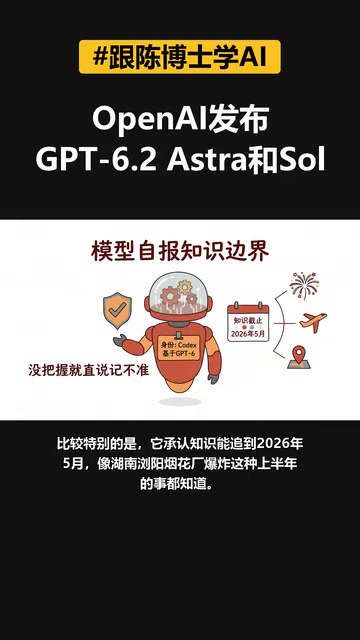
Knowledge cutoff date refers to the latest point in time covered by the model's training data; events beyond that date cannot be learned by the model from training. The model in the article claims its knowledge can be traced back to May 2026, meaning its training corpus includes information at least up to that month. The knowledge cutoff date directly affects the reliability of the model's answers to time-sensitive questions: the closer it is to the current date, the less likely the model is to give outdated or blank answers about recent events. The industry usually mitigates this limitation through retrieval augmentation, tool calling, or periodic incremental training, but the cutoff date remains one of the key indicators for evaluating a model's practicality.
Uncertainty expression refers to the model proactively stating "I can't remember accurately" or "I'm not sure" when it lacks confidence, rather than forcing out an answer. This is the opposite of "hallucination": hallucination is when the model generates plausible but incorrect content, while uncertainty expression is the model's self-calibration of its own knowledge boundaries. Implementation methods include introducing refusal samples during training, performing confidence assessment during inference, or requiring the model through system prompts to flag uncertain information. For users, a model admitting uncertainty is safer than giving a wrong answer, especially in high-risk scenarios such as healthcare, law, and current affairs, where this capability directly affects credibility.
Creativity and Tool Capabilities: Bright Spots and Rough Edges
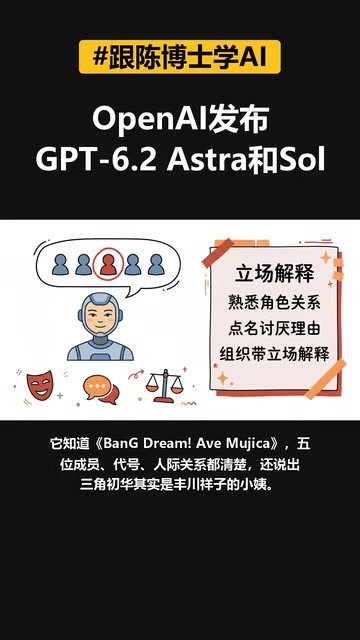
The anime knowledge questions were quite dramatic. The model clearly knew the relationships and code names of five members including Benji Dream, Avi, and Mheika, and could even explain that "Sanjiao Chu Hua" is actually a certain character's kinship relation. When asked who it disliked most, it named a specific character, on the grounds that the other party removed a mask without permission and pushed a teammate to the point of publicly showing their face. The point isn't who it actually dislikes, but that it was organizing an explanation with a stance, rather than listing facts.
In the tools and creativity questions, it used Lagrange interpolation to trace a character image into a function, running for almost 17 minutes; the overall outline was restored fairly well, but the blush was not. For 3D web page generation, Sol presented an early low-poly style, while Astra leaned green, and the three-spin-two details weren't fully grasped. But when it came to writing fan fiction, it threw Chu Hua and Xiangzi into a western fantasy world, using a lamp that burns memories to send people back, with a complete emotional arc. Later it also imitated a certain character's tone to talk about how humans taught large models to speak, ending with the line "Old Silly, I miss you a bit."
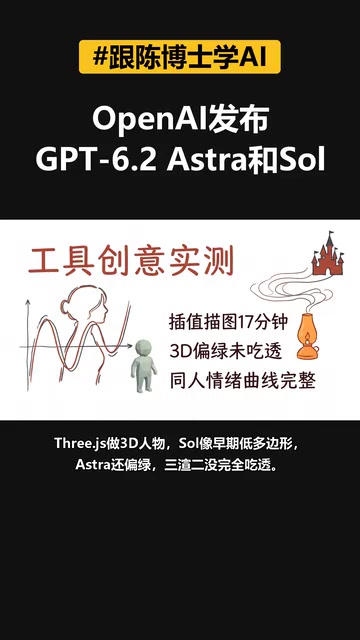
Lagrange interpolation is a mathematical method that constructs a polynomial function from a given set of discrete points so that the function passes exactly through all known points. In the article, the model used it to fit sampled contour points of a character image into a function curve, thereby restoring the image's shape with a mathematical expression. The advantage of this method is that the formula is concise and analytically tractable, but the drawback is that when there are many points, the "Runge phenomenon" occurs—the polynomial oscillates violently at the edges of the interval, causing contour distortion. This explains why the overall outline could be restored reasonably well while details like the blush were difficult to reproduce: interpolation has limited ability to capture high-frequency details, and computational complexity rises as the number of points increases, which the 17-minute runtime also reflects.
This Generation Is Not Yet the Complete Form
Combining official information and community hands-on tests, the judgment on this generation of GPT-6.2 is: it is not yet the complete form. Sol is more like the slower, more cautious everyday workhorse with creativity intact; Astra handles complexity, but visual generation is still somewhat rough. The real progress lies in knowledge freshness, long context, the willingness to admit uncertainty, and the beginnings of knowing how to tell stories.
In November, as Anthropic prepares to go public and both Claude and Gemini keep pushing forward, this wave from OpenAI is not a one-hit kill; it is more like laying out the foundation of the next generation first. Who can cross the line of "reliability" first will become clearer in the coming weeks.
One-line Summary
OpenAI releases the dual-model GPT-6.2 Astra and Sol, applying pressure with long context and lower prices, but it is not yet the complete form.
Paragraph Summary
On November 17, OpenAI released two models in the GPT-6.2 series, Astra and Sol, both supporting a 1.05 million token context window, with Astra's API unit price 20% lower than the previous flagship. Astra targets complex professional tasks, while Sol focuses on everyday conversation and lightweight creation, with the product lines split by complexity. Community long tests show the model's knowledge can be traced back to May 2026, it admits when it can't remember uncertain questions, and it has bright spots in creative writing and character explanations, but 3D generation and visual details still look rough. The overall judgment is that this generation is not yet the complete form, and the competitive focus is shifting toward reliability and the practicality of long context.
Related articles
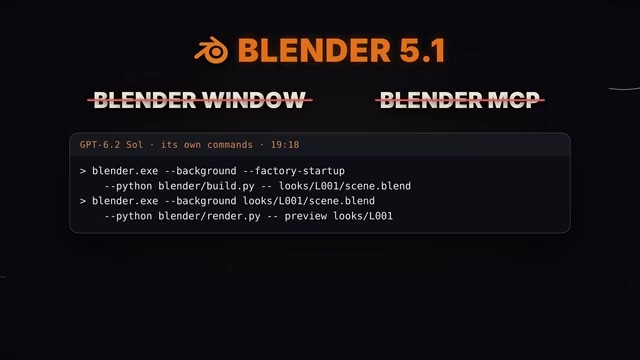
GPT-6.2 Astra vs Sol Hands-On: Blender Clockwork, Neon Cube, and Godot Racing Compared
Bilibili creator tests GPT-6.2 Astra vs Sol on a Blender clock workshop, Neon Cube, and a Godot racing game: Astra executes but costs more, Sol is cheap but lazy, and the racing game drops to two FPS.

Bot-sitting: The New Work Trap of the AI Era?
The bot-sitting phenomenon reveals the verification burden behind AI-generated content: 60% of workers say getting quality results from AI takes as much effort as training a new hire. This article analyzes the AI efficiency illusion, the transformation of work, and response strategies.

Pandex: Connecting AI Agents to Official European Law via MCP
Pandex exposes official European law to AI agents via MCP, exploring new paths for agent compliance. This article analyzes the architecture, practical advantages, implementation challenges, and implications for AI application developers.