OpenAI Releases LLM Security Testing Tool, Reddit Highlights Linux Kernel Maintainers

A Reddit post juxtaposes OpenAI's article on reducing privilege escalation paths with Linux kernel maintainers, sparking security associations.
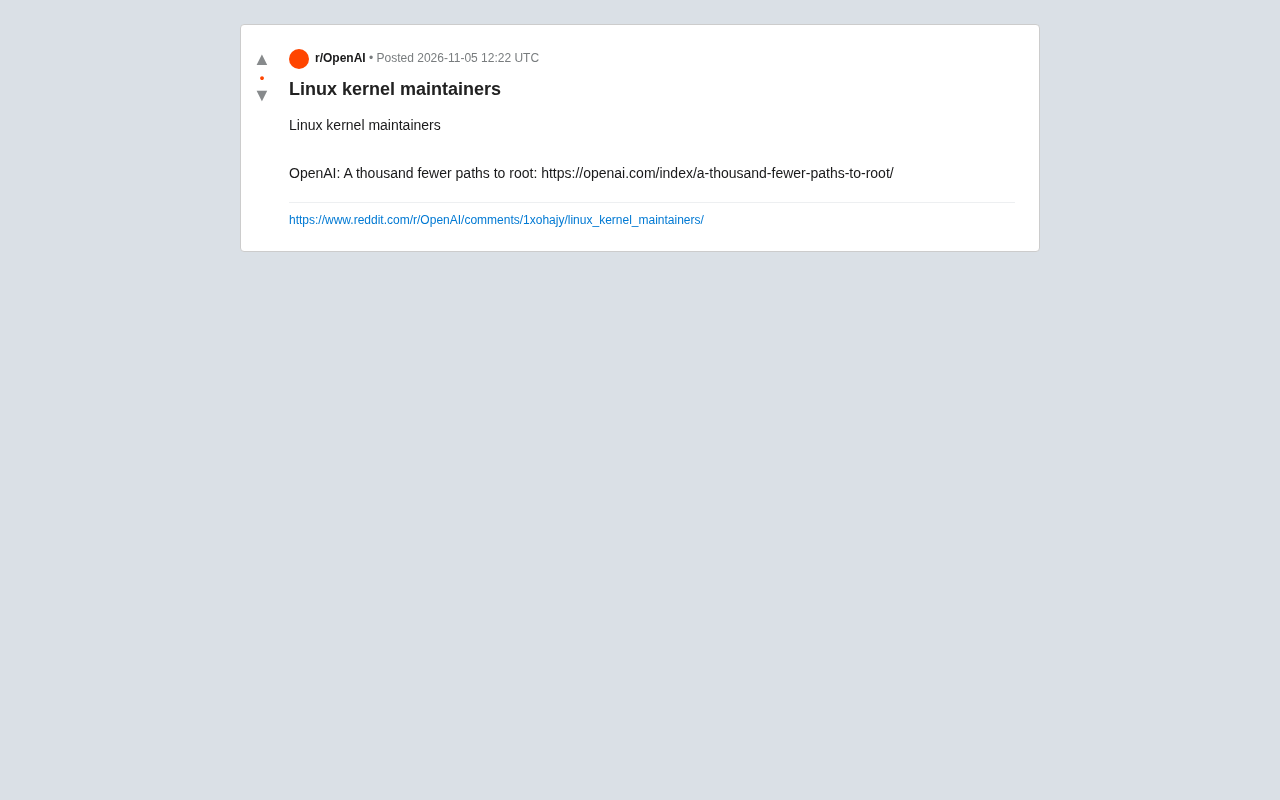
The article analyzes a Reddit Linux kernel community post containing only a title and an OpenAI link. The post is titled 'Linux kernel maintainers,' with the body reading only 'OpenAI: A thousand fewer paths to root.' The author infers two topics: OpenAI's article discusses reducing system privilege escalation paths, reflecting an attack surface reduction security hardening approach; Linux kernel maintainers are responsible for reviewing patches and converging privileged interfaces, creating an intersection in security responsibilities. The article notes that as AI agents gain system operation capabilities, model security boundaries are extending from content compliance to high-risk system operation control, and recommends developers focus on least-privilege design for AI tools and kernel security patch tracking. Due to limited source material, the article explicitly avoids definitive inferences about specific technical conclusions.
Quick Overview: Two Tech Community Developments
Recently, a brief but noteworthy discussion thread appeared in Reddit's Linux kernel community section. The post was titled "Linux kernel maintainers," with the body containing only "OpenAI: A thousand fewer paths to root" along with a link to OpenAI's official blog. The post offered no elaboration, yet it simultaneously sparked associations across both the Linux kernel and AI security domains.
Judging from the title, the post touches on at least two topics: first, the role and current state of Linux kernel maintainers; second, OpenAI's official article titled "A thousand fewer paths to root." Since the source material consists only of a title and a link, the following analysis is based on the thematic direction indicated by the public link and does not involve specific technical details or data not mentioned in the source.
What OpenAI's "A Thousand Privilege Escalation Paths" Refers To
In security, "paths to root" typically refers to the various ways an attacker can gain the highest system privileges (root). OpenAI published content under the title "A thousand fewer paths to root," which literally means "a thousand fewer paths to root"—understandable as a statement about security hardening or attack surface reduction.
As AI systems interact ever more closely with operating systems, LLM-driven tool invocation, automated code generation, and system administration agents can all become new entry points for privilege escalation risks. OpenAI's decision to publicly discuss this topic suggests that model security boundaries are extending from "whether output content is compliant" to "whether the model can be induced to perform high-risk system operations." However, the original article's specific technical approach, testing methodology, and quantitative results are not presented in the source material; readers should consult the official original for complete information.
Attack Surface is a core concept in security, referring to the sum of all entry points in a system that an attacker could exploit to carry out an intrusion. For an operating system, the attack surface includes network services, system call interfaces, device drivers, file permission mechanisms, and more; each additional feature or interface may add several potential privilege escalation paths. Attack Surface Reduction is a fundamental principle of security hardening—its approach is not to patch vulnerabilities one by one, but to architecturally remove unnecessary features, tighten default permissions, and limit the exposure of privileged interfaces. The "thousand fewer paths" in OpenAI's title embodies exactly this approach: reducing overall risk through systematic convergence rather than point fixes. Understanding the concept of attack surface helps readers grasp the level at which the article operates: it focuses not on a specific CVE, but on the design philosophy of permission boundaries when models interact with systems.
Why Linux Kernel Maintainers Are Placed Under the Same Title
Linux kernel maintainers are among the most critical and scarcest roles in the open-source community. They review patches, handle regressions, coordinate subsystem merges, and directly determine the quality and security baseline of kernel code. The Reddit post uses "Linux kernel maintainers" as its title but provides only a link to OpenAI in the body—possibly as an analogy or juxtaposition: kernel maintainers are precisely the people who decide "which paths can lead to root."
From a security perspective, every interface in the kernel that permits privilege escalation is a potential "path to root." One of the maintainers' jobs is to review and converge such interfaces. If OpenAI's article discusses reducing privilege escalation paths, it naturally intersects with kernel maintainers' security responsibilities—though the source material provides no evidence of a direct connection, the juxtaposition itself is worth the tech community's attention.
Linux Kernel Maintainer is a core role in the kernel development process, typically divided by subsystem—for example, the network stack, file systems, and memory management each have dedicated maintainers. The workflow roughly proceeds as follows: developers submit patches to the mailing list; after review and testing, subsystem maintainers decide whether to include them in their own git trees; and finally they are submitted to Linus Torvalds during the merge window. Maintainers not only review code correctness but also gatekeep security implications, maintain API stability, and handle regressions. Since the kernel is the trust boundary between all user-space programs and hardware, maintainers have substantive decision-making authority over "which interfaces can exist and at what privilege level they are exposed." This also explains why the role is naturally related to the "privilege escalation paths" topic: maintainers' merge decisions directly shape the kernel's attack surface.
Practical Implications for Developers
For ordinary developers, this discussion points to two directions worth tracking. The first is permission design for AI tools in system administration scenarios: when AI agents are granted shell or system call capabilities, default permissions should be as minimal as possible, and high-risk operations should require explicit confirmation. The second is the habit of tracking kernel security patches: the pace at which maintainers converge privilege escalation paths is often reflected in the release notes of stable kernel updates.
Given the limited information in the source material, this article does not make further inferences about the specific conclusions of OpenAI's article. Interested readers are advised to visit OpenAI's official blog to read the original and to follow discussions of related security patches on the Linux kernel mailing list.
The Principle of Least Privilege is a cornerstone of permission design, requiring that any entity (user, process, or AI agent) receive only the minimum permissions necessary to complete its task. In scenarios where AI agents invoke shells and execute system commands, implementing this principle includes: running agent processes as non-root users, using containers or sandboxes for isolation, requiring human confirmation for high-risk operations (such as modifying system configurations or installing software packages), and granting specific operations through capability mechanisms rather than full root privileges. A common practical mistake is granting agents sudo or full shell access for convenience—which amounts to directly exposing "a thousand paths" to a model that could be induced by prompt injection attacks. Only by combining the principle of least privilege with attack surface reduction can effective protection be achieved for AI system administration scenarios.
Notes on Information Limitations
It should be noted that this source material contains only a Reddit post title, a single sentence of body text, and an OpenAI link; it lacks the original article's technical details, community comments, and quantitative data. Therefore, this article focuses on event positioning and thematic association analysis, without definitive descriptions of specific technical mechanisms. Multi-source cross-validation cannot be fully carried out with this material; readers should maintain a cautious attitude toward single sources.
Related articles
 Tech Frontiers
Google Omni 1.2 Flash: 15-Second AI Video at Just $0.07 per Second
Google DeepMind releases Gemini Omni 1.2 Flash: 15-second video, 720p at $0.07/sec (30% cheaper), multi-turn editing without regeneration, draft upscaling to 4K.
 Tech Frontiers
No AI Ghostwriting: Writer's Quarter Reinvents Novel Writing with a Visual Workbench
The Writer's Quarter is an AI-free novel writing and planning tool that unifies character building, story planning, and manuscript writing in one visual workbench. This article analyzes its positioning, target users, and differentiated value amid the rise of AI writing tools.
 Tech Frontiers
Fleeep: A Unified Inspiration Collection Notes App for Creatives
Fleeep is a notes app for creatives that unifies screenshots, bookmarks, saved posts, and inspiration into one calm, cross-device, offline-capable space. This article analyzes its positioning, differentiation, and target users.