OpenAI Rolls Out GPT-6 and Intelligent UI to All Users: ChatGPT Moves Beyond Plain Text
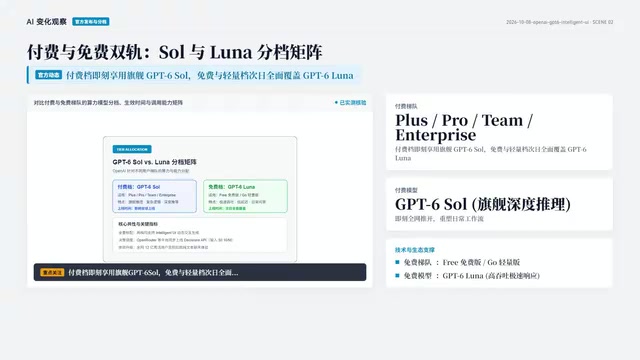
OpenAI launches GPT-6 dual-flagship and Intelligent UI globally, shifting AI from text output to dynamic interaction generation.
OpenAI has rolled out GPT-6 to all ChatGPT users simultaneously, breaking from its usual phased release pattern. Paid users (Plus/Pro/Team/Enterprise) access the deep-reasoning GPT-6 Soul, while free users get the speed-optimized GPT-6 Luna — a "dual-flagship" tiered structure. More disruptive is Intelligent UI, which lets ChatGPT dynamically generate buttons, sliders, and interactive charts based on conversational intent, turning answers into usable tools. The rollout is limited to the Chat tab; Codex and Work retain separate configurations; Enterprise requires admin activation; and free-tier users face a clear reasoning gap versus paid tiers.
A Full-Scale Rollout: GPT-6's Dual-Flagship Strategy
According to AI-focused content creators on Bilibili, OpenAI has announced the global rollout of its latest GPT-6 model to all ChatGPT users, alongside the launch of a new smart interaction layer called Intelligent UI. What makes this move particularly noteworthy is its scope — rather than the familiar pattern of paid users getting early access while free users wait, OpenAI has opted for an near-universal release from day one.
In terms of model tiers, OpenAI has adopted a "dual-flagship" structure. Paid users on Plus, Pro, Team, and Enterprise plans get access to the full flagship experience powered by GPT-6 Soul in the Chat tab, while the much larger base of free and lightweight users is served by GPT-6 Luna, a variant optimized for high throughput and fast response times. In short, everyone now has a foot in the GPT-6 door — the distinction lies in the depth of capability each tier unlocks.
The logic behind this strategy is worth unpacking. Luna emphasizes speed for free-tier users; Soul emphasizes deep reasoning for paying users. This is a classic OpenAI balancing act between compute costs and user scale: use a lightweight model to absorb the massive free-tier traffic, while using the flagship model to retain high-value paying customers.
The "dual-flagship" naming convention (Soul and Luna) continues OpenAI's recent practice of differentiated brand management across model families. The o1 and o3 series focused on reasoning; GPT-4o prioritized multimodal speed. Having multiple models coexist within the same product interface has become the norm. The name "Luna" evokes lightness and speed, while "Soul" suggests depth and completeness — a naming strategy that's as much about managing user expectations as it is about technical differentiation. It's worth noting that there is no industry-standard definition of a "lightweight flagship": whether Luna is a smaller model distilled from Soul, or a faster variant achieved through inference-time compression, has not been officially disclosed. Users should exercise caution when assessing its actual capability ceiling.
Intelligent UI: From Typewriter to Dynamic Mini-Apps
Even more disruptive than the model upgrade is the interaction revolution brought by Intelligent UI. Previously, ChatGPT could only output text or Markdown tables — a fundamentally one-dimensional experience. Intelligent UI can now dynamically generate buttons, sliders, interactive charts, and even functional mini-tools directly within a conversation, based on the intent behind the user's query.
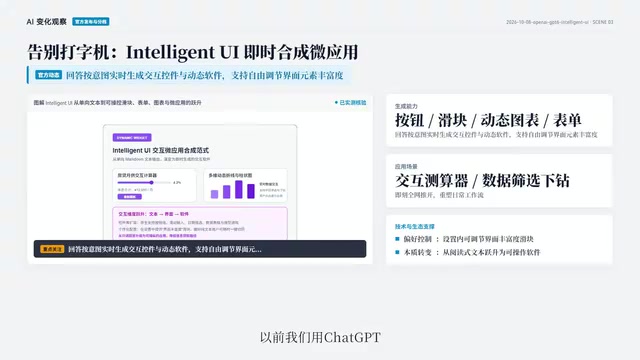
For example, ask about your mortgage payment and instead of a formula and a string of numbers, you get a live calculator with sliders and a real-time line chart. Need to compare datasets? A dynamically filterable interactive chart appears. Users can even adjust the balance between "rich interaction" and "plain text" components in their settings.
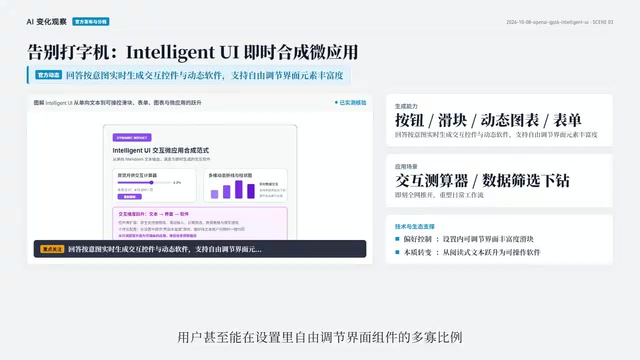
This marks a qualitative shift in what an AI assistant actually is: from a passive chatbot that responds to queries, to an on-demand "software engine" that synthesizes front-end interfaces in real time. If previous large language models solved the problem of content generation, Intelligent UI is tackling interaction generation — turning answers into operable tools rather than readable text.
From a technical standpoint, the core of Intelligent UI is enabling the model to simultaneously generate structured UI descriptions (akin to JSON Schema or a DSL) alongside its response, which a front-end rendering engine then converts into interactive components in real time. This is fundamentally different from the traditional separation of "model outputs text, front-end hard-codes the interface" — the interface itself becomes one of the model's inference outputs. This approach aligns with the emerging "AI-generated UI" (AIGUI) research direction, and echoes explorations by products like Anthropic's Artifacts and Google's Workspace AI integrations. The key difference is that Intelligent UI embeds this capability directly into the everyday conversation flow, rather than requiring users to explicitly trigger a separate feature. The architectural challenge is significant: the model must simultaneously understand user intent, select the right component type, and generate correct data-binding logic — a hallucination at any step could cause components to behave unexpectedly. This is likely where the gap between paid and free tiers will be most pronounced for complex interactions.
The Scale Behind It: 1.2 Billion Weekly Actives and 40 Million Combined Actives
Such an aggressive universal rollout is only possible with the backing of substantial infrastructure and ecosystem scale. According to the source content, the OpenAI team stated that this full-scale push is designed to support the platform's evolution toward 1.2 billion weekly active users. On the day of the announcement, combined active users across Codex and ChatGPT Work reportedly hit an all-time high of 40 million, and credit resets for paid accounts were fully processed.
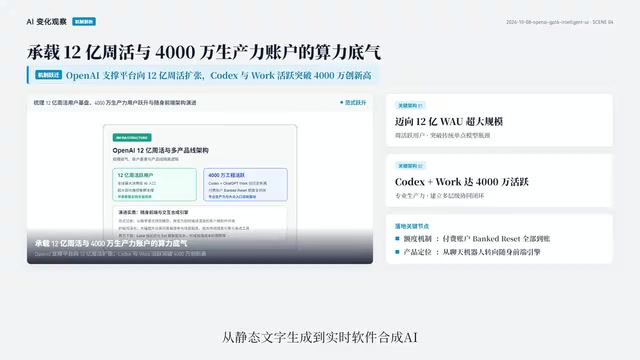
These figures suggest OpenAI is transforming ChatGPT from a standalone tool into a platform capable of handling an enormous volume of everyday tasks. Only when the underlying compute infrastructure and model tiering can absorb this scale does a "universal rollout" strategy become viable. It should be noted that these numbers come from a single video source and have not been cross-verified against official public data — treat them as directional indicators rather than confirmed figures.
One of the key technologies enabling large-scale universal deployment is inference-side cost compression. Over the past two years, OpenAI has dramatically reduced marginal inference costs through model distillation, quantized inference, KV cache optimization, and custom inference chips (developed in deep collaboration with Microsoft Azure). If the Codex and ChatGPT Work combined active user data is accurate, it also signals that OpenAI's user stickiness is shifting from "occasional Q&A" to "continuous workflow integration" — a use pattern that places far greater demands on inference throughput and stability than typical conversational scenarios. If the 1.2 billion weekly active figure is eventually confirmed officially, it would surpass all known single AI application scales and approach the territory of top-tier messaging apps like WhatsApp. This also explains why OpenAI needs a lightweight model like Luna to absorb the vast majority of free-tier traffic.
Clear Boundaries: Three Key Limitations
Amid the excitement, it's important to objectively define the limits of this update to avoid over-interpretation.
Chat Tab Only
The full rollout of GPT-6 and Intelligent UI is strictly confined to the Chat tab. Codex, designed for deep engineering workflows, and the dedicated Work environment retain their own independent professional model configurations and are unaffected by this change. This means the developer experience in coding scenarios is managed separately from general conversation.
Enterprise Requires Admin Enablement
For Enterprise users, whether these features are enabled still depends on a workspace-level administrator toggle. Availability for enterprise users is governed by organizational policy — it's not something individual users can activate on their own.
The Capability Gap Between Free and Paid Tiers
While Luna on the free tier is extremely fast, it has a clear gap compared to Soul on paid tiers when it comes to complex, long-horizon reasoning tasks. Free users have gained a "ticket" into the GPT-6 ecosystem, but true flagship reasoning capability remains the differentiated value proposition behind the paywall.
Conclusion: A New Paradigm for Human-AI Interaction
From text bubbles that appear character by character, to dynamic interfaces that materialize on demand — this update reflects a paradigm shift underway in human-AI interaction. When AI can not only answer questions but package those answers as operable tools, the boundary between "having a conversation" and "using software" begins to blur.
Of course, the information above is primarily drawn from a Bilibili content creator's interpretation of OpenAI's announcement. Specific details — such as exact model names and active user figures — should be verified through official channels. But the direction it points to — AI assistants moving from content generation to interaction synthesis — represents a trend that genuinely deserves close and continued attention.
Related articles

Google's AMIE Clinical Study Published in The Lancet: First Real-Clinic Validation of AI-Powered Medical History Taking
Google's AMIE conversational diagnostic AI study is published in The Lancet, marking the first prospective real-clinic validation of a patient-facing AI system, with 90% DDx alignment.

UstaWork: A Workflow Control Plane for Multi-Agent AI Coding Collaboration
UstaWork is a multi-agent AI workflow control plane that splits coding into plan, implement, review, and merge stages with flexible human approval and context cost controls.

Claude Opus 5.5 Builds a Retro J2ME Shooter From a Single Prompt
A Reddit user used one prompt to have Claude Opus 5.5 build a complete 3D J2ME shooter — integer engine, procedural art, MIDI music, TTS audio, and a 500KB JAR that runs on a 20-year-old phone.