OpenAI's Finance Chief in Action: How AI Shrinks Their Team to 20% the Size of Peers

OpenAI's finance team runs at 20% normal headcount by deeply embedding ChatGPT and Codex into every workflow.
OpenAI finance head Stacy Fagioli details how her team embeds ChatGPT, Codex, and ChatGPT for Excel into core financial workflows — from an investor relations agent that handled two massive fundraising rounds in-house, to automated LBO models and marketing ROI dashboards — enabling the team to operate at just 20% the headcount of peer companies.
Article
OpenAI isn't just leading the AI race — it's also one of the most aggressive adopters of its own products. Stacy Fagioli, Head of Finance for OpenAI's Applied business, recently gave a detailed public breakdown of how her team has deeply embedded ChatGPT, ChatGPT for Excel, and Codex into their day-to-day financial workflows. The value of her talk wasn't in flashy demos — it was in showing what it actually looks like when an AI company "eats its own dog food": doing the same volume of finance work as comparable companies, with just 20% of the headcount.
Three Principles for Building the "Future Finance Team"
Stacy says one of her core OKRs at OpenAI is to "build the finance team of the future." To get there, her team has adopted three guiding principles.
Principle 1: AI native by design. When deploying any tool or agent, the team never treats it as a patch on existing processes. Instead, they redesign the entire workflow from scratch around what it should look like. Going further, they've begun restructuring hiring strategies and org design around agents — a fundamental shift in mindset, not just a layer of tooling.
It's worth noting that "AI native by design" is a fundamentally different philosophy from "AI-augmented." The traditional AI-augmented approach layers AI tools on top of existing processes — essentially patching the old way of working. AI native design, by contrast, starts from first principles: What is the core objective of this work? Then it rebuilds the entire process around AI capabilities. The parallel to "cloud native" is apt — early enterprises simply lifted on-premise applications to the cloud without really leveraging its elasticity. Truly cloud-native architectures rewrote application logic entirely, embracing microservices and containerization. The hard part of AI native is that it requires organizations to be psychologically prepared to rebuild processes from zero — which is far harder for most mature enterprises than simply purchasing an AI tool.
Principle 2: Headcount leverage must be demonstrable. A PwC benchmarking assessment found that OpenAI's finance team is roughly 20% the size of comparable tech companies. In other words, OpenAI runs full finance operations with one-fifth the headcount. Stacy considers this the strongest proof of "doing more with less."
Principle 3: Deploy early, iterate fast. The technology moves quickly. The team's default is always to deploy first and refine continuously, rather than wait for some mythical stable final version.
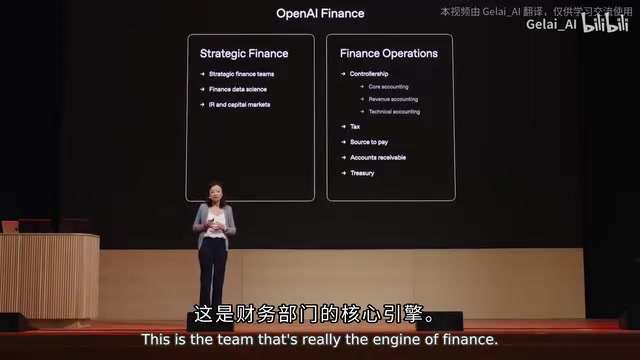
Embedding Engineers Inside the Finance Team
OpenAI's finance organization is built on three pillars: Strategic Finance, Finance Operations (including Accounting), and Corporate Finance Technology. Engineers who build tools and agents are embedded directly within the Finance Technology pillar, working side by side with domain experts.
This structure completely bypasses the slow "finance submits a ticket, IT queues it up" cycle. Engineers and business experts collaborate in real time, letting tools evolve with the business as it changes — dramatically improving deployment and iteration speed. For any organization looking to drive AI adoption, this org design is highly instructive.
Individual Productivity: ChatGPT, the Excel Add-in, and Codex in Practice
Stacy breaks AI deployment into two dimensions: tools that raise individual productivity, and agents that raise overall team productivity. On the individual side, she shared several high-ROI real-world examples.
Investor Relations Agent: Saving Millions in Advisor Fees
This is Stacy's most celebrated case. Over the past year, OpenAI closed two historically large equity funding rounds, each bringing a flood of investor due diligence requests.
Due diligence (DD) is the standard process in investment transactions where investors conduct comprehensive reviews of a target company across financial, legal, commercial, and technical dimensions. In large private or strategic financings, investors typically submit checklists of hundreds or even thousands of questions, requiring written responses within a matter of weeks. This process has historically consumed enormous amounts of management bandwidth, and is one of the main reasons investment bank and law firm advisory fees run so high. Both rounds that OpenAI completed rank among the largest private financings in tech history, making the due diligence complexity exceptionally high.
The team's solution: train an "investor relations agent" on internal data, tuned to communicate in the style of a "public-company-grade IR professional." When faced with volumes of DD questions, the agent produces answers that are data-grounded, factually consistent, and framed within a strategic narrative — in minutes rather than through manual assembly. The agent's core value also lies in organizing responses within a unified strategic narrative framework, ensuring factual consistency across different answers — which is precisely the quality dimension hardest to guarantee when assembling answers manually.
Critically: the company has just one CFO, but with this agent, every team member can deliver "CFO-level" professional responses. This allowed OpenAI to run both fundraising processes entirely in-house, saving substantial advisory fees. The agent was later shared with the recruiting team and other executives — used to tell the company's equity value story to candidates — achieving lateral reuse of its impact.
ChatGPT for Excel: Building Financial Models Like an Analyst
Stacy describes ChatGPT for Excel as a tool that "thinks like a human analyst" — it receives a task, builds the analytical framework, writes formulas directly into the workbook, and delivers results that are traceable, auditable, and scenario-switchable.

She walked through a vivid demo: imagine you're a private equity analyst asked to analyze a take-private transaction for a public company. This involves building a Leveraged Buyout (LBO) model — one of the most central financial analysis tools in private equity. The basic LBO logic is that the acquirer borrows heavily (typically 60–80% of the purchase price) against the target's assets and future cash flows to complete the acquisition, using less of its own equity to control a larger transaction. A full LBO model typically includes capital structure assumptions, multi-tranche debt interest rates and repayment schedules, revenue and profit projections, exit multiple assumptions, and IRR calculations — components that traditionally take analysts days or weeks to build and validate in a banking environment.
Now, you simply upload the equity research report PDF, type "think like an investment professional and build an LBO model," and the tool plans the analysis, populates the spreadsheet, and produces a complete model — including capital structure, equity and debt cost assumptions by tranche, sources and uses of funds, and an investment recommendation. The whole process takes roughly 10 minutes.
Codex: Putting Engineering Capability in Non-Technical Hands
Stacy rates Codex highest because it "puts software engineering capability in the hands of non-technical people like me."
OpenAI Codex is a large language model based on the GPT architecture, fine-tuned specifically for code generation tasks, and is the underlying technology behind GitHub Copilot. The new generation of Codex released in 2025 has evolved into an agentic system capable of autonomously planning and executing tasks — running code in a sandbox environment, debugging errors, reading and writing files, and completing the full chain from understanding requirements to delivering code. For finance professionals without a technical background, Codex's most important value is eliminating the "translate business requirements into technical specifications" step — historically the most time-consuming and error-prone part of working with IT. Finance staff can describe their goal in business language, and Codex handles the technical implementation.
She shared three specific scenarios.
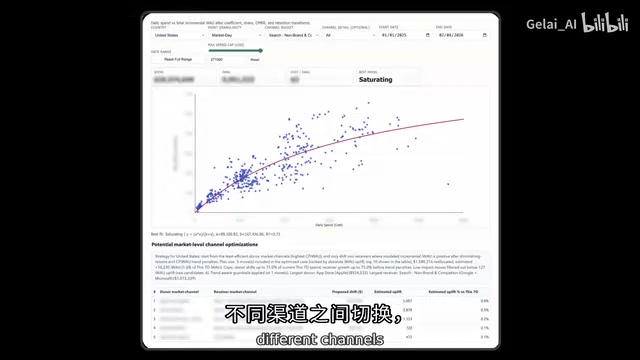
Marketing Spend ROI Dashboard: OpenAI receives massive amounts of data from marketing agencies every week — across regions, channels, and keywords. The team isn't short on data; they're short on time to analyze it. They feed the data to Codex, ask it to build an ROI dashboard, identify which channels are seeing diminishing returns due to saturation, and surface the top five budget reallocation recommendations. The team now dynamically adjusts marketing budgets weekly, shifting resources from underperforming to high-performing channels.
Sales Insight Analysis: After a new product launched, Stacy and the CRO wanted to know whether sales reps were actually pitching it to customers. Codex pulled insights directly from Gong call transcripts and customer emails, generating dashboards broken down by segment, geography, and individual customer account — letting the team judge before quarter-end whether resource reallocation was needed.
Automated Executive Presentations: Because Codex can write front-end interfaces, it can also automate report production for the CFO and board. Take the monthly compute gross margin slide: previously this required manually reconciling telemetry data across systems and layering on accounting rules. Now, using Codex and reusable "skills," the entire process compresses to a few hours. One important detail: the team doesn't send outputs directly to the CFO. They still have a human review the data and run a QA pass to pressure-test the numbers for accuracy.
Org-Level Agents: Automating High-Volume Repetitive Work
Beyond individual tools, OpenAI's finance team has built agents that plug directly into workflows to orchestrate repetitive cross-system tasks.

- Procurement Agent: Handles procurement and travel policy questions (e.g., "What's the hotel budget per night in London?"). Currently automates roughly 60% of such queries, with ongoing improvement.
- Credit Check Agent: For customers exceeding a spending threshold, credit risk analysts previously had to research each one manually to generate a score. The agent now does this in minutes and embeds the score directly into the CRM, letting sales reps make instant go/no-go decisions.
- Contract Review Agent: Reads agreements in bulk and structures the data, specifically identifying non-standard terms to ensure compliance with GAAP, ASC 606, and other revenue recognition standards. ASC 606 (Revenue from Contracts with Customers) is the standard issued by FASB in 2014 and effective in 2018, built around a five-step framework: identify the contract, identify performance obligations, determine the transaction price, allocate the price to each obligation, and recognize revenue upon satisfaction of each obligation. For SaaS and AI software companies, subscription contracts often bundle platform access, implementation services, training, and support — requiring precise price allocation. Any non-standard clause (deferred payment, variable consideration, refund terms) can shift revenue recognition timing. The contract review agent essentially codifies this compliance logic, maintaining review quality as contract volume scales without requiring the accounting team to scale headcount in lockstep.
- Vendor Risk Agent: Automatically produces risk reports that previously required extensive manual research, embedding risk scores into the procurement system so approvers can make decisions or escalate directly.
Key Takeaways: The AI Mindset and Bottom-Up Innovation
Stacy closed her talk with two of her most important lessons.
First: Cultivate an "AI-first" reflex. Before tackling any challenging task, her team now instinctively asks: "What can ChatGPT help me do here?" This isn't a slogan — it's a thinking pattern wired into daily behavior.
Second: Innovation comes from the front lines, not the top. Stacy was candid: not one of the innovations described above was her idea. Zero. The actual approach is to "democratize tool access" — put ChatGPT and Codex in the hands of every team member, especially those closest to the problems, most familiar with the data, and grinding away in the systems every day. When powerful tools are within reach, the solutions they create often surprise even management.
This may be the most important insight for business leaders in the entire talk: The key to AI transformation isn't how elegant the top-down strategy is — it's about putting powerful tools in the hands of the people closest to the problems.
Key Takeaways
Related articles

Gaussian Process Bandit Optimization: Exploration Strategies and Inference Regret Guarantees
Cumulative regret guarantees in Bayesian optimization fail to reflect final recommendation quality. This article examines a new study that provides inference regret guarantees for Gaussian process bandit optimization through exploration query strategies and fill distance analysis, validated on hyperparameter optimization and control tasks.

The Most Detailed Codex Guide on Bilibili: From Installation to Real-World Practice
The most detailed Codex guide on Bilibili: from app store installation to daily work mode configuration, with a real coffee shop project demonstrating file organization, data extraction, dashboard creation, and other practical tasks. Learn to use Plan Mode and desktop pets to leverage Codex efficiently.

Appearance Compensation in Volume Rendering: Why RGB Accuracy Cannot Guarantee Density Correctness
Volume rendering research reveals that volumetric data perfectly reproducing external RGB views may still contain density errors: appearance compensation can double central density and keep external rays unchanged even when L2 error exceeds 14.52%. Density recovery depends on appearance capacity, spatial resolution, and measurement design.