OpenAI's First AI Hardware Revealed: A Screenless, Animated Emotional Companion Speaker

A Reddit leak reveals OpenAI's first hardware may be a screenless, emotionally intelligent AI companion speaker.
A Reddit leak claims OpenAI's debut hardware product is a screenless, motorized smart home speaker positioned as an AI companion rather than a voice assistant. With built-in mechanical movement, a camera, and sensors designed to create emotional connection, the device reflects a collaboration with Jony Ive and signals OpenAI's ambition to redefine the smart home category against Amazon, Google, and Apple.
A "Speaker" Unlike Any Speaker
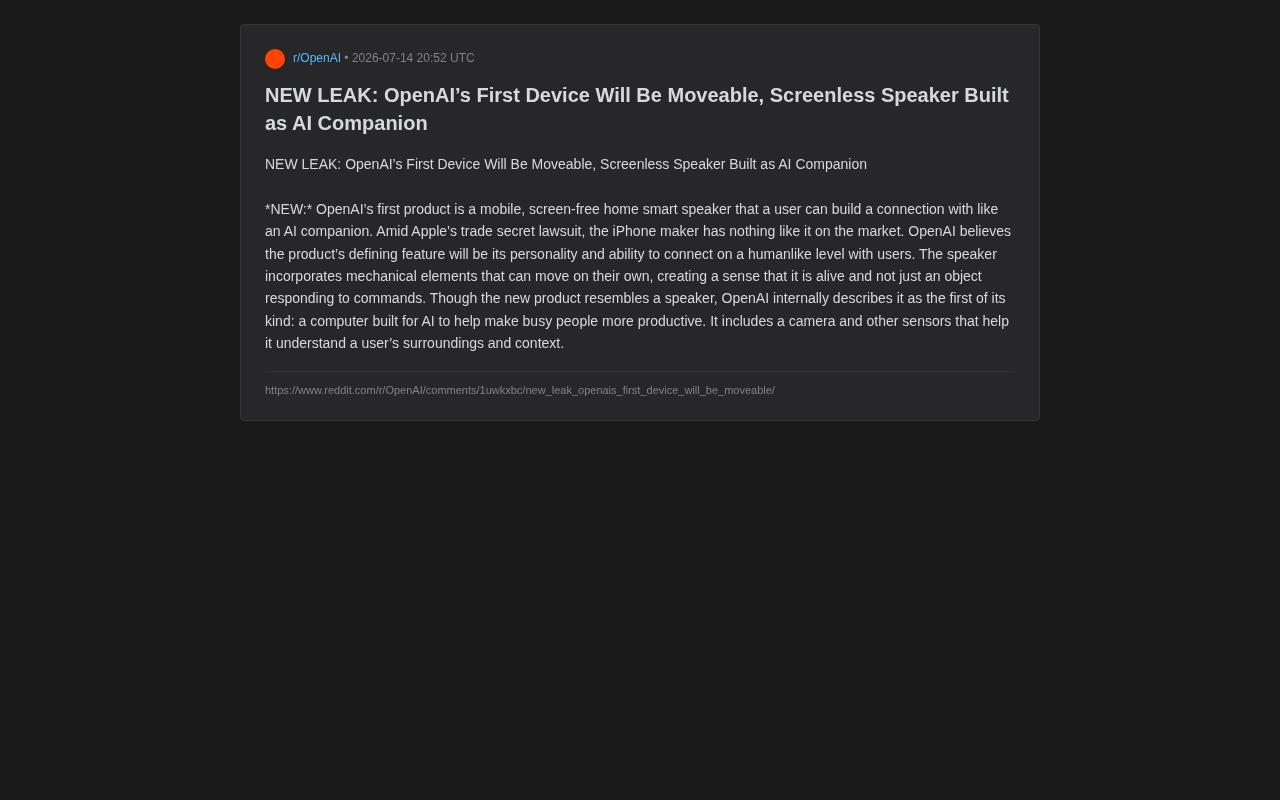
A Reddit leak has sent ripples through the tech world: OpenAI's first hardware product will reportedly be a movable, screenless smart home speaker — one positioned not as a traditional voice assistant, but as an "AI companion" capable of forming genuine emotional connections with its users.
According to the leak, the device may look like a speaker on the outside, but OpenAI internally describes it as "the first of its kind" — a computer "built for AI, designed to help busy people get more done." That's an ambitious framing, suggesting OpenAI isn't simply looking to grab a slice of the existing smart speaker market, but to redefine the category entirely.
Notably, this information surfaced during a sensitive period when Apple is pursuing a trade secret lawsuit against OpenAI-linked personnel. The leak specifically notes that Apple has no comparable product on the market — a detail that feels deliberate, and may hint at the deeper motivations behind the legal dispute.
Industry Context: The concept of AI companion hardware isn't new to OpenAI. As early as 2023, products like the Humane AI Pin and Rabbit R1 attempted to embed large language models into portable devices — but both stumbled due to poor interaction experiences, battery limitations, and functional constraints. These failures offer a useful lesson: pure "de-smartphone" portable gadgets are hard to sustain, while always-on home AI assistants may be a more viable entry point.
The Core Pitch: "Personality" and Emotional Connection
OpenAI believes the defining characteristic of this product is its "personality" and its ability to connect with users on a human level. This stands in sharp contrast to existing smart speakers — whether Amazon Echo or Google Nest, which are fundamentally passive, command-response tools.
The smart speaker market has been evolving for a decade since Amazon Echo launched in 2014, with cumulative global shipments exceeding 500 million units. Yet growth slowed noticeably after 2022 — Amazon's Alexa division fell into sustained losses, and Google Nest struggled with user engagement. The root cause: existing smart speakers are essentially "voice-powered search boxes," lacking the depth of value that keeps users coming back. OpenAI is entering this market precisely at the inflection point where large language models have matured enough to make a genuinely useful daily AI assistant possible for the first time — something that rule-based NLP systems could never deliver. That's the core of OpenAI's confidence in redefining this category.
A Machine That Moves
Perhaps the most striking detail in the leak is that the device includes a mechanical structure capable of autonomous movement. These mechanical components can move independently, creating the impression that "it is alive — not merely an object responding to commands."
This design is grounded in well-established academic theory: Affective Computing, introduced by MIT Media Lab's Rosalind Picard in 1997. Research shows that humans instinctively interpret motion, rhythm, and directional movement as emotional signals — the so-called "anthropomorphic projection" effect. Sony's Aibo robot dog and the Jibo social robot were early practitioners of this approach. By embedding this mechanism into a speaker-form device, OpenAI aims to trigger emotional resonance through minimal physical movement, rather than relying on complex humanoid robotics.
Through this physical sense of "aliveness," OpenAI clearly hopes to shatter the cold, tool-like nature of human-machine interaction — giving the device the illusion of being a living entity. This reflects a grander product philosophy: the AI devices of the future shouldn't passively wait to be woken up. They should be active, warm presences.
The Ability to Read Its Environment
Beyond mechanical movement, the device is also equipped with a camera and multiple sensors to understand the user's environment and context. This means it can not only "hear" but also "see," actively perceiving what's happening around it.
The combination of a camera and sensor array points toward multimodal LLM capabilities deployed locally or in the cloud. OpenAI's GPT-4o already handles text, voice, and images simultaneously; paired with hardware sensors, the device could achieve true "contextual awareness" — proactively suggesting recipes when it detects you're cooking, or softening its conversational tone when it notices you look tired. This overlaps significantly with the direction Google's Project Astra is exploring for a "universal AI assistant," but OpenAI's choice to use dedicated hardware rather than a phone app implies stronger data collection capabilities and deeper penetration into everyday life.
That said, a home device with a camera and always-on microphone will face intense scrutiny on privacy. Amazon Echo's accidental recording uploads and Google Nest's data breach incidents each triggered massive user trust crises. If OpenAI releases such a product, it will face hard architectural choices — local vs. cloud data processing — along with EU GDPR compliance pressure and users' psychological resistance to the idea of "an AI always watching me." Striking the right balance between perceptual capability and privacy boundaries will be a critical variable in determining whether this product can scale.
Strategic Reading: Hardware as an Inevitable Next Step
The industry has long anticipated OpenAI's move into hardware. OpenAI has already been working with former Apple Chief Design Officer Jony Ive and his design firm on exploring the form of AI-native hardware. The product form described in this leak aligns closely with Ive's characteristic design philosophy: screenless, minimal, human-centered.
Why Go Screenless?
Jony Ive spent nearly 30 years at Apple, leading the design of era-defining products like the iMac G3, iPod, iPhone, and Apple Watch. He has long championed a "form follows humanity" design philosophy, believing that good design should make technology "invisible" from the user's perspective. After leaving Apple, he partnered with OpenAI through his LoveFrom design firm — a collaboration reportedly valued in the billions.
The screenless design is no accident, and it's more than an aesthetic choice — it's a philosophical stance. As large language models and voice interaction mature, the necessity of screens as the primary medium for information input and output is being reexamined. Screens create competition for attention; a screenless device frees people from the behavior pattern of "staring at a device," aligning with Ive's longstanding advocacy against overstimulation and in favor of restrained experiences. OpenAI is betting on a natural interaction paradigm centered on conversation — users no longer need to look at a screen to operate it; they communicate with the device the way they'd talk to a person.
This philosophy continues the product logic that runs from ChatGPT's voice mode to Advanced Voice Mode: letting AI integrate into daily life in the most natural, lowest-friction way possible. The screenless design not only reduces hardware costs and interaction complexity, but reinforces the product's positioning as a "companion" rather than a "tool."
Going Head-to-Head with the Giants
If the leak is accurate, OpenAI will be moving directly into the smart home gateway market long dominated by Amazon and Google — while also creating potential friction with Apple's ecosystem. The difference is that OpenAI is attempting to use "AI personality" as a differentiating selling point to bypass the hardware spec arms race and build a moat at the experience layer.
For Apple, this may be precisely the source of its alarm — a company known for software and models is disrupting the consumer electronics market with an entirely different product logic, in a space Apple has yet to deeply develop. Apple's HomePod line has never broken out of the niche audiophile segment, and Siri's conversational capabilities have long drawn user complaints. If OpenAI can pair GPT-level conversational intelligence with emotionally resonant hardware design, it could deliver a genuinely disruptive blow to Apple's smart home ambitions.
A Measured Take: The Leak Still Needs Official Confirmation
It bears emphasizing that all of this information comes from a single Reddit post and has not been officially confirmed by OpenAI. The product's exact form, release timeline, pricing, and even whether it ultimately ships at all remain highly uncertain. History is full of hardware projects that were substantially altered or killed during development.
That said, given OpenAI's publicly known collaboration with Jony Ive and the industry's broader momentum toward AI-native hardware, the directional credibility of this leak is reasonable. Regardless of whether the final product matches the description exactly, OpenAI's entry into AI hardware appears to be a matter of when, not if.
Conclusion
The AI companion speaker described in this leak represents a fundamentally new product philosophy: liberating AI from the screen, giving it a tangible physical presence and an emotionally resonant personality. It draws on the academic foundations of affective computing, the technical breakthroughs of multimodal LLMs, and a minimalist design philosophy — all in an attempt to open a second front in a smart speaker market that has been dominated by giants for a decade.
If OpenAI can genuinely deliver on the promise of interaction that feels "alive," it may redefine the smart home device category the way iPhone once redefined the phone.
Of course, there's still a distance between ambition and reality. Can an AI personality truly resonate with users? Will the mechanical movement come across as gimmicky? How will the privacy implications of an always-watching camera be resolved? These are questions this product will have to answer head-on. We'll watch with interest to see how OpenAI tells its next story on the new frontier of hardware.
Related articles

Gaussian Process Bandit Optimization: Exploration Strategies and Inference Regret Guarantees
Cumulative regret guarantees in Bayesian optimization fail to reflect final recommendation quality. This article examines a new study that provides inference regret guarantees for Gaussian process bandit optimization through exploration query strategies and fill distance analysis, validated on hyperparameter optimization and control tasks.

The Most Detailed Codex Guide on Bilibili: From Installation to Real-World Practice
The most detailed Codex guide on Bilibili: from app store installation to daily work mode configuration, with a real coffee shop project demonstrating file organization, data extraction, dashboard creation, and other practical tasks. Learn to use Plan Mode and desktop pets to leverage Codex efficiently.

Appearance Compensation in Volume Rendering: Why RGB Accuracy Cannot Guarantee Density Correctness
Volume rendering research reveals that volumetric data perfectly reproducing external RGB views may still contain density errors: appearance compensation can double central density and keep external rays unchanged even when L2 error exceeds 14.52%. Density recovery depends on appearance capacity, spatial resolution, and measurement design.