OpenAI's Free AI Course Goes Into Communities: Helping Caregivers Bring ChatGPT Into Daily Life
OpenAI's Free AI Course Goes Into Comm…
OpenAI Academy offers free hands-on ChatGPT workshops for caregivers in five cities, exploring how to bring AI skills to everyday people.
OpenAI Academy launched free, in-person, hands-on ChatGPT workshops for caregivers in five U.S. cities, aiming to help non-technical people build practical AI skills transferable to daily work. The article analyzes why caregivers were chosen: their work is information-intensive and process-heavy, aligning well with generative AI's text-processing strengths, and they lack systematic learning channels. The workshop model's key is giving learners a first successful task experience and emphasizing verification of AI output. The approach is measurable and replicable but remains a community pilot, not yet a mature paradigm.
AI tools are moving from the tech world into ordinary people's daily lives, but what truly enables frontline workers to "use it and dare to use it" is still systematic training. OpenAI Academy recently brought free, hands-on ChatGPT workshops to caregiver communities in five U.S. cities, with the goal of helping them build practical AI skills that can be directly transferred to everyday life.
A skills downshift aimed at "non-technical people"
The core of this initiative is not complicated: free, in-person, hands-on practice. OpenAI Academy chose caregivers as its training audience rather than developers or corporate teams, which shows its positioning is to deliver AI capabilities to the people who most need daily efficiency support but have the least access to technical training.
Caregivers' work is highly fragmented, full of repetitive tasks, and generates heavy demand for information organization—characteristics that naturally align with what ChatGPT excels at. Compared with generic "everyone should learn AI" campaigns, targeting specific occupational groups with actionable workshops is more likely to produce real usage conversion.
In terms of coverage, the project is being implemented in five U.S. cities, a typical community-based pilot path: first validate the training model within a limited geographic scope, then consider replication. This pace also suggests that OpenAI positions such projects closer to public good and ecosystem cultivation than direct commercial conversion.
OpenAI Academy is an educational program launched by OpenAI that offers free AI literacy resources and training activities to the public, including online courses, in-person workshops, and community events. Its positioning is not to sell products but to lower the barrier to AI use and cultivate a user ecosystem through educational outreach. Academy courses typically center on basic ChatGPT operations, prompt writing, and scenario-based applications, emphasizing hands-on practice rather than theoretical explanation. This workshop for caregivers is a线下 extension of the program, reflecting OpenAI's intent to bring AI education down to non-technical communities.
Why caregivers
Care work often involves multiple threads at once: scheduling coordination, medical information records, communication with family members, and welfare policy inquiries. The information density is high, but specialized tool support is lacking. In these "text-intensive, process-heavy" scenarios, generative AI can take on auxiliary work such as preliminary organization, rewriting, and reminder list generation.
Delivering training to caregivers also responds to a real problem: AI capability distribution is uneven. Tech workers can learn on their own, but frontline care staff usually have neither the time nor the channels to systematically learn prompt writing and result verification methods. Free workshops lower the barrier, so skill acquisition no longer depends on individuals' extra financial and time investment.
This choice has both social value and product value: once caregivers form usage habits, they naturally become community-level propagation nodes for AI tools, influencing colleagues and families around them.
Caregivers in the U.S. context generally refers to people who provide daily care for older adults, people with disabilities, or patients with chronic illnesses, including both unpaid family caregivers and paid workers such as nursing assistants. This group commonly faces multi-threaded tasks such as scheduling coordination, medical record organization, insurance and welfare policy inquiries, and communication with family members, with high information processing volume and high repetitiveness. At the same time, they often lack the time and channels to systematically learn digital tools, and technical training coverage is low. Therefore, caregivers are seen as a high-potential user group for generative AI assistive tools—real needs, specific scenarios, but high barriers to skill acquisition.
Key variables of the workshop model
What really determines the success of such training is not how comprehensive the course content is, but whether learners continue using it after leaving the classroom. Hands-on practice matters because the AI tool learning curve centers on the experience of "successfully completing a task for the first time"—one effective on-site exercise is often more effective than an hour of theoretical explanation.
Another variable is awareness of result verification. Care scenarios involve health and welfare information, and AI output must be confirmed by humans. If this is not clearly emphasized in training, it can easily lead to misuse risks. Currently, public information only discloses the project's format and coverage, with no course outline details yet. How verification and boundaries are taught going forward deserves continued observation.
Output verification refers to the process of manually checking and fact-confirming AI-generated content. In care scenarios, AI may be used to organize medical appointment information, interpret welfare policies, or generate communication emails; once the output is wrong, it may affect health decisions or benefit applications. Verification awareness training usually includes: identifying hallucinations that AI may produce, cross-checking authoritative information sources, and clarifying that AI output is advisory rather than decisive. For AI training aimed at non-technical people, the verification step is as important as operational teaching; otherwise, misuse risks can easily arise.
Implications for the path of AI adoption
From an industry perspective, this initiative represents an emerging approach to AI adoption: rather than waiting for users to learn spontaneously, the platform side proactively goes down to specific occupational communities and uses free workshops to establish the first wave of usage habits.
The value of this path lies in its measurability—whether sustained use forms after training and whether actual workflows improve can both be observed at the community level. For organizations hoping to promote AI adoption, high-frequency text-processing groups such as caregivers are good samples for testing whether "AI is really useful."
As for whether this model can be replicated to more cities and more occupational groups, it depends on the cost structure of individual workshops and the follow-up support system. For now, OpenAI Academy's move points in a direction, but it is not yet a mature paradigm.
One-line Summary
OpenAI Academy offers free hands-on ChatGPT workshops for caregivers in five cities, exploring a path to bring AI skills down to the ground.
Paragraph Summary
OpenAI Academy has launched free, in-person, hands-on ChatGPT workshops for caregiver communities in five U.S. cities, aiming to help non-technical people build practical AI skills that can be directly transferred to daily work. The article analyzes why caregivers were chosen: care work is information-intensive and process-heavy, highly compatible with generative AI's text-processing capabilities, and this group lacks systematic learning channels. The key to the workshop model is giving learners the experience of "successfully completing a task for the first time" and emphasizing awareness of verifying AI output. The article argues that this adoption approach—platforms proactively going down to occupational communities—is measurable and replicable, but it is still a community-based pilot and has not yet formed a mature paradigm.
Related articles

GPT-6 Security Model and the AI Attack-Defense Escalation: This Week in AI
This week in AI: OpenAI's GPT-6 Saber found 948 Linux kernel root-escalation paths; Cursor deploys full apps from one sentence; Binance details a social engineering attack; C++26 fails ISO vote.
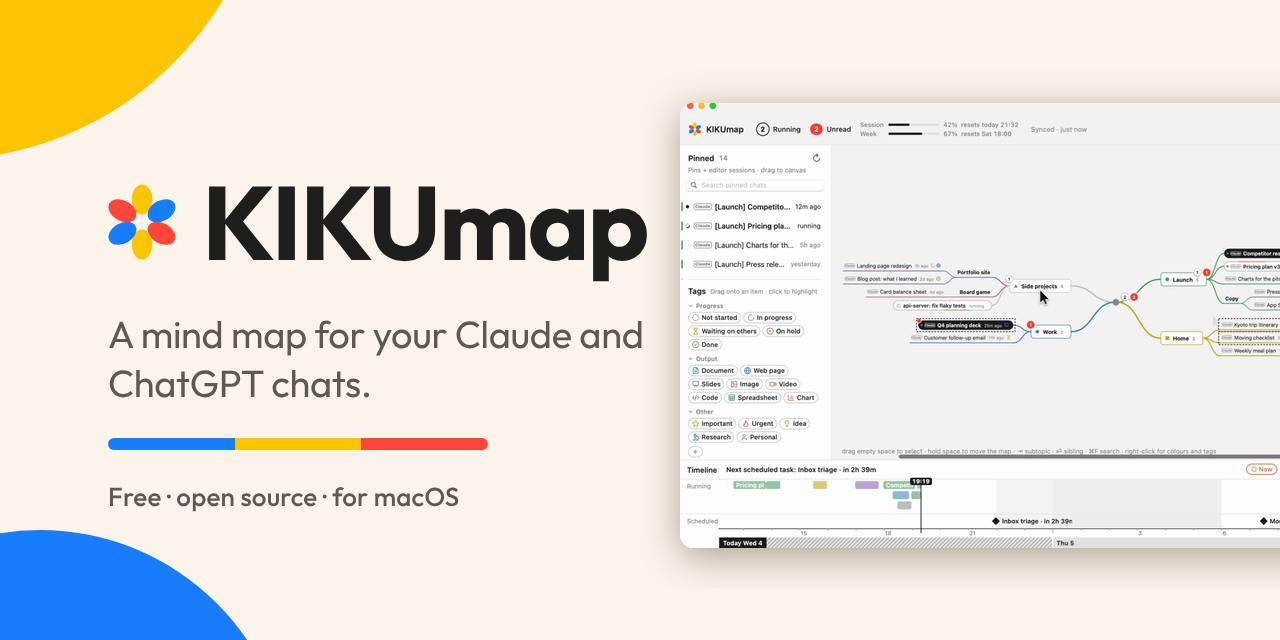
KIKUmap: Manage Your Claude and ChatGPT Conversations with Mind Maps
KIKUmap is a macOS menu bar app that visualizes Claude and ChatGPT conversations as mind maps with real-time status. Free and open source.

Hugging Face Executive Warns: Cyberattacks Are Eroding the Openness of Open-Source AI
Hugging Face executive Irene Solaiman warns that rising cyberattacks on open AI platforms may force stricter security limits, threatening the openness of the open-source community and affecting the developer ecosystem.