OpenAI's Math Breakthrough: AI's First Comprehensive Assault on Mathematics

OpenAI's 372 new math results may mark AI's first full-scale disruption of an academic field.
OpenAI published 372 new mathematical results on GitHub, with its model fully solving 90 of the 500 greatest unsolved problems and partially advancing the Riemann Hypothesis and Hodge Conjecture — using just ~3 hours of compute per result. Reactions range from "instant Fields Medal" to measured skepticism, while deeper concerns center on whether math is becoming a collection of machine-verified propositions no human can fully absorb. Notably, cryptography breakthroughs are conspicuously absent, raising questions about what AI may already know but isn't showing.
Will AI Disrupt Entire Industries? Mathematics May Be the First
For a long time, predictions that "AI will disrupt entire industries" have remained largely theoretical. Programming is arguably the field most transformed so far — and yet, paradoxically, demand for programmers has risen. But with OpenAI's latest release of mathematical results, a new question has emerged: Is this the first time AI has dealt a "field-wide" blow to an academic discipline in any practical sense?
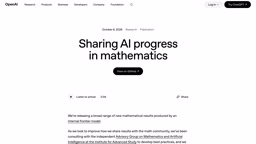
According to analysis from AI Daily Brief, OpenAI this week published a mathematical proof "magnum opus" on GitHub, containing 372 new results and 722 supporting papers. These were generated by an undisclosed internal frontier model — most likely the same one that solved the Navier-Stokes equations last month. The release was coordinated with OpenAI's newly formed mathematics advisory board.
90 Top-Tier Problems Solved — With Just 3 Hours of Compute Each
To appreciate the weight of these results, consider ProofAtlas's curated list of "500 Greatest Unsolved Problems in Mathematics." OpenAI's model fully solved 90 of them, with partial proofs on dozens more that would constitute major contributions to their respective fields. This includes partial answers to two Millennium Prize Problems — the Riemann Hypothesis and the Hodge Conjecture.
The Riemann Hypothesis is arguably the most important open problem in number theory. Each Millennium Prize Problem carries a $1 million prize; only one has ever been solved by a human. Even making substantive progress on any of them would traditionally be enough to secure a Fields Medal — the so-called "Nobel Prize of Mathematics."
What's even more striking is the efficiency. OpenAI revealed that each result consumed, on average, roughly 3 hours' worth of ChatGPT Pro thinking time. Just one month ago, solving the Navier-Stokes equations required approximately 10,000 agents running for 88 hours. The efficiency leap within just a few weeks has led many observers to declare this an "intelligence explosion in real time."

The Riemann Hypothesis, proposed by German mathematician Bernhard Riemann in 1859, posits that all non-trivial zeros of the Riemann zeta function lie on a line in the complex plane with real part 1/2. It is deeply tied to the distribution of prime numbers, and countless theorems in number theory assume its truth. The Hodge Conjecture belongs to algebraic geometry and roughly states that certain topological features (Hodge classes) of complex algebraic manifolds can be expressed as combinations of algebraic cycles — its complexity arises from the deep intersection of algebraic geometry, topology, and complex analysis. The Millennium Prize Problems were announced by the Clay Mathematics Institute in 2000, with seven problems each carrying a $1 million prize. To date, only Grigori Perelman has solved one (the Poincaré Conjecture, in 2003), and he declined the prize. AI achieving a "partial answer" to the two problems above means advancing the formal characterization of the problem structure — but it does not constitute a complete proof.
The Math Community Reacts: From "Nuclear" to "Math Genie"
The response from mathematicians speaks volumes. Rutgers University professor Alex Konturovich wrote: "A quasi-Riemann Hypothesis? You've got to be kidding. If a human had done this, it would be an instant Fields Medal, no question."
A former OpenAI researcher called the quasi-Riemann result mathematics' "Move 37 moment" — a reference to AlphaGo's counterintuitive move against Lee Sedol in 2016. Anthropic researcher Levin, who has studied Navier-Stokes, called it "the most important moment in the history of mathematics."
But cooler heads also weighed in. Mathematician Micah Warren said he didn't see anything particularly surprising: "Labs can solve math problems now. They spent a lot of money and solved a lot of problems." He used a baseball analogy: it's like Barry Bonds hitting his 756th home run — if you'd told him in 1987 it would happen, he'd have been stunned, but by 2007, it was just the inevitable conclusion.
Meanwhile, mathematics graduate students expressed confusion and anxiety. Some asked, "If AI has taken math, what can I pivot to?" — admitting that these results had effectively "nuked" nearly every topic they'd hoped to work on.
On the optimistic side, former University of Washington math professor Sriram Kanan argued: "From 5000 BC to January 2026, if you asked any mathematician whether they'd want a math genie, 100% would say yes." He sees this as a jarring but temporary disruption to the identity of "being a world-class mathematician."
AlphaGo's Move 37 came during Game 2 of DeepMind's 2016 match against world champion Lee Sedol. AlphaGo played its 37th move on the right side of the board — a position almost no professional human player would consider. Commentators initially thought it was a blunder, but it proved to be the foundation of the entire winning strategy. It became a landmark moment in AI history because it demonstrated not just superhuman performance, but strategies entirely outside human intuition — meaning AI's capability boundary had already exceeded what humans could anticipate. Comparing the quasi-Riemann result to "mathematics' Move 37" is meant to emphasize that the model's reasoning path may similarly transcend mathematical intuition, rather than simply computing faster.
The Real Concern: Results Are Being Produced Faster Than Humans Can Absorb Them
A critical challenge looms: how to actually understand what's being published. Last month's Navier-Stokes result is still being verified by mathematicians, and now there are hundreds more results awaiting review.
Mathematician Francesco Maggi identified the core problem with high-volume AI mathematics: "Mathematics doesn't grow by accumulating correct propositions. Results need to be understood, connected, interpreted, challenged, and reused." He asks: what is the mathematical value of releasing hundreds of proofs at once? What happens if there simply aren't enough people willing or able to read them?
Physicist Steve Hsu pushed the question further: "What happens when AI research produces more mathematics in a single day than humans can absorb in a century?" In his view, formal systems may be able to verify proofs, but humans will lack the context to understand the conceptual networks invented by machines. Mathematics and physics could lose their interpretability — AI would no longer be merely a scientific tool, and humans would be receiving "selective explanations" from a vast intellectual civilization they cannot independently comprehend.
Mathematical proof verification has traditionally relied on peer review: other mathematicians check every step of a logical argument line by line, and only after approval is it accepted by the community — a process that often takes months or years. In recent years, formal verification tools (such as Lean, Coq, and Isabelle) have made it possible to use computers to automatically check the formal logical correctness of a proof, theoretically bypassing the bottleneck of human review. However, formal verification can only confirm that "the derivation steps are correct" — it cannot guarantee that the proof has mathematical depth, readability, or value for other problems. This is precisely the dilemma Maggi points to: when AI mass-produces proofs that are formally valid but semantically opaque, even if every step is machine-verified, the mathematical community may be unable to extract transferable conceptual insights — fundamentally changing how mathematical knowledge accumulates.
What's Next — And the Conspicuous Absence of Cryptography
Most of these theoretical mathematics results lack clear real-world applications — Erdős problems are largely intellectual exercises, and a proof of Navier-Stokes doesn't change the fact that engineers use simplified equations to design aircraft. But there are exceptions: a significant improvement in the theoretical efficiency of matrix multiplication (with the exponent dropping from roughly 2.37 to no more than 2.25). Matrix multiplication is the mathematical backbone of AI inference, and Cornell professor Steven Strogatz compared this leap to Bob Beamon's legendary long jump record.

Even more intriguing is what's missing. Bitcoin security researcher Justin Drake noted a conspicuous scarcity of cryptography breakthroughs among the 722 results. University of Texas computer science professor Scott Aaronson revealed on his blog that AI companies have already begun quietly and cautiously probing whether their internal models can break important cryptographic protocols — and if they can, the implications extend far beyond Bitcoin, reaching the cryptographic foundations of the entire digital world.
On the question of which fields will be disrupted next, Google Distinguished Scientist Payman Millanfar proposed a useful framework: the speed of automation is inversely proportional to a field's "entropy." Mathematics and programming are highly structured and ordered, so AI excels; hard sciences are next, constrained by noisy measurements and experimentation; financial markets are harder still — complex adaptive systems shaped by human psychology; clinical diagnosis and law rely more heavily on fragmented signals, ambiguous language, and human judgment; while culture, art, and strategic leadership sit at the top of the disorder spectrum, depending on tacit knowledge and emotional intelligence, and remain safe for the foreseeable future.
The matrix multiplication complexity exponent is typically denoted ω, with a theoretical lower bound of 2 (meaning it can't be much faster than the square of the input size). From Strassen's algorithm reducing ω from 3 to approximately 2.81 in 1969, to decades of slow progress since, every small reduction in ω has been considered a major breakthrough. AI compressing it further from roughly 2.37 to no more than 2.25 matters because matrix multiplication is a foundational operation in deep learning inference, scientific computing, and cryptography — a lower ω means larger-scale computations become feasible on the same hardware. Bob Beamon's 1968 Mexico City Olympic long jump of 8.90 meters shattered the world record by 55 centimeters, a mark that stood unbroken for 23 years. Strogatz invokes this comparison to emphasize the magnitude of the improvement.
Two Paths Worth Watching
From here, two threads are especially compelling. The first is the trajectory Payman sketches out — in what manner, and in what order, will this disruption reach different fields, and where will it be slowed by human or institutional inertia? NYU's Arpit Gupta argues that a similar shock is coming for economics and the social sciences. Wharton's Ethan Mollick has already observed "nearly autonomous research reaching top-journal quality" in economic sociology.
The second is how mathematicians will actually use all of this. When every mathematician has a "math genie," does that negate years of hard-won expertise — or does it free them to accomplish things they never dared imagine? The answer will become clearer over the months ahead.
Related articles

Gaussian Process Bandit Optimization: Exploration Strategies and Inference Regret Guarantees
Cumulative regret guarantees in Bayesian optimization fail to reflect final recommendation quality. This article examines a new study that provides inference regret guarantees for Gaussian process bandit optimization through exploration query strategies and fill distance analysis, validated on hyperparameter optimization and control tasks.

The Most Detailed Codex Guide on Bilibili: From Installation to Real-World Practice
The most detailed Codex guide on Bilibili: from app store installation to daily work mode configuration, with a real coffee shop project demonstrating file organization, data extraction, dashboard creation, and other practical tasks. Learn to use Plan Mode and desktop pets to leverage Codex efficiently.

Appearance Compensation in Volume Rendering: Why RGB Accuracy Cannot Guarantee Density Correctness
Volume rendering research reveals that volumetric data perfectly reproducing external RGB views may still contain density errors: appearance compensation can double central density and keep external rays unchanged even when L2 error exceeds 14.52%. Density recovery depends on appearance capacity, spatial resolution, and measurement design.