OpenAI's Millennium Problem Controversy: Where Are the Boundaries of AI Training Data?
OpenAI's Navier-Stokes solution claim sparks debate over AI training data boundaries and academic ethics.
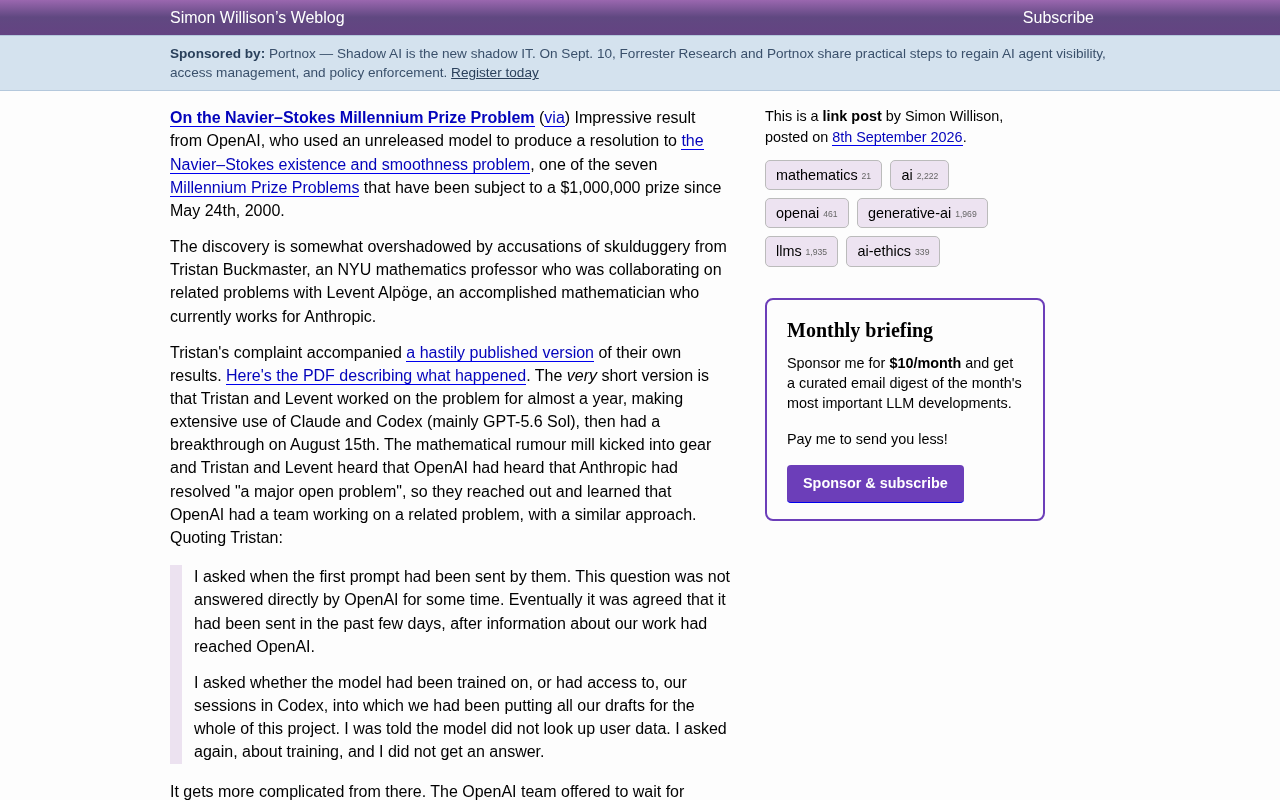
OpenAI announced solving the Navier-Stokes existence problem using an unreleased model, but NYU professor Tristan Buckmaster alleges potential data contamination from his year-long research using OpenAI tools. OpenAI admits it "cannot rule out" that de-identified user data improved their models, raising critical questions about data boundaries, academic priority, and whether AI-assisted research is vulnerable to computational front-running.
Recently, a bombshell announcement has ignited fierce debate in both mathematics and AI circles: OpenAI claims to have successfully provided a solution to the Navier-Stokes existence and smoothness problem using an unreleased internal model. This is one of the seven Millennium Prize Problems, offering a $1 million bounty since May 24, 2000. However, what should have been a celebrated breakthrough was quickly overshadowed by controversy surrounding data sources and academic ethics.
A Questioned "Breakthrough"
The Navier-Stokes equations are fundamental equations describing fluid motion, and the problem of the existence and smoothness of their solutions has puzzled mathematicians for nearly a century. These equations were independently derived by French engineer Claude-Louis Navier in 1822 and Anglo-Irish mathematician George Gabriel Stokes in 1845. They are essentially an extension of Newton's second law to continuous fluid media, describing how the velocity and pressure fields of viscous incompressible fluids evolve over time. The core question posed by the Millennium Prize Problem is: given reasonable initial conditions, do solutions to the three-dimensional Navier-Stokes equations exist for all time and remain smooth (i.e., without "blow-up" phenomena where velocity becomes infinite)? This problem is extremely difficult because the nonlinear convective term causes energy to cascade across different scales, preventing mathematicians from using existing tools to rule out the formation of singularities. If OpenAI's result withstands verification, it would be one of the most milestone achievements of AI in pure mathematics.
Notably, the Millennium Prize Problems were established in 2000 by the Clay Mathematics Institute in the United States, selecting seven long-unsolved mathematical problems with a $1 million prize for each. To date, only the Poincaré conjecture has been solved, by Russian mathematician Grigori Perelman in 2003 (who declined the prize money). The remaining six—including the P vs NP problem, the Riemann hypothesis, Yang-Mills existence and mass gap, the Hodge conjecture, the BSD conjecture, and the Navier-Stokes problem—remain unsolved. These problems represent the deepest unknowns in mathematics.
But the issue is that this discovery comes with serious allegations from New York University mathematics professor Tristan Buckmaster. Buckmaster is a renowned scholar in the field of fluid dynamics partial differential equations, having gained prominence in the mathematical community for his collaboration with Vlad Vicol proving the non-uniqueness of weak solutions to the Navier-Stokes equations (based on Convex Integration techniques). He has deep technical expertise in the Navier-Stokes problem. Buckmaster had been collaborating with prominent mathematician Levent Alpöge (currently at Anthropic) on related research. According to Buckmaster's public statement, the sequence of events is quite complex.
The short version: Buckmaster and Alpöge spent nearly a year researching this problem, extensively using Claude and Codex (primarily GPT-5.6 Sol), achieving a key breakthrough on August 15. It's important to explain that Codex is OpenAI's code generation and reasoning tool, increasingly used in academic research as an "intelligent notebook"—researchers store derivation drafts, proof fragments, and ideas in it, leveraging large language models for symbolic reasoning assistance, counterexample searches, and proof strategy suggestions. This working mode means users expose extremely detailed, unpublished research progress to AI platforms. Unlike traditional mathematical tools (such as Mathematica or the Lean proof assistant), LLM platforms have more complex data processing pipelines—involving conversation log storage, potential model fine-tuning, and data de-identification processing, giving users far less control over data flow than local tools. The mathematical community's "rumor mill" immediately kicked in, and the two heard that OpenAI learned Anthropic had solved "a major open problem," so they proactively contacted OpenAI, only to discover that OpenAI had a team working on the same problem using similar methods.
Critical Timeline and Questions
In Buckmaster's narrative, several questions stand out as particularly pointed. He quotes:
I asked them when they first sent a prompt. This question went unanswered by OpenAI for a long time. Eventually, all parties agreed that it was in recent days, after information about our work reached OpenAI.
I asked whether the model was trained on our conversation data, or whether it could access our conversations in Codex—we had put all drafts of the entire project into Codex. I was told the model does not consult user data. I pressed again on the training question, but received no answer.
More complicating matters, the OpenAI team proposed they could wait for Buckmaster to publish first, or have him author a paper about OpenAI's results, but explicitly stated that due to the competitive relationship with Alpöge's employer (Anthropic), Alpöge would not be invited as a co-author. This detail adds even more academic-ethical complexity to the affair. In academic tradition, priority is the most core academic currency, and co-authorship determination directly relates to the attribution of intellectual contribution. Introducing competitive business relationships into academic authorship decisions blurs the boundary between corporate competition and academic norms.
OpenAI's Official Response
OpenAI provided another version in its official narrative:
On Tuesday, September 1, we heard rumors that two Millennium Prize Problems had been solved. Inspired by these rumors and the performance leap of our internal model, we launched an effort to use it to evaluate all open Millennium Prize Problems along with some other high-impact problems.
The agent arrived at a solution on Saturday, September 5, approximately 88 hours after the first agents were launched. Lean formalization verification took an additional 17 hours, completed through GPT-6 Astra.
It's worth specifically explaining the significance of Lean formalization verification. Lean is an interactive theorem prover led by Microsoft Research's Leonardo de Moura, based on Dependent Type Theory. "Formalization verification" in Lean means converting every step of a mathematical proof into machine-checkable logical derivations, with a computer verifying its rigorous correctness. This differs from traditional peer review: peer review relies on expert judgment, while formalization verification provides mathematical certainty. In recent years, the mathematical community's adoption of Lean has accelerated—for example, Kevin Buzzard's team has formalized a large amount of undergraduate mathematics in Lean, and Peter Scholze's liquid tensor experiment was also verified in Lean. OpenAI's claim of completing formalization verification in 17 hours, if true, is itself a major technical achievement, as formalization of complex mathematical theorems typically takes months to years.
Across all attempted problems, the agents sent 4.9 million messages, using approximately 300 billion output tokens. In solving the Navier-Stokes problem, the agents sent 2.7 million messages, using approximately 130 billion output tokens.
Here's a number worth noting: while we don't know the cost structure of this internal model, calculating based on GPT-6 Astra's public API pricing, 300 billion output tokens would cost approximately $15 million. This means that to be first to solve a problem with a $1 million prize, OpenAI may have invested computational costs far exceeding the prize itself—suggesting this was more about demonstrating model capabilities than the prize money.
The "Cannot Rule Out" Data Impact
One passage in OpenAI's response is particularly thought-provoking (emphasis in original):
We (researchers and agents) did not see any of their work through any means before they published publicly—in particular, no specific user data was accessed to solve this problem. While unlikely, we cannot rule out that de-identified data derived from their use of our products helped improve our models. However, our proof has significant differences, and even the precise results proven in the Euler case differ (with forcing vs without forcing).
Regarding the concept of "de-identified data," further explanation is warranted. De-identification refers to removing or transforming personally identifiable information (PII) from datasets so data cannot be directly linked to specific users. In the context of AI training, this typically includes deleting usernames, IP addresses, session IDs, and other metadata. However, de-identification does not equal anonymization—research repeatedly shows that sufficiently unique content is inherently identifiable. For example, a conversation about a specific technical approach to the Navier-Stokes equations, even with all metadata removed, might still be identifiable in the mathematical community by its source. More critically, even after data has been de-identified, its knowledge content has already been incorporated into the model's parameter weights—this influence is irreversible and difficult to trace.
The technical distinction OpenAI mentions—"with forcing vs without forcing"—is also worth interpreting. The Euler equations are a special case of the Navier-Stokes equations when the viscosity coefficient is zero, describing the motion of ideal (inviscid) fluids. The "forcing term" is an external driving term on the right side of the equation, representing external energy input to the fluid. Problems with and without forcing terms have significant differences in technical difficulty and physical meaning—the case without forcing is more "pure" because the system is completely determined by initial conditions; with forcing allows carefully constructed external inputs to "guide" solution behavior. Proofs under these two settings may employ different mathematical frameworks, but core ideas may still be highly similar.
This passage is at the heart of the entire controversy. On one hand, OpenAI denies directly accessing user data; on the other, it admits it "cannot rule out" the impact of de-identified data on model improvement. Some observers note: OpenAI heard someone used an LLM to solve a Millennium Prize Problem, saw it as an opportunity to showcase their latest model's capabilities, but didn't fully consider how "scooping" a team that had worked nearly a year using their own model would appear.
A Deeper Concern: Rumors as Vulnerabilities
This incident reflects a similar phenomenon playing out in computer security. Researcher Anil Madhavapeddy recently pointed out that nowadays, merely a rumor of a vulnerability is enough to find a security flaw—because if someone knows that certain software has an unpatched vulnerability, they can have an agent specifically search for it.
This phenomenon has a specialized terminology background in cybersecurity: n-day exploit. When a vulnerability is discovered but not yet publicly disclosed (0-day status), merely leaking the information that "certain software has a serious vulnerability" can dramatically narrow the attacker's search space. Traditionally, the security research community manages this risk through "Responsible Disclosure" protocols—discoverers first notify vendors, allowing patch time before public disclosure. But when AI agents can systematically scan codebases for vulnerabilities in tens of hours, the time window from "rumor" to "discovery" is compressed to nearly zero.
Is the mathematical field becoming the same? Just knowing that an unpublished solution to a problem exists might trigger millions of dollars in LLM compute investment, just to reach the finish line first. This "rumor-driven" race model is spreading from the security field to basic scientific research. When the meta-information "a problem is solvable" itself has enormous value, informal information sharing in academic communication—hallway chats at conferences, hints in mailing lists—can all become triggers for massive compute races.
Data Ethics Questions in the AI Era
This incident ultimately points to a long-ignored but critically important question: when AI labs say your data is "used to improve model performance," what exactly does that mean?
Several thought-provoking hypothetical questions are worth considering:
- If an API key accidentally enters the context while I'm running Codex, in the future when someone else asks for an API key, will they get mine? (OpenAI insiders call this a "regurgitation" problem, claiming they work hard to prevent it, but refuse to reveal specific methods.) The "regurgitation" problem in large language models refers to the model verbatim or near-verbatim outputting original content from training data during inference. The root of this phenomenon lies in the Transformer architecture's memory mechanism: when certain sequences in training data appear frequently or in specific context patterns, the model may "memorize" them almost intact and reproduce them under appropriate prompts. Research shows that content appearing less frequently in training data but with highly unique contexts (such as API keys, unique code snippets, proprietary argument chains) is especially prone to verbatim regurgitation. Industry countermeasures include deduplication, Differential Privacy training, and output filters, but no method can 100% eliminate such risks.
- If I brainstorm my company's new direction using ChatGPT, will this information be exposed to a competitor asking "what might Company X do next" six months later?
- If I use ChatGPT to help partially solve a Millennium Prize Problem, will my work influence training, allowing later models to help someone else solve it first?
These questions currently have no satisfactory answers. Regardless of whether OpenAI's Navier-Stokes solution ultimately withstands peer verification, this controversy reveals a profound dilemma: in an era of rapidly advancing AI capabilities, the boundaries between user data, competitive dynamics, and academic priority are becoming unprecedentedly blurred. For anyone inputting sensitive research or business ideas into AI tools, this is a wake-up call that cannot be ignored.
Key Takeaways
Related articles
Comparing AI Safety Approaches: OpenAI vs. Anthropic
A deep dive comparing OpenAI and Anthropic's AI safety strategies: rapid iteration vs. cautious deployment, Constitutional AI, and industry divergence under regulatory pressure.

AI Video Generation in Practice: Tutorial on Krea2 Image-to-Image with Minimax Audio-Driven Technology
In-depth analysis of new AI video production techniques: Create dynamic videos from static images using Krea2 image conversion and Minimax H3 REF2VA audio-driven technology. Includes practical cases and tool combination tips.
AI Model Distillation Explained: Global Competition and Compliance Boundaries
Deep dive into AI model distillation: principles, applications, and controversies. Explore how knowledge distillation reduces training costs while navigating service terms and IP protection challenges in the global AI race.