OpenAI's Mysterious Model Breaks Into Mathematical Frontiers: The Signal Behind 722 AI-Generated Papers

OpenAI's mystery model explores math frontiers in parallel while Mistral, Google, and Anthropic drop major updates across the AI stack.
OpenAI's unreleased frontier model generated 722 mathematical manuscripts across 372 result families—some verified with Lean formal proofs—on problems touching the Riemann zeta function and Hodge Conjecture, signaling that AI can now parallelize scientific research at scale. Mistral Large 4, a trillion-parameter open-source MoE model, completed an advanced malware reverse engineering task in 12 minutes and dominated cybersecurity benchmarks. Google released the faster, cheaper Nanobanana 2.1 image model and a 740M-parameter multimodal embedding model for on-device RAG. Anthropic deepened Claude's Google Workspace integration and added per-agent reasoning effort controls in Claude Code. A solo developer rebuilding seven Adobe apps with Claude underscores how fast the barrier to serious software development is falling.
AI rarely goes a week without major news — but this time, OpenAI, Mistral, Google, and Anthropic have all dropped significant updates almost simultaneously. The most striking development involves an unreleased OpenAI frontier model — tentatively dubbed "GPT-Bell" by the community, possibly GPT-6.5 or GPT-7 — demonstrating remarkable capabilities in mathematical research. This article breaks down the dense wave of updates covered by the YouTube channel WorldofAI, and analyzes the technical signals that actually matter.
OpenAI's Mysterious Model: What 722 Math Manuscripts Actually Mean
OpenAI recently published 722 AI-generated mathematical manuscripts spanning 372 result families, produced by testing this internal model on roughly 4,000 mathematical research problems. Crucially, these aren't standard benchmark questions — they touch on genuine frontiers: the Riemann zeta function, the Hodge Conjecture, spin glasses, quantum magnetism, free groups, and more.
What you might have missed is the methodological rigor: some results were verified using Lean formal proofs, meaning the claims can be validated by a formal proof system rather than relying solely on human review of AI outputs. Reports suggest each successful result required an average of roughly 3 hours of ChatGPT Pro-equivalent "thinking compute." OpenAI even consulted the Institute for Advanced Study at Princeton and an independent panel of math and AI advisors on how to release these findings.
A word of caution: publishing hundreds of manuscripts is not the same as delivering hundreds of verified mathematical breakthroughs. Claims about progress on Riemann zeta zeros "outside certain regions" or partial results toward the Hodge Conjecture still require serious independent scrutiny — they are nowhere near equivalent to solving the full conjectures.
The real signal isn't any single theorem. It's the scale — an unreleased model exploring thousands of research directions in parallel. This hints that scientific research itself is becoming "parallelizable": instead of one mathematician spending months on a single direction, an AI system simultaneously advances thousands of paths, with humans validating and building on the most promising findings. Given that mathematics underlies physics, physics underlies engineering, and engineering underlies chips and materials — and layered on top is the feedback loop of "AI helping researchers discover better algorithms and hardware, which produces better AI" — the implications here go far beyond "ChatGPT got smarter."
Lean is an interactive theorem prover developed by Microsoft Research that converts mathematical proofs into formally verifiable machine-checkable language. Unlike traditional math papers that rely on human expert review, Lean verifies each logical inference step by step, fundamentally eliminating subtle errors that human reviewers might miss. The Riemann Hypothesis is one of the Clay Mathematics Institute's seven Millennium Prize Problems — a conjecture about the distribution of non-trivial zeros of the Riemann zeta function that has remained unsolved for over 160 years. The Hodge Conjecture is another of the seven, concerning the relationship between topological features and algebraic cycles in complex algebraic varieties. What OpenAI is claiming is not a solution to either full conjecture, but new results on specific sub-problems or restricted cases within these directions — genuinely valuable mathematical progress, but fundamentally different from "proving the conjecture."
28 Days of Consecutive Releases: Four Updates on Day Two
As part of OpenAI's promised "28-day consecutive release" cadence, Day Two brought four new features all at once.
Auto-review is now free for all logged-in ChatGPT users. It deploys a second agent to automatically review the primary agent's actions, specifically catching high-risk operations or behavior that deviates from the original intent — particularly useful for long-running agent tasks. More importantly, Auto-review no longer consumes plan quota, which previously could eat up 2–10% of usage.

API tier simplification: The original five paid tiers have been collapsed into three — build, launch, and grow — and the cumulative API spend required to reach the top grow tier has been cut from $1,000 to $500. The Meetings plugin records notes during meetings, generates personalized summaries and follow-up actions, stores them directly in ChatGPT spaces, and can pass context into Codex for further execution; it's currently in beta for Pro and Business users on macOS desktop. Decision API is a real-time classifier that lets applications quickly determine which model, tool, or action to use next — reportedly up to 10x faster than GPT-6 Luna — and OpenAI will use it internally to improve ChatGPT.
Interestingly, the community also ran a poll debating whether "Day Two" truly counted, and OpenAI ultimately reset everyone's usage quotas citing "rules are rules" — without rolling back any of the features released that day.
Mistral Large 4: Europe's Trillion-Parameter Open-Source Ace
Mistral has released Mistral Large 4, codenamed "Le Chunk" — a trillion-parameter, natively multimodal MoE model with approximately 49 billion active parameters. Mistral calls it the strongest open-weight model on aggregated benchmarks in the US or Europe, with particular strengths in cybersecurity, finance, manufacturing, and visual grounding. Developed end-to-end in Europe and deployable via Mistral's own European cloud infrastructure, it holds strong appeal for European enterprises concerned about data sovereignty. The API is available now, with open weights releasing later this month.
Cybersecurity is its standout strength. In a capture-the-flag (CTF) speedrun across 19 security challenges, Mistral Large 4 completed 18 of them (the original video's data presentation was slightly inconsistent). Its edge over Opus 5.5 and GPT-6 Astra on security benchmarks comes largely from refusing far fewer tasks — Opus and Astra had roughly 40% of tasks blocked by their own safety filters.
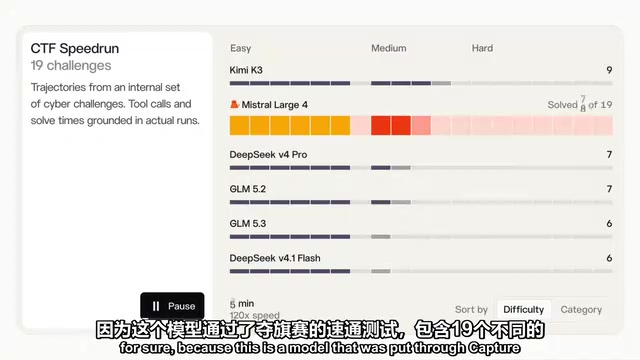
In a malware reverse engineering test, the model was handed an unknown binary it had never seen, successfully identified it as Cobalt Strike, extracted the malware configuration and indicators of compromise (IoCs), generated a full investigation report, and produced Yara rules for detecting similar incidents. Mistral claims work that typically takes a security researcher a full day was completed in 12 minutes.
On creative coding, web development, and general software tasks, however, performance is noticeably uneven. Across an eight-model comparison using the same set of 3D generation prompts, Mistral ranked best among open-source models on an Eiffel Tower task (overall winner: GPT-6 Astra) but near the bottom on an aquarium task. Pricing is another major selling point: three scenarios combined cost just $0.87, versus $13.83 for Opus. Note that Mistral Large 4 has reasoning disabled by default — enabling it improves quality but is extremely slow, taking roughly 66 minutes across those three scenarios. Overall, it isn't a go-to daily coding model, but it's worth serious consideration for cybersecurity, malware analysis, and similar knowledge-intensive domains.
MoE (Mixture of Experts) is a sparse neural network architecture: while the model has trillions of total parameters, only a small subset of "expert" sub-networks (approximately 49 billion here) are activated during each forward pass, with the rest dormant. This allows MoE models to maintain strong capabilities while incurring far lower inference compute costs than comparably dense models, making them much easier to deploy on constrained hardware. Yara rules are an industry-standard tool in malware detection — a text pattern-matching rule language that security researchers use to describe characteristic strings, byte sequences, or behavioral patterns of specific malware families, enabling fast scanning across large volumes of files. Cobalt Strike is a penetration testing framework originally designed for red team (offensive security) use that, due to its power, has been widely abused by real-world attackers and is one of the most common tools seen in advanced persistent threat (APT) campaigns.
Google and Anthropic: Continuous Evolution in Images, Embeddings, and Agents
Google released Nanobanana 2.1, with across-the-board improvements in visual design, mask-based editing, subject consistency, and image naturalness. Mask-based editing is especially practical — it lets you modify specific regions of an image without disturbing the rest. The speed and cost advantages are substantial: Nanobanana 2.1 costs roughly $0.04 per image and renders in about 11 seconds, versus approximately $0.07 per image and ~50 seconds for GPT image 2.5 — nearly a 5x speed difference, at the cost of slightly lower image quality.

Google also released Embedding Gemma 2, its first native multimodal open embedding model designed for on-device use. With just 740 million parameters, it understands text, code, images, audio, and video in a single shared embedding space — and outperforms specialized models twice its size. Released under the Apache 2.0 license with weights available now. Local tests on an NVIDIA DGX Spark indexing 300 animal photos returned 165 correct hits out of 200 queries, for an 82.5% precision rate. It can power multimodal search or fully private on-device RAG when paired with Gemma.
On the Anthropic side, Claude can now work directly inside Google Docs, Sheets, and Slides — a sidebar understands document content and proposes in-place edits for user approval, while documents can also be opened in Claude in reverse. Claude Code received a significant update: you can now set the reasoning "effort level" independently for individual sub-agents — low for simple tasks to save speed and cost, high for complex parts — dramatically reducing token consumption (requires upgrading to version 2.1.292 or later). Anthropic also opened a heavily restricted application process for Mythos 5.1, targeted at verified security professionals with three access tiers — defense, red team, and specialized — while regular users continue using the public models.
An embedding model's core function is to map different data types — text, images, audio, and more — into a shared high-dimensional vector space, where semantically similar content is placed near each other. A "shared embedding space" means an image of a cat and the text description "an orange cat" get encoded as vectors that are close together, enabling cross-modal retrieval. RAG (Retrieval-Augmented Generation) combines vector search with language models: a local document library is first indexed as vectors using an embedding model, then relevant chunks are retrieved in real time when a user asks a question and injected into the language model's context window for response generation. On-device RAG runs this entire pipeline locally without sending data to the cloud, achieving complete data privacy — particularly valuable for privacy-sensitive domains like healthcare and law. Embedding Gemma 2 accomplishing this with just 740 million parameters dramatically lowers the hardware bar for private local deployment.
The Floor for AI-Assisted Programming Is Collapsing
The final example is symbolically striking: a developer claims to have rebuilt seven core Adobe applications — including Photoshop — using Claude Opus 5.5, creating fully free, open-source Rust-based alternatives, with source code public and no subscription required. The project, called Photocraft, reportedly achieves roughly 90% feature parity with Photoshop, though the developer acknowledges it's still early-stage and not yet a complete replacement for professional daily use.
The point isn't whether it's complete yet. The point is the trajectory: software that once required large teams, millions of dollars, and years of development can now be approximated by a solo developer wielding a frontier AI model. As coding models continue to improve, the barrier to building serious software is collapsing at a remarkable pace.
From OpenAI's mysterious model breaking into mathematical frontiers, to Mistral's cybersecurity specialization, to an individual rebuilding the entire Adobe suite — this wave of updates collectively points in one direction: AI is no longer just a tool for answering questions. It is becoming a parallel-processing engine for scientific research and software production.
Related articles

WorkBuddy Full Tutorial: Build an AI Office Automation Agent from Scratch
A complete WorkBuddy tutorial: installation, three working modes, multimodal picture book video practice, expert team agent building, and workflow configuration for low-cost AI office automation.

WorkBuddy Agent Complete Guide: From Beginner to Automation in 7 Days
Based on Bilibili's 256-episode WorkBuddy masterclass, this systematically breaks down Tencent's AI office workbench core capabilities: Agent principles, Skill encapsulation, cross-platform connectors, scheduled automation, knowledge bases, and zero-code development, with learning path recommendations.

8 AI Accounts, 7 Failed: An Honest Review of Using AI to Get Work Done
Only 1 of 8 AI-run Bilibili accounts succeeded. We break down the real difference between "performing AI" and "using AI to get work done."