OpenAI's Mysterious Model "Doug" Exposed: Capable of Making Fable Look Primitive?

Leaked OpenAI model "Doug" allegedly represents its biggest pre-train ever, making "Fable" look primitive.
A social media leak claims OpenAI is developing a model codenamed "Doug" — allegedly its biggest pre-training effort to date — that will make the "Fable" model look primitive. The leak also references codenames Astra (delayed for cybersecurity concerns) and Mythos (a competitive wake-up call), with a potential November release constrained by training time, White House coordination, and extensive security testing.
A Leak from Social Media
Recently, a post originating from Reddit and citing X (formerly Twitter) user ChrisGPT has sparked heated discussion in the AI community. According to the leak, OpenAI is internally developing a brand-new large model codenamed "Doug," whose capabilities will allegedly make the previously formidable "Fable" model look "primitive."
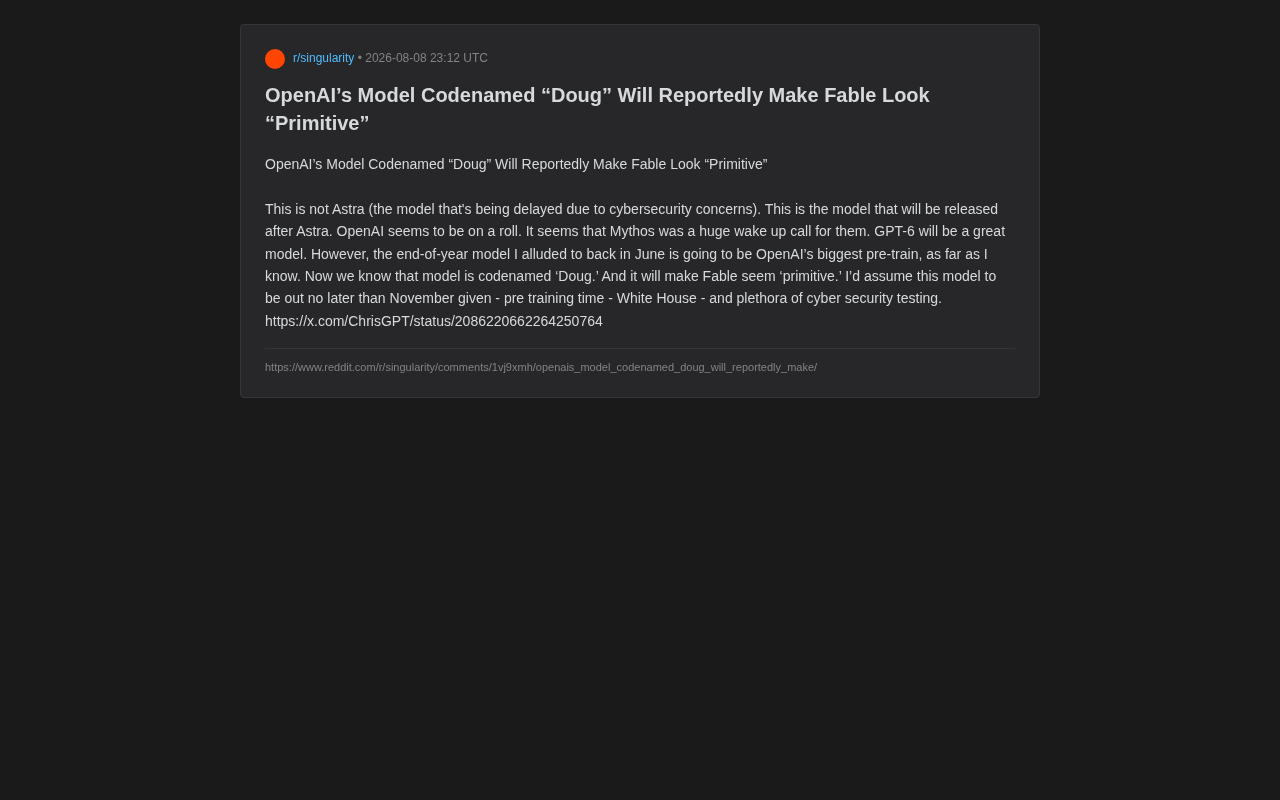
It must be made clear that this information remains an unverified community rumor, and OpenAI has not officially responded in any way. This article will organize and analyze the leaked content while reminding readers to approach such unconfirmed information with a rational mindset.
"Doug," "Astra," and "Fable": Behind the Naming Mystery
A Series of Mysterious Codenames
According to the leak, OpenAI appears to be intensively advancing multiple model projects recently, with several codenames emerging:
- Astra: Reportedly delayed due to cybersecurity concerns.
- Doug: A model to be released after Astra, allegedly OpenAI's "biggest pre-train" to date.
- Fable: Used as a reference point for comparison — the leak claims Doug will make Fable look "primitive."
- Mythos: Described as a "huge wake up call" for OpenAI, hinting at possible competitive pressure.
A notable detail: most of these codenames have never appeared through OpenAI's official channels. It's standard industry practice for labs to use internal codenames for models under development, but the authenticity of codenames circulating externally is often difficult to verify.
OpenAI's current model release system exhibits multi-layered parallel characteristics. The consumer- and developer-facing GPT series (such as GPT-4, GPT-4o) is its core product line, emphasizing general capabilities and usability; the o-series (such as o1, o3) focuses on reasoning ability, employing techniques like chain-of-thought; and there are also scenario-specific models like Codex. At the internal R&D level, labs typically use codenames to distinguish different research projects, which may represent different technical paths — such as larger-scale pre-training, new architectural explorations, multimodal fusion, etc. The coexistence of multiple codenames in the leak is highly consistent with this multi-project parallel development model.
GPT-6's Positioning
The leak also mentions that GPT-6 "will be a great model," but the year-end model (i.e., Doug) is the main event. This reveals an intriguing signal: if the rumors are true, OpenAI may be pursuing two parallel tracks — a productized GPT series and exploratory large-scale pre-training models.
This "dual-track" strategy makes commercial sense: incremental GPT series upgrades serve business rhythm and customer expectations, ensuring the continued competitiveness of ChatGPT and API products; while codename projects like Doug pursue capability leaps at the technological frontier, stockpiling ammunition for future generational product updates. The two tracks follow different development cycles and release standards — the former prioritizes balancing stability and safety, while the latter focuses more on exploring capability ceilings.
Timeline Speculation: Why Doug Might Launch in November
The leaker provided a relatively specific timeline expectation — believing Doug will be released "no later than November" — and listed three supporting reasons:
- Pre-training time: Large-scale pre-training requires lengthy compute cycles, which is a hard constraint.
- White House factor: Suggesting that model release may involve government-level communication or policy coordination.
- A plethora of cyber security testing: Echoing the reason for Astra's delay, indicating that safety assessments have become a necessary step before releasing frontier models.
What Pre-training Scale Implies
Pre-training is the most core and resource-intensive phase of large language model development. During this phase, the model undergoes unsupervised learning on massive text data, mastering statistical patterns of language, world knowledge, and reasoning patterns. The "biggest pre-train" typically means more training data (potentially reaching tens of trillions of tokens), larger model parameter counts (potentially exceeding a trillion parameters), and longer training durations (typically requiring thousands to tens of thousands of GPUs running for months).
This inevitably brings up Scaling Laws. This theory, proposed by OpenAI in 2020, states that model performance has a predictable power-law relationship with parameter count, data volume, and compute — as long as you keep increasing all three, model capabilities will continue to improve. However, since 2024, the industry has begun discussing whether this law is hitting its ceiling, with some researchers arguing that the marginal returns from simply scaling up are diminishing, requiring breakthroughs in architectural innovation, data quality, and training methods. If Doug truly represents the "biggest pre-train ever" and its capabilities overwhelm Fable, it would be strong evidence that Scaling Laws remain effective.
The Policy Context of the White House Factor
The "White House factor" mentioned in the leak is not unfounded. In October 2023, the Biden administration signed an Executive Order on Safe, Secure, and Trustworthy AI, which stipulates that developers of any foundation model trained using more than 10^26 FLOP of compute must notify the federal government before training begins and submit safety assessment reports upon completion. This threshold roughly corresponds to the training scale of current frontier models. Additionally, OpenAI and other companies signed voluntary safety commitments with the White House in July 2023, including conducting internal and external safety testing before release and sharing safety research findings with government and academia. If Doug truly represents the "biggest pre-train ever," its training compute would almost certainly exceed the reporting threshold, meaning coordination with the government would become a rigid constraint on the release timeline.
Industry Practices in Cybersecurity Testing
Conducting cybersecurity testing before releasing frontier AI models has become standard industry practice. These tests primarily assess whether a model could be maliciously exploited to generate cyberattack code, discover zero-day vulnerabilities, write malware, or assist social engineering attacks. Red Teaming is the core methodology, where security experts simulate adversarial use scenarios to systematically probe the model's dangerous capability boundaries. Since 2023, leading labs including OpenAI, Anthropic, and Google DeepMind have all established dedicated safety assessment teams and partnered with external organizations for independent audits. The claim that Astra was delayed due to safety concerns is highly consistent with this trend — the more powerful a model, the higher its potential security risks, and the longer the required assessment period.
These three points precisely reflect the real ecosystem of frontier AI releases today: Beyond the capability race, safety reviews and regulatory coordination are becoming key variables that determine release cadence.
A Rational Perspective: The Distance Between Rumors and Reality
Credibility Issues with a Single Source
It must be emphasized that the core source of this information is merely a single social media post — a single unverified source. In the AI field, such "internal codename + capability dominance" style leaks are commonplace, among which there is no shortage of marketing hype, engagement-baiting, or even pure fabrication. Without official confirmation or multi-source cross-verification, any specific capability claims about "Doug" should be treated with caution.
Industry Signals Worth Noting
Despite questionable details, this leak still reflects several genuine industry trends:
- Pre-training scale continues to expand: Even as the industry discusses "Scaling Law slowdowns," leading labs are still betting on larger-scale pre-training. The logic behind this: even if marginal returns diminish, absolute capability gains remain substantial, and the compute investment threshold itself constitutes a competitive moat.
- Safety is becoming a release bottleneck: The claim that Astra was delayed due to safety concerns aligns with the increasingly stringent red-teaming trends for frontier model releases in recent years. The stronger a model's capabilities, the more complex risk assessments become in areas like cybersecurity and biosecurity, and the longer assessment periods stretch.
- Competitive pressure drives acceleration: The notion that "Mythos is a wake-up call" suggests that competitor advances are forcing OpenAI to pick up the pace.
Regarding the competitive landscape, the 2024-2025 AI field has reached a white-hot intensity. Google DeepMind's Gemini series continues iterating, Anthropic's Claude models frequently earn praise for reasoning and safety, Meta's Llama series has built an ecosystem advantage through open-source strategy, and emerging forces like xAI's Grok and Mistral are also rising rapidly. More notably, China's DeepSeekAd trained a model in early 2025 that rivals top-tier models at extremely low cost, posing a paradigm-level challenge to Western labs' "brute force" approach. In such an environment, any major breakthrough by competitors could force OpenAI to accelerate its R&D and release cadence, which also explains the urgent "wake-up call" language in the leak.
Conclusion
Whether "Doug" can truly make "Fable" look primitive remains unverifiable at this point. The greater value of this leak may lie in the profile it sketches of frontier AI development: compute, safety, regulation, and competition — four forces are collectively shaping the release cadence of next-generation models.
For general readers, the correct approach to such information is — stay curious, but don't believe blindly. What's truly worth waiting for is OpenAI's official release and reproducible capability evaluations, not mysterious codenames circulating on social media.
Related articles

Amphibious Transforming Drone: Beyond 100x Power Savings, What Are the Real Needs?
Is the amphibious transforming drone just a gimmick? Starting from the 100x power difference of the M4 Morphobot, explore real application scenarios and thesis topic ideas, analyzing boundary conditions where pure drones and pure ground robots both fail.

Warhound Raises $200 Million: Genetically Engineered "War Dogs" Paired with Anduril Gear
Warhound raises $200M, backed by Ben Lamm and Palmer Luckey, to genetically engineer dogs for military and law enforcement use and equip them with Anduril gear. This article analyzes its technology direction, funding logic, and ethical controversy.

Claude API Comes to Google Cloud: IAM Integration and SDK Access Guide
Anthropic hosts the full Claude API on Google Cloud with IAM-controlled permissions and unified billing. This guide covers the Vertex AI and Anthropic-hosted entry points, IAM role configuration, and SDK access.