OpenAI's New Model Bel Leaked: 10 Trillion Parameters, Potentially the Foundation for AGI
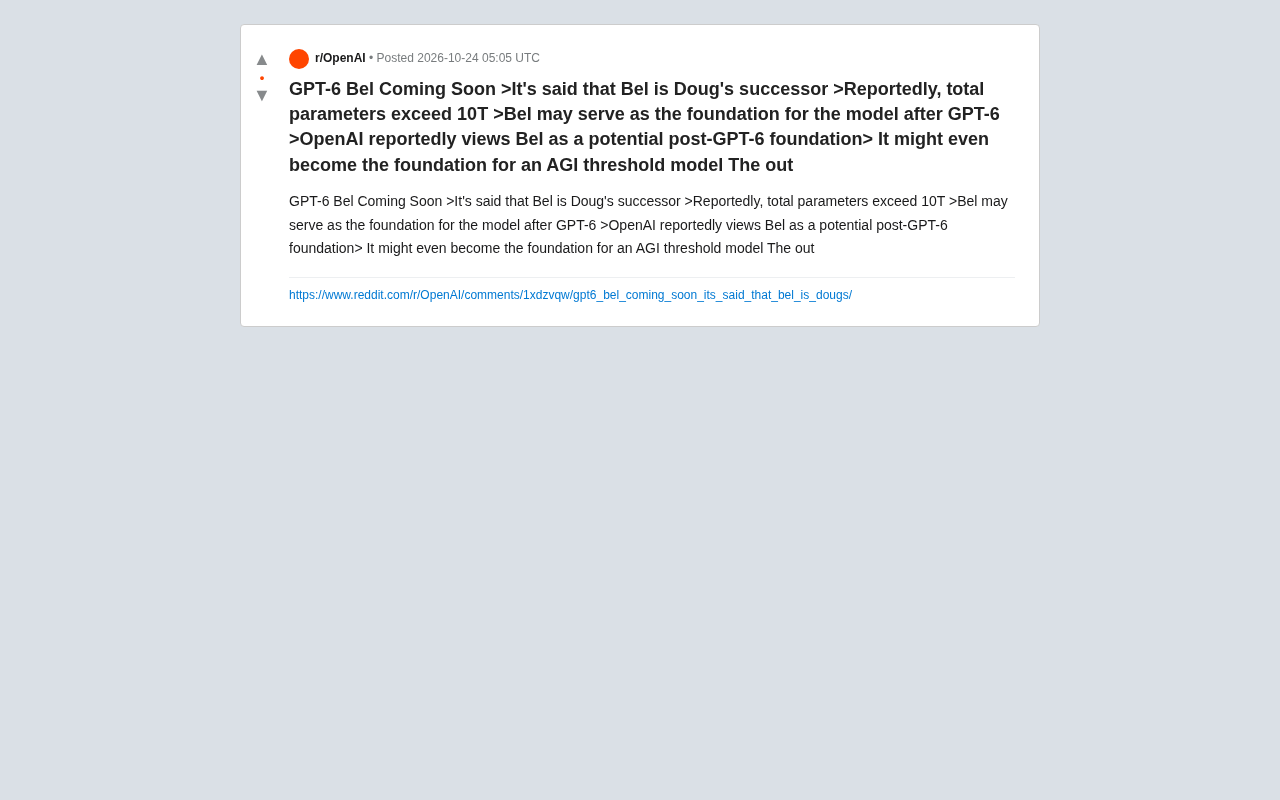
A Reddit leak claims OpenAI's new model Bel has over 10 trillion parameters and may be the post-GPT-6 foundation model and an AGI threshold candidate.
The article analyzes a Reddit leak about OpenAI's new model "Bel." The leak claims Bel has over 10 trillion total parameters, is the successor to the internal project "Doug," and is positioned as the foundation model after GPT-6, even regarded as the base for an AGI threshold model. The author breaks down the key information, noting that "successor" implies technical inheritance, that 10T parameters may correspond to a sparse MoE architecture, and that parameter count does not equal capability; "AGI threshold model" is a vague strategic expression rather than a technical commitment. The article stresses that the leak has only a single source, with vague wording and truncated content, so its credibility is limited, though it is not contradictory to OpenAI's recent technical trajectory. It also discusses potential industry impacts and recommends attention without overinterpretation.
A leak from Reddit lifts the curtain on OpenAI's next-generation model
Recently, a leak post about an internal OpenAI model appeared on Reddit, packed with information yet vague on details. The post claims that a new model codenamed "Bel" is about to be released, with a total parameter count rumored to exceed 10 trillion (10T), and that it may serve as the foundation model after GPT-6, or even be regarded internally by OpenAI as the base for crossing the AGI threshold.
This information currently comes from a single source. The original Reddit post is scattered in content and lacks detail, but several key points it mentions—succession relationship, parameter scale, and strategic positioning—happen to touch the most sensitive nerves in the current large-model race.
Breaking Down the Key Information: What Is Bel?
The Codename "Bel" and "Doug's Successor"
The original post mentions that "Bel is Doug's successor." "Doug" here most likely refers to an internal OpenAI model project or codename. If this claim holds, Bel is not a new project starting from scratch, but an iterative product that inherits an existing technical line. This way of describing internal codename replacement is not uncommon in OpenAI's past model development—from GPT-3 to GPT-4, each generation of foundation model has been backed by multiple parallel experiments and internal codenames.
The wording "successor" suggests that Bel may inherit Doug's technical accumulation rather than completely start over. This is important for understanding Bel's positioning: it is most likely a foundation model, not a product model aimed at end users.
10 Trillion Parameters: A Number That Needs to Be Viewed Calmly
The leak claims that Bel's total parameter count exceeds 10T. For reference, GPT-4's parameter scale is widely speculated to be in the trillions (the exact number has not been made public), and 10T would mean the parameter scale may rise by another order of magnitude.
But the expansion of parameter count does not automatically equal capability improvement. The industry is currently more focused on sparse activation (such as MoE architecture), training data quality, and inference efficiency. 10T total parameters very likely correspond to a mixture-of-experts model, with actual activated parameters far below the total. Measuring model capability simply by "parameter count" is itself an outdated narrative framework. This point needs to be kept clearly in mind when interpreting the leak.
Mixture of Experts (MoE) is a sparse activation architecture whose core idea is to decompose the model into multiple "expert" subnetworks, with only a few experts activated for each input. In this way, the model's total parameter count can be very large (for example, 10T), but the parameters actually involved in computation in each forward pass (activated parameters) are far smaller than the total, thereby expanding model capacity while maintaining inference efficiency. Key designs of MoE include the expert routing mechanism (which determines which experts an input is assigned to) and load-balancing strategies (to prevent uneven expert utilization). Current mainstream large models such as GPT-4 and Mixtral all adopt or are suspected to adopt MoE architecture, so 10T total parameters very likely correspond to an MoE model with activated parameters in the hundreds of billions, rather than a dense model.
"The Foundation Model After GPT-6" and the AGI Threshold
The most imaginative part of the post is this: OpenAI is said to regard Bel as "a potential foundation model after GPT-6," and possibly even the base for an "AGI threshold model."
There are two layers of meaning here. First, Bel's release time may be after GPT-6, or at least it may be a next-generation architecture advanced in parallel. Second, internal OpenAI discussion about the "AGI threshold" is still ongoing, and Bel has been given the role of a candidate for crossing that threshold.
As a side note, "AGI threshold model" is a vague expression. OpenAI has never publicly defined specific technical standards for AGI, and internal criteria for judging AGI are constantly adjusted as model capabilities evolve. Therefore, this statement is more a description of strategic positioning than a commitment to technical specifications.
AGI (Artificial General Intelligence) refers to artificial intelligence systems with broad cognitive abilities comparable to or surpassing humans, capable of completing a wide range of tasks. However, there is no universally accepted technical definition or evaluation standard for AGI, and different institutions interpret its threshold differently. OpenAI internally often treats AGI as a gradual goal, and its judgment may involve vague conditions such as surpassing humans in most economically valuable work and possessing autonomous learning and cross-domain transfer capabilities. Therefore, "AGI threshold model" is more of a strategic narrative used to describe a potential leap in model capability rather than a quantifiable technical specification. This expression both reflects internal ambition and serves public communication and regulatory dialogue.
Credibility Assessment: The Limitations of a Single Source
It must be made clear: all current information about Bel comes from this one Reddit post, with no second independent source to corroborate it. Reddit's AI leak sections have always been places where true and false information mix, and there have been multiple cases in the past where "inside information" was ultimately disproven.
Judging from the characteristics of the information, the post uses vague wording such as "It's said" and "Reportedly," and the original text stops abruptly at "The out," clearly truncated or unfinished content. This reduces the completeness and credibility of the information.
However, this leak can also be compared with OpenAI's recent technical trajectory. OpenAI has been advancing larger-scale foundation model training, and Sam Altman has repeatedly mentioned publicly that the next-generation model will bring a "significant leap." Bel's rumor is at least not contradictory to this general direction.
What Does It Mean for the Industry?
If Bel's rumor is partly true, several trends deserve attention:
The race for foundation models is still accelerating. A model at the 10T parameter level means training costs, compute demands, and engineering complexity will all enter a new order of magnitude. The players capable of participating in competition at this level will further decrease.
The narrative of "post-GPT-6" has already begun. Regardless of the name under which Bel is eventually released, OpenAI is clearly preparing for the technical roadmap after GPT-6. The iteration cycle of foundation models is being compressed from "years" to "quarters."
The struggle for AGI discourse power. Positioning a model as an "AGI threshold model" is both a technical judgment and a narrative strategy. Between regulatory pressure and public expectations, OpenAI needs to find a positioning for the next-generation model that can both support valuation and respond to doubts.
Stay Attentive, but Do Not Overinterpret
Bel's leak is currently only an unverified signal. It may point to a real large-scale foundation model project, or it may simply be fragments of internal discussion that have been amplified. For readers following AI progress, the valuable approach is to track whether more independent sources emerge for cross-verification, rather than drawing conclusions from a single leak.
Competition in the large-model industry has entered deep waters. The real watershed is not the size of the parameter number, but whether model capabilities can deliver in real scenarios. What Bel ultimately is can only be revealed by OpenAI itself.
One-line Summary
A Reddit leak claims OpenAI's new model Bel has over 10 trillion parameters and may be the post-GPT-6 foundation model and an AGI threshold candidate.
Paragraph Summary
The article analyzes a Reddit leak about OpenAI's new model "Bel." The leak claims Bel has a total parameter count exceeding 10 trillion, is the successor to the internal project "Doug," and is positioned as the foundation model after GPT-6, even regarded as the base for an AGI threshold model. The author breaks down the key information point by point: noting that "successor" implies technical inheritance, that 10T parameters may correspond to a sparse MoE architecture, and that parameter count does not equal capability; "AGI threshold model" is a vague strategic expression rather than a technical commitment. The article emphasizes that the leak has only a single source, with vague wording and truncated content, so its credibility is limited, though it is not contradictory to OpenAI's recent technical trajectory. Finally, it discusses potential industry impacts, including the acceleration of the foundation model race, the opening of the post-GPT-6 narrative, and the struggle for AGI discourse power, recommending attention without overinterpretation.
Related articles
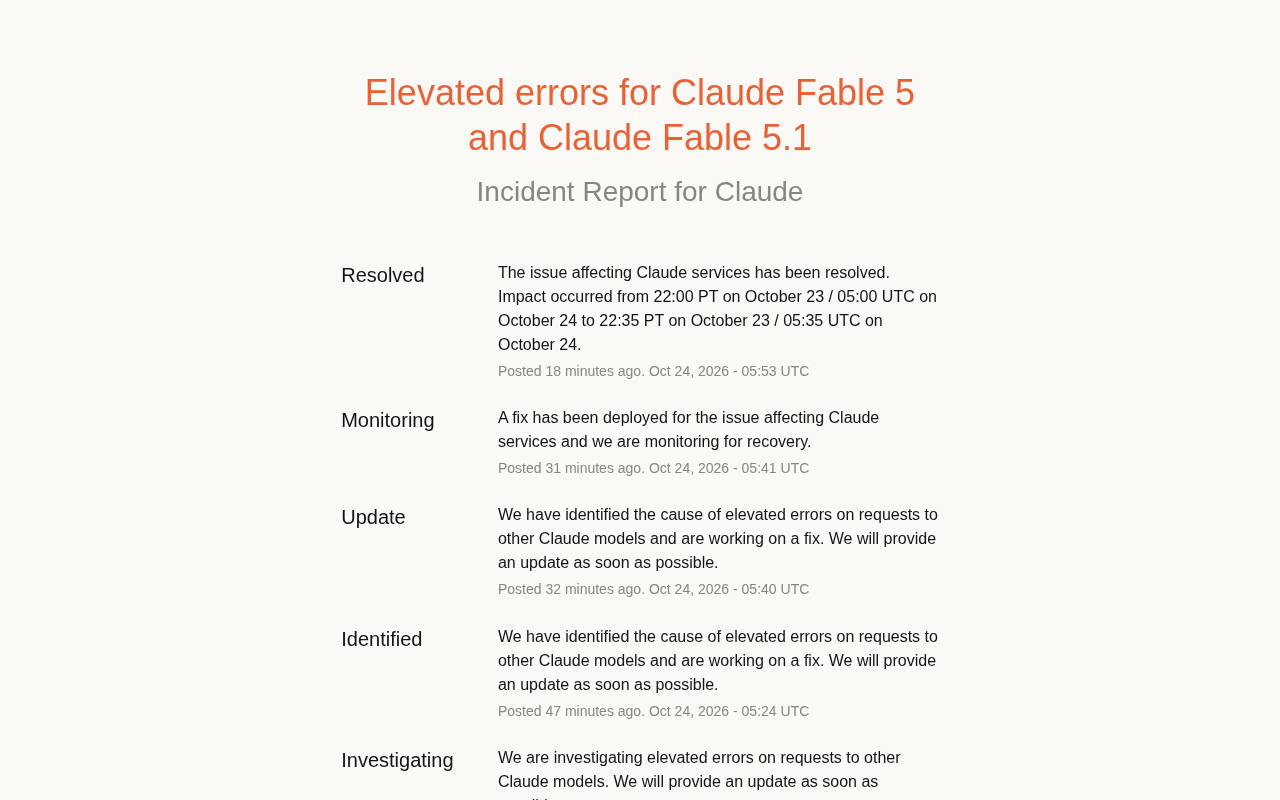
Claude Fable 5/5.1 Outage: A 30-Minute Postmortem
Claude Fable 5 and Fable 5.1 saw elevated error rates for about 35 minutes, per the official status page—from Investigating to Resolved in 37 minutes. This post reconstructs the timeline, analyzes impact on other Claude models, and offers developer guidance on retries, multi-model routing, and monitoring alerts.
Kimi K3.1 Open-Weight Model Hands-On: 3 Trillion Parameters Take On Closed-Source Giants
Kimi K3.1 open-weight model hands-on: 3T-parameter MoE, 1M-token context, stunning 3D rendering but weak spatial reasoning and factual accuracy. Benchmarks near Opus 5.5 at $2.11/task.
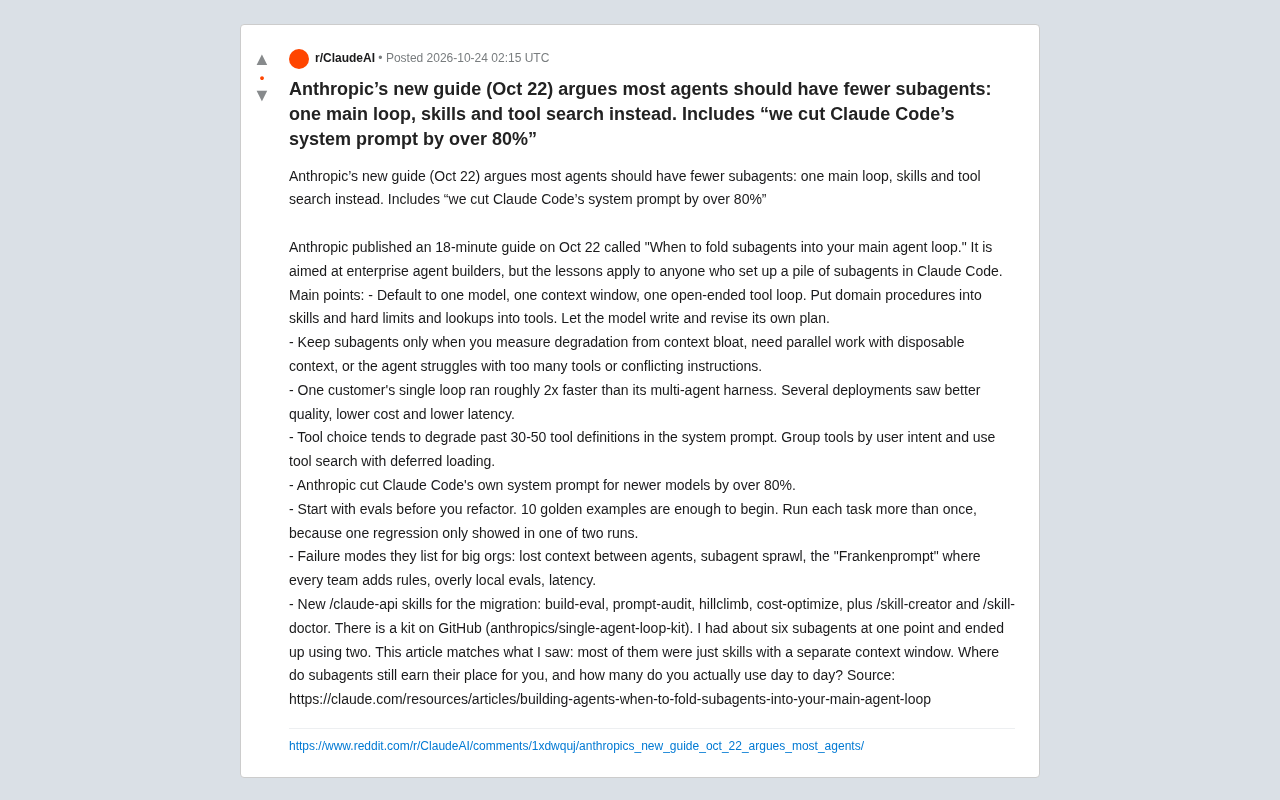
Anthropic's New Guide: Most AI Agents Don't Need Subagents — a Single Main Loop Is the Right Answer
Anthropic's new Agent architecture guide argues most use cases should return to a single-model, single-context open-ended tool loop, splitting only on measurable degradation. Single loops are ~2x faster, tool selection degrades past 30-50 definitions, and Claude Code's system prompt was cut by over 80%.