OpenAI's Private Safety Processing: Achieving Both Zero Data Retention and AI Safety

OpenAI's Private Safety Processing balances zero data retention with autonomous AI safety oversight.
OpenAI has previewed Private Safety Processing, a new mechanism designed to address the tension between AI safety and privacy. By combining zero data retention with a "machines can review, humans cannot see" architecture leveraging privacy-preserving computation techniques, OpenAI aims to enable safety monitoring across agentic AI interactions without exposing user content to employees. This approach could set new industry standards for enterprise AI trust.
OpenAI Reaffirms Privacy Commitments for Frontier Models
OpenAI recently announced on social media that it will continue to offer Zero Data Retention (ZDR) options for its frontier models. This commitment carries significant weight for enterprise customers — it means that sensitive business data will not be stored by OpenAI or used for subsequent training after interacting with models via the API.
Zero Data Retention is a data handling strategy where the service provider retains no input or output data on its servers after fulfilling a user's request. In traditional cloud service models, API call logs, request bodies, and response content are typically retained for a period of time for debugging, auditing, or model improvement. ZDR eliminates this entirely. The importance of this mechanism is closely tied to the tightening of global data protection regulations — the EU's General Data Protection Regulation (GDPR), California's Consumer Privacy Act (CCPA), and China's Personal Information Protection Law (PIPL) all impose strict requirements on data retention periods, usage purposes, and cross-border transfers.
For industries with extremely high compliance requirements — such as finance, healthcare, and legal — Zero Data Retention has long been a critical threshold for adopting large model services. The financial industry is subject to regulatory frameworks like SEC and PCI-DSS, the healthcare industry is protected by HIPAA, and the legal industry must uphold attorney-client privilege. For enterprises in these sectors, whether data is stored and repurposed is the most fundamental consideration when evaluating third-party AI services. By reaffirming this policy, OpenAI is sending a clear signal to the enterprise market: data sovereignty and privacy protection will not be sacrificed in the pursuit of advancing model capabilities.
New Safety Challenges Brought by Autonomous AI
As AI capabilities evolve, models are taking on increasingly longer and more autonomous tasks. In its announcement, OpenAI noted that as AI creates greater value for enterprises, safety systems must also be able to identify risks that span multiple related interactions.
From Single Conversations to Long-Horizon Agentic Tasks
Traditional safety reviews typically focused on individual request-response pairs, making it relatively straightforward to determine whether a piece of content violated policies. But when AI begins executing agentic, long-horizon tasks, risks are often distributed across a series of seemingly innocuous interactions. Each individual step may appear compliant, but when chained together, they can form a dangerous behavioral sequence.
Agentic AI refers to AI systems capable of autonomously planning, decomposing tasks, invoking tools, and maintaining context across multiple steps. Unlike the traditional "ask one question, get one answer" conversational pattern, agentic AI may execute dozens or even hundreds of tool calls within a single task — browsing web pages, reading and writing files, operating databases, sending emails, and more. OpenAI's Operator, Anthropic's Computer Use, and Google's Project Mariner are all representative explorations in this direction. The rise of agentic AI has transformed safety evaluation from "single-point content moderation" into "behavioral chain analysis," similar to the shift in cybersecurity from detecting individual malicious requests to analyzing APT (Advanced Persistent Threat) attack chains. A classic risk scenario: an AI agent separately queries a database, aggregates information, and sends an email — each step is fully compliant on its own, but combined, they could constitute unauthorized data exfiltration.
This gives rise to a fundamental contradiction: to identify complex risks across interactions, safety systems need access to more contextual content; but accessing that content conflicts with privacy protection commitments. Finding the balance between the two has become a technical challenge that OpenAI must solve.
Private Safety Processing Explained
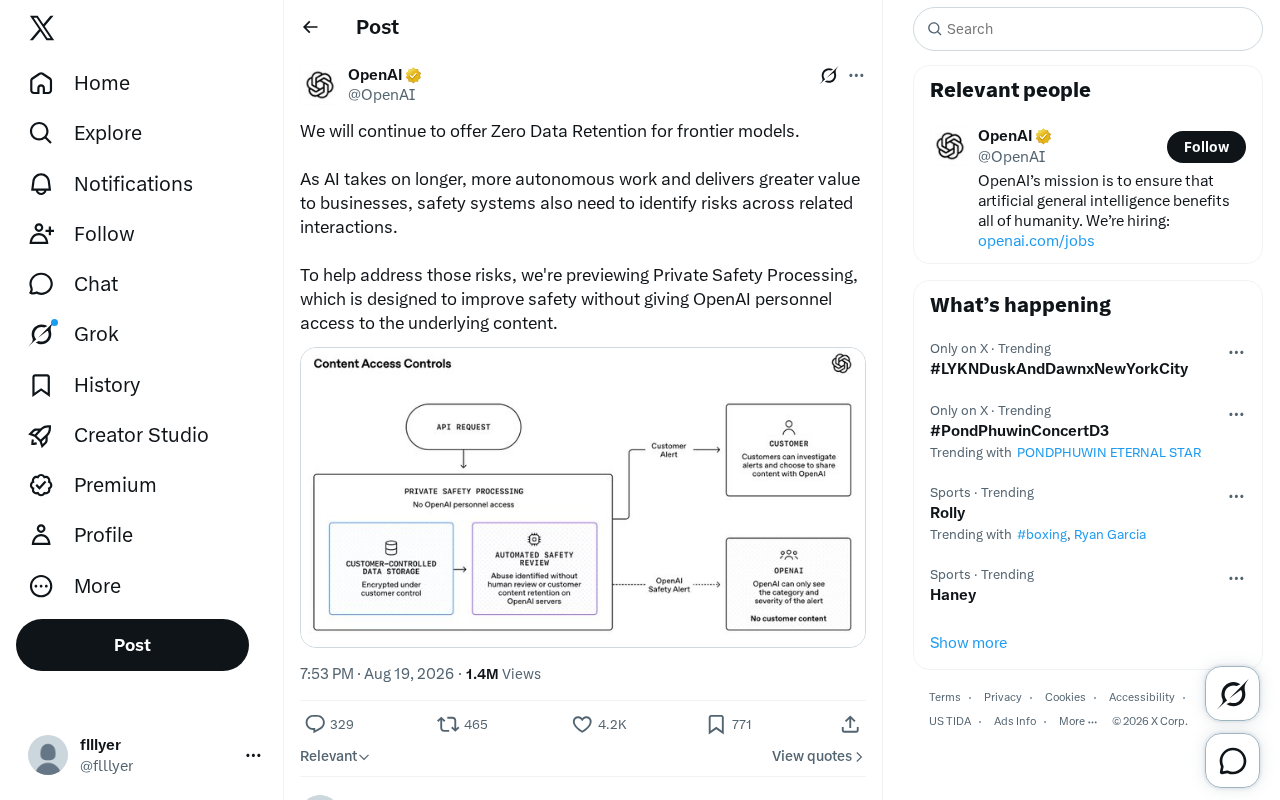
To address this contradiction, OpenAI previewed a new mechanism called Private Safety Processing. Its core design goal is to enhance safety without allowing OpenAI staff to access the underlying content.
Core Technical Approach
Based on the information revealed in the announcement, this system attempts to implement a "machines can review, humans cannot see" architecture. In other words, automated safety systems can perform risk analysis and identification on interaction content, but that content remains inaccessible to any OpenAI employee.
This design philosophy is highly aligned with the industry's ongoing exploration of Privacy-Preserving Computation. Privacy-Preserving Computation encompasses a set of technologies that enable computation without exposing raw data. The main technical approaches include: Confidential Computing, which leverages CPU Trusted Execution Environments (TEEs) such as Intel SGX, AMD SEV, and ARM TrustZone to isolate data processing at the hardware level — even server administrators cannot access data during processing; Homomorphic Encryption, which allows computations to be performed directly on encrypted data; Secure Multi-Party Computation, where multiple parties jointly compute results without revealing their respective inputs; and Differential Privacy, which injects mathematical noise into query results to prevent individual information from being inferred. Apple's Private Cloud Compute has already applied confidential computing to its AI inference services, and OpenAI's Private Safety Processing likely draws on a similar technical approach, particularly the combination of TEE and cryptographic methods.
By decoupling "safety review" from "human access" through these technical means, OpenAI aims to satisfy both regulatory and risk management requirements without violating its privacy commitments to users and enterprises.
Technical Challenges at the Implementation Level
However, implementing a "machines review, humans cannot see" architecture faces multiple layers of technical challenges. First is the remote attestation problem for Trusted Execution Environments — how can users verify that the server is indeed running the claimed code within a TEE, rather than a tampered version? This requires a complete chain of trust, from the hardware manufacturer's root keys to the hash values of runtime code, all of which must be externally verifiable. Second is performance overhead — running large language model inference or safety analysis within a TEE typically introduces significant latency increases and throughput reductions, making the balance between security and service quality a core engineering challenge. Third is key management and access control — even if data is technically inaccessible to humans, robust governance mechanisms must be designed to prevent information leakage through side-channel attacks, memory dumps, or system upgrades. Finally, there is audit transparency — when the safety system flags a risk but humans cannot view the specific content, how to conduct effective false-positive appeals and compliance audits remains without mature precedent at the institutional design level.
Practical Implications for Enterprise Data Security
As AI agents increasingly penetrate core enterprise workflows, the trust issues facing users become ever more acute — they want models that are sufficiently safe and controllable, yet they don't want service providers peering into their trade secrets or personal privacy. Private Safety Processing is a direct response to this dual demand.
If this mechanism matures and is successfully deployed, it could become part of an industry standard, helping more enterprises confidently entrust sensitive operations to AI systems.
Balancing AI Privacy and Safety
The deeper significance of this announcement lies in revealing a core tension in current AI development: the more capable and autonomous AI becomes, the more oversight it requires; but oversight itself can erode privacy.
OpenAI's answer is not a simple trade-off between the two, but rather an attempt to redefine the boundaries of "safety review" through engineering and cryptographic means:
- Zero Data Retention addresses the problem of "data not being stored"
- Private Safety Processing addresses the problem of "humans not touching content during the review process"
Together, they form a relatively complete enterprise AI trust framework.
Notably, OpenAI's initiative is not an isolated action but a microcosm of the entire industry's shift toward the "Privacy by Design" philosophy. Anthropic emphasizes automated alignment mechanisms in its Constitutional AI framework to reduce human intervention; Google promises that customer data will not be used for model training in the enterprise version of Gemini and provides Customer-Managed Encryption Keys (CMEK) capabilities; Microsoft's Azure OpenAI Service offers additional isolation layers through private network deployment and Azure Confidential Computing. On the regulatory side, the EU AI Act has codified data governance requirements for "high-risk AI systems" into law, and U.S. AI executive orders are driving the development of federal-level AI safety standards. This means that mechanisms like Private Safety Processing may not just be a competitive advantage in the future, but a necessary condition for market access.
Of course, as a feature still in the "preview" stage, its specific implementation details, effectiveness, and whether it will introduce new technical trade-offs remain to be seen as OpenAI discloses more information. But one thing is certain: as the era of autonomous AI arrives, drawing a line between safety and privacy that all parties can accept will be a question every major model provider must continuously answer.
Summary
OpenAI's statement conveys information on two levels: on one hand, it upholds its Zero Data Retention privacy commitment to enterprise customers; on the other, it proactively addresses the new safety risks introduced by autonomous AI. The introduction of Private Safety Processing marks a shift in AI safety governance from "post-hoc review" to "privacy-friendly real-time prevention and control." For enterprises and developers focused on AI compliance and data security, this is an important development worth tracking closely.
Related articles

Chain of Thought Isn't Just for AI: How Humans Can Use CoT to Improve Thinking Quality
Chain of Thought isn't just a prompt trick for large models. Starting from a Hacker News discussion, this article analyzes why CoT works for human thinking too, breaks down actionable ways to transfer it, and highlights the key differences between human CoT and machine CoT.
Cloudflare Teams Up with OpenAI: Closi…
Cloudflare Teams Up with OpenAI: Closing the Loop from Vulnerability Discovery to Defense with AI
Cloudflare uses OpenAI Daybreak to investigate security vulnerabilities and generate reviewable remediation plans, while developers use Codex to boost coding efficiency and quality.

Orca Multi-Agent Orchestration in Practice: A Guide to Parallel Collaboration with Claude and Codex
Orca is Stable AI's free open-source agent workbench supporting 34 agents like Claude Code and Codex in parallel. Learn its Git worktree isolation, multi-model orchestration, and mobile management.