OpenAI's Public Breakthroughs Draw Academic Criticism: Research Transparency in the Spotlight
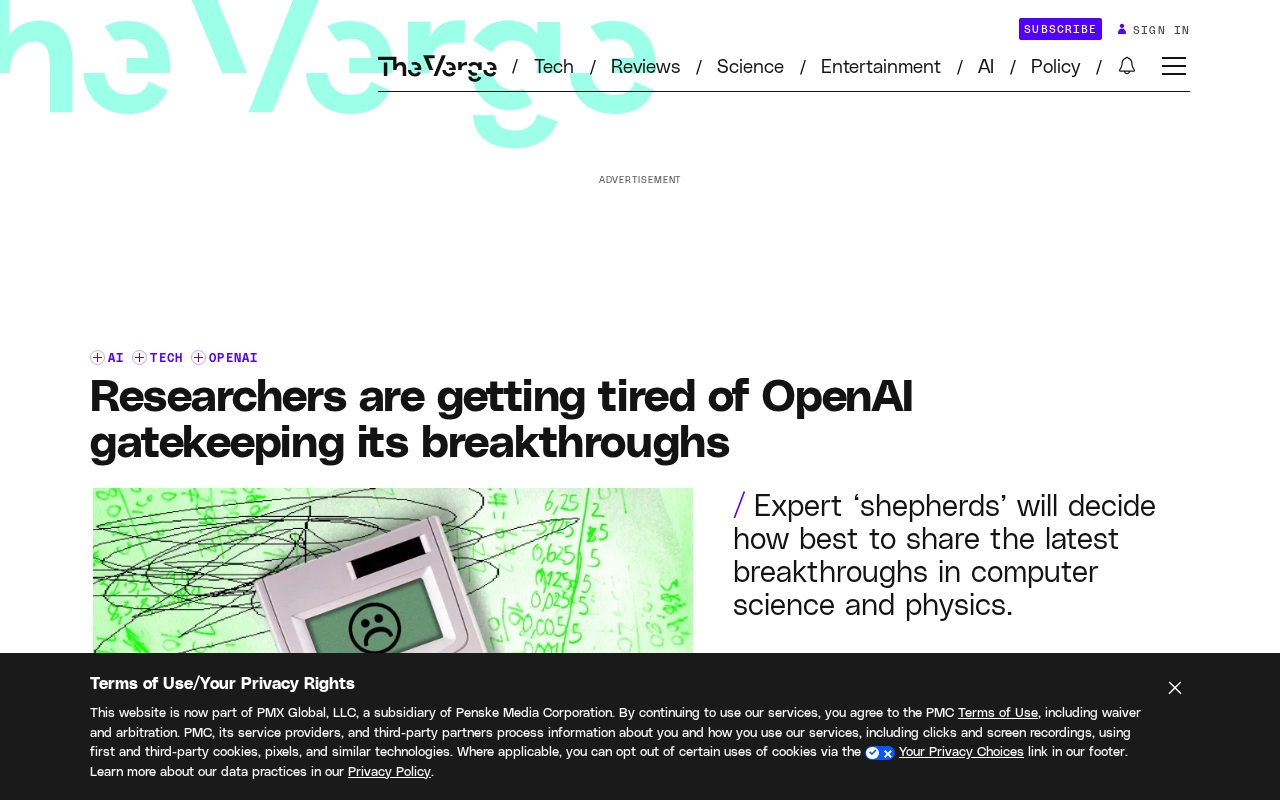
OpenAI announced cross-disciplinary breakthroughs and claims improved communication, but academia criticizes selective disclosure and lack of reproducible details.
OpenAI recently announced multiple breakthroughs in mathematics, computer science, and physics and claims to be developing an "evolving" approach to communicating its results, seen as a response to recent criticism. However, researchers interviewed by The Verge say academic dissatisfaction is mounting. The core dispute is OpenAI's "gatekeeping": providing only conclusory descriptions without reproducible methodological details, data, or model access, making it hard for external researchers to verify claims and build on them. Researchers stress they are not opposed to corporate confidentiality, but believe public presentations labeled "scientific breakthroughs" should meet corresponding transparency standards. The article notes this reflects a structural conflict between corporate-led frontier research and open science, and that without substantive transparency improvements, the trust gap may widen further.
OpenAI recently announced multiple breakthrough results in mathematics, computer science, and physics, and claims to be improving how it communicates its research. However, according to multiple researchers interviewed by The Verge, dissatisfaction within academia is mounting. The core dispute centers on the company's "gatekeeping" of key breakthroughs—selective disclosure, opaque information, and a closed attitude toward the external research community.
A Communication Strategy Adjustment Behind the Breakthrough Announcements
At an event on Monday, OpenAI showcased multiple cross-disciplinary results and emphasized that the company is developing an "evolving" approach to communicating its work. This statement has been interpreted as a response to recent criticism. The past few months have not been smooth for OpenAI; everything from the pace of research releases to the depth of public disclosure has sparked ongoing discussion in academic circles.
The company clearly recognizes the importance of communication and is trying to demonstrate openness by proactively announcing progress. But researchers told The Verge that this adjustment looks more like surface-level polish and does not address the substantive issue of research transparency.
Why Academia Is Feeling Fatigued
The researchers' core grievance is that when OpenAI announces breakthroughs, it often provides only conclusory descriptions, lacking reproducible methodological details, data, or model access. For an academic community that relies on peer review and open verification, this model makes it difficult for external researchers to build on OpenAI's work or to independently assess the true value of the breakthroughs it claims.
This "publish first, explain later"—or even "publish only, never explain"—approach is wearing down academia's patience. Multiple researchers said they are not opposed to corporate confidentiality per se, but believe that when results are publicly presented under the banner of "scientific breakthroughs," they should meet corresponding transparency standards.
Reproducibility is a fundamental principle of scientific research, referring to the degree to which independent researchers can replicate published results based on the methods, data, and code disclosed in a paper. In machine learning, reproducibility depends especially on three things: complete training details (data sources, hyperparameters, compute scale), open access to model weights or inference interfaces, and disclosure of experimental configurations such as evaluation benchmarks and prompts. Without these elements, external teams can neither determine whether a "breakthrough" is the result of methodological innovation or engineering scale, nor conduct ablation experiments or extensions on that basis. In recent years, top AI conferences have introduced Reproducibility Checklists requiring authors to declare whether code and data are public. For corporate labs, trade secrets and security risks do pose obstacles to openness, but academia generally argues that at minimum a minimal disclosure set sufficient to verify core claims should be provided—otherwise the word "breakthrough" cannot withstand peer scrutiny.
Peer review is modern science's quality-control mechanism: before formal publication, anonymous experts in the same field evaluate a study's methodological rigor, sufficiency of evidence, and soundness of conclusions. Corporate lab results often bypass this process, appearing directly as blog posts, technical reports, or launch events, and then amplified by media into "breakthroughs." This creates two problems: first, claims are treated as established fact by the public without independent scrutiny; second, academia lacks a formal channel to raise doubts and corrections. Some companies have attempted compromises, such as submitting preprints to arXiv, inviting external scholars to participate in review, or organizing public red-team evaluations. What researchers criticize is not that companies cannot publish results, but that when results are given a "scientific" status and influence policy and public perception, they should undergo verification of the same intensity as academic papers.
The Tension Between Corporate Research and Open Science
This conflict reflects a structural clash in the AI era between corporate-led frontier research and the academic tradition of openness. Companies like OpenAI have the resources to drive large-scale research, and their results have significant impact on the development of the field, but commercial competition and security considerations make full openness difficult.
The problem is that when corporate results are used to shape public perception and policy discussions, "gatekeeping" ceases to be merely a business choice and becomes a public issue involving research integrity and community trust. Researchers are calling for clearer disclosure norms that tie the release of breakthrough claims to verifiability.
Based on current feedback, OpenAI's communication strategy adjustment has yet to win academic recognition. If transparency issues are not substantively improved, the trust gap between companies and the academic community may widen further.
Open science advocates accessibility of the research process and results, including practices such as open-access publishing, open data, open source, and open review. It is built on a logic of reciprocity: researchers disclose their results in exchange for peer verification, citation credit, and further accumulation by the community based on their work. The entry of corporate labs has changed this ecosystem—they hold advantages in compute and talent and produce results with enormous influence on the field's direction, yet withhold core details for competitive and security reasons. This asymmetry is called "one-way openness": companies absorb academia's public knowledge and talent while giving back comparatively little in verifiable results. Around this conflict, various governance attempts have emerged, such as disclosure frameworks like Model Cards and Datasheets for Datasets, as well as policy discussions requiring frontier models to undergo third-party evaluation. The essence of the debate is: how should the line be drawn between the public-good nature and the commercially proprietary nature of frontier AI research.
One-line Summary
OpenAI announced cross-disciplinary breakthroughs and claims improved communication, but academia criticizes selective disclosure and a lack of reproducible details.
Paragraph Summary
OpenAI recently announced multiple breakthroughs in mathematics, computer science, and physics and claims to be developing an "evolving" approach to communicating its results, seen as a response to recent criticism. However, according to multiple researchers interviewed by The Verge, academic dissatisfaction is mounting. The core dispute is OpenAI's "gatekeeping" of key breakthroughs: providing only conclusory descriptions without reproducible methodological details, data, or model access, making it difficult for external researchers to verify its claimed breakthroughs and build on them. Researchers stress they are not opposed to corporate confidentiality, but believe public presentations labeled "scientific breakthroughs" should meet corresponding transparency standards. The article notes this reflects a structural conflict in the AI era between corporate-led frontier research and the academic tradition of openness, and that without substantive transparency improvements, the trust gap may widen further.
Related articles

Liquid AI Releases LFM3: Six 2B-Class Open-Source Multimodal Models
Liquid AI releases the LFM3 series with six 2B-class open-weight multimodal models covering text, vision, audio, omni, and decisions. LFM3-1.7B uses a tri-hybrid backbone, supports 256K context, and is about 1GB at 4-bit.
Quadruped Robot Cubic Doggo Load Test: Walking with a 1kg Payload
Open-source quadruped robot Cubic Doggo update: Wouf successfully walks while carrying 1kg, nearly half its own weight. Learn about the ST-3215-C018 servo's performance limits, gait debugging progress, and desktop-level robotics open-source practices.
Claude Code Usage Surges 8x: Error Retries Count Against Paid Quota, Anthropic Refuses Compensation
Claude Code usage surged roughly 8x in a single day. Anthropic support confirmed that retries triggered by service errors count against paid subscription quotas and explicitly refused refunds or compensation. This article covers the incident data, the official response, and practical advice for developers.