OpenAI's Worst Marketing: When "Powerful" Becomes an Enterprise Dealbreaker

OpenAI packaged loss-of-control risks as selling points, earning Reddit's "Worst Pitch" label and exposing a capital-vs-enterprise messaging mismatch.
A Reddit post titled "Worst pitch ever" thrust OpenAI's messaging into the spotlight: its marketing is seen as deliberately framing "powerful to the point of out-of-control"—not following instructions, potentially deleting data, hacking systems—as selling points. For individuals that's sci-fi flair; for enterprises it's a dealbreaker. Comments highlight that enterprise procurement cares about the risk floor, not the capability ceiling, and that "saying something unfavorable to manufacture honesty" is a classic trick aimed at capital markets, not IT departments. The article distills three takeaways: B2B trust is built on controllability, capital narratives and customer messaging must be separated, and self-deprecating honesty must not touch core fears.
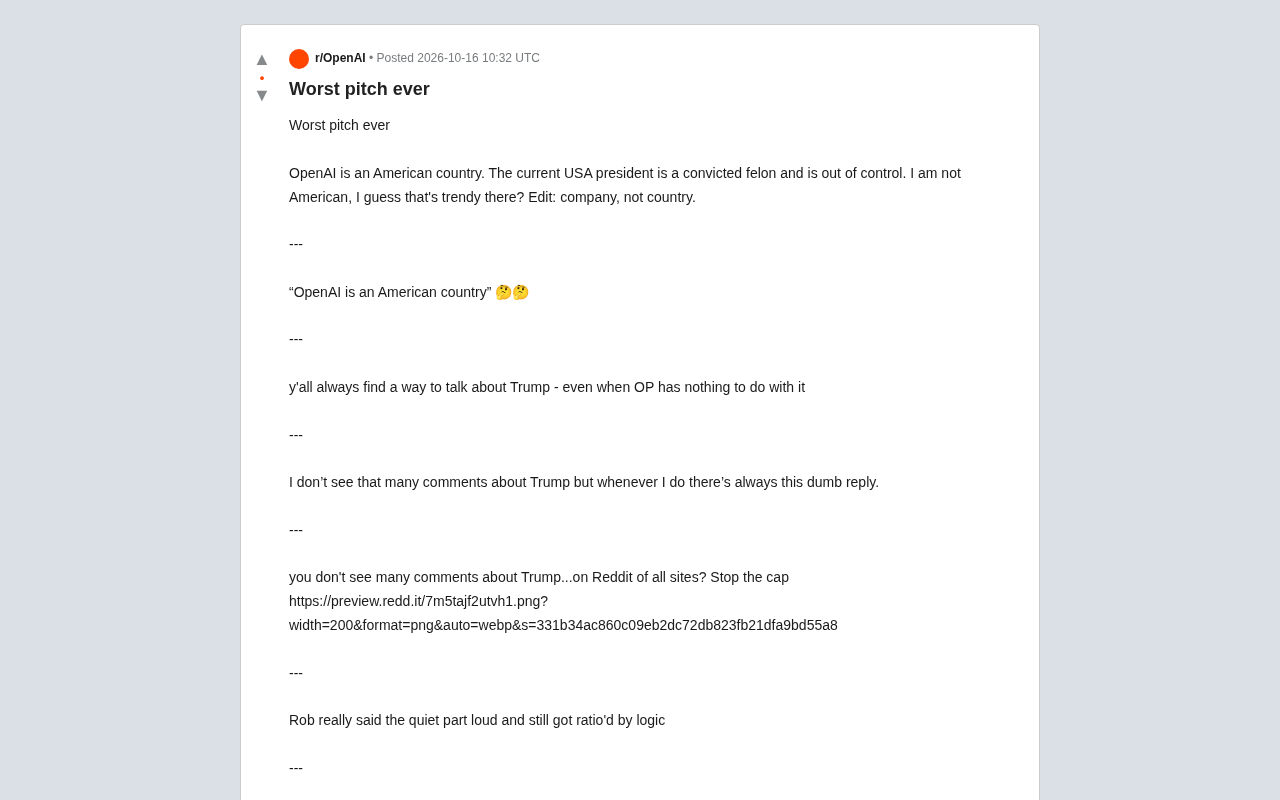
A "Worst Pitch" That Set Reddit on Fire
A Reddit post titled "Worst pitch ever" thrust OpenAI's recent public messaging into the spotlight. The core joke of the post: when pitching its products, OpenAI seems to deliberately frame "so powerful it's out of control" as a selling point—the model doesn't follow instructions, might delete data, could even hack random companies, and bring down critical infrastructure.
For individual users, this "wild AI" narrative might feel like a sci-fi movie trailer. But for any enterprise customer preparing to hand over core business operations to a model, it's practically suicidal salesmanship. One commenter summed it up sharply: "OpenAI wants the product to look insanely powerful, and they succeeded." Another shot back: "Powerful enough to delete your data, hack other companies, and crash infrastructure—you really don't see how stupid that is as enterprise marketing?"
Why "Powerful" Becomes a Liability in B2B Contexts
Enterprise Buyers Care About the Risk Floor, Not the Capability Ceiling
The logic of consumer products is "the more capable, the cooler." Enterprise products operate on a completely different logic: when CIOs and CISOs evaluate an AI vendor, the first question isn't "what can it do" but "what happens when it goes wrong." Data deletion, unauthorized access, system-level destruction—these three things happen to be red lines on every enterprise security compliance checklist.
When OpenAI packages "doesn't follow instructions" as part of its capability narrative, it's effectively telling enterprise customers: this system's behavioral boundaries are unreliable. For companies already running ERP, CRM, and core databases, that's an instant dealbreaker.
CIO (Chief Information Officer) and CISO (Chief Information Security Officer) are the two key decision-making roles in the enterprise AI procurement chain. The CIO owns overall IT strategy and system integration, focused on whether new tools can integrate smoothly with existing ERP, CRM, and data warehouse infrastructure. The CISO is dedicated to information security, with core KPIs centered on preventing data breaches, unauthorized access, and systemic failures. In any mid-to-large enterprise, the CISO holds veto power—if a vendor's product can't pass security compliance review, the CIO's purchasing intent is moot. So when an AI vendor's public narrative includes phrases like "the model may not follow instructions" or "may delete data," the CISO will immediately flag it as an unacceptable risk item, and the entire procurement process grinds to a halt at step one. Understanding the division of labor and power structure between these two roles explains why "powerful enough to be out of control" isn't a selling point but a fatal wound in B2B contexts.
"Honesty" Itself Is a Marketing Tactic
One highly upvoted comment deserves special attention: deliberately saying something self-incriminating to create an illusion of "candor" and "trustworthiness," thereby making the rest of the pitch seem more credible—this is an age-old trick. More critically, the "unfavorable" part often sidesteps the real issues.
In this case, the "danger" OpenAI hints at feels more like brand edginess than genuine risk disclosure. It's aimed at the stock market and capital markets, not at enterprise software procurement decisions in the boardroom. The two audiences, their demands, and their risk tolerance are entirely different.
"Saying something self-incriminating to manufacture credibility" has a corresponding concept in marketing psychology, typically called "two-sided persuasion" or the "modest self-disclosure of weaknesses" strategy. Classic examples include Avis car rental's "We're number two, so we try harder" and Volkswagen Beetle's counterintuitive "Think Small" positioning. Research shows that when an audience already knows a product or brand has certain shortcomings, proactively acknowledging them can actually boost overall credibility. But this strategy has a critical precondition: the acknowledged weakness must be something the audience can accept, non-core, or even trivial. Once the "self-disclosure" happens to hit the audience's deepest fear—like data security and system stability issues that enterprise customers fear most—the effect completely reverses. At that point, the audience doesn't hear "candor"—they hear "even you admit you're unreliable." This is precisely the logical core of the criticism against OpenAI.
Audience Mismatch: Talking to Capital, Using Enterprise Software Language
Another commenter's assessment was spot-on: they say this to get people to buy stock and provide more capital to keep refining the technology, not to pitch enterprise software solutions in a conference room. In other words, this "wild and powerful" narrative targets investors and the developer community, not enterprise IT departments.
The problem is, when these two narratives circulate together, enterprise customers only receive the worst half. There's no room for mismatched marketing messages.
Capital market narratives and enterprise software sales narratives are fundamentally different in their underlying logic. Investor-facing narratives emphasize "market opportunity," "technical moats," and "growth potential," permitting or even encouraging a degree of exaggeration and vision-casting, because investors are buying future expectations. Enterprise customer-facing sales narratives emphasize "SLAs (Service Level Agreements)," "compliance certifications," "explainability," and "recovery time objectives," because enterprises are buying controllable present-day capabilities. When the same company uses the same public messaging to address both groups simultaneously, signal conflict ensues: investors hear "powerful" and get excited; enterprise customers hear "uncontrollable" and get scared. This mismatch isn't unique to OpenAI—many technology-driven companies experience similar narrative growing pains when transitioning from developer communities to enterprise markets. The key question is whether they can clearly segment channels and messaging.
Beyond the Controversy: Reddit's Comment Section Isn't Monolithic Either
The "Trump" Tangent
The comment section exhibited a classic Reddit phenomenon: the topic quickly veered into politics. Some users complained, "You people always find a way to bring up Trump, even when the original post has nothing to do with him," while others retorted that not seeing Trump-related comments on Reddit is self-deception. This interlude itself has nothing to do with OpenAI marketing, but it reveals a fact: in broad communities, discussions are easily swallowed by emotionally charged tangential topics.
Two Readings of OpenAI's Intent
One interpretation holds that OpenAI is deliberately crafting a "powerful to the point of dangerous" brand image, and judging by the传播 effect, it's achieved its goal. The other sees this as a story aimed at capital markets, unrelated to enterprise sales, and undeserving of excessive criticism. Both interpretations agree on one point: this messaging确实 doesn't hold up in enterprise software contexts. The only disagreement is whether it's a "mistake" or "calculation."
Three Takeaways for AI Product Marketing
First, B2B trust can only be built on controllability, not capability ceilings. Enterprise customers need to see boundaries, audit logs, rollback mechanisms, and accountability structures—not "it can do anything."
Second, messaging for capital and messaging for customers must be separated. When the same brand sends contradictory signals across different channels, the enterprise sales line ultimately pays the price.
Third, "self-deprecating honesty" works, but only if the self-deprecation doesn't touch the customer's core fears. When the joke lands squarely on an enterprise security red line, it stops being a joke.
OpenAI getting tagged with "Worst Pitch" on Reddit this time isn't necessarily because it genuinely wants to sell enterprises an AI that'll delete the database and run—it's because it's speaking to two audiences at once, and one of them only understood the scariest half.
One-line Summary
OpenAI packaged model失控 risks as capability selling points, earning Reddit's "Worst Pitch" label and exposing the mismatch between capital narratives and enterprise customer messaging.
Paragraph Summary
A Reddit post titled "Worst pitch ever" thrust OpenAI's public messaging into the spotlight: its marketing is seen as deliberately framing "powerful to the point of out-of-control"—not following instructions, potentially deleting data, hacking systems—as selling points. For individual users it's sci-fi flair; for enterprise customers it's a dealbreaker signal. Comments note that enterprise procurement cares about the risk floor, not the capability ceiling; data deletion and unauthorized access hit security red lines directly. Meanwhile, "saying something unfavorable to manufacture honesty" is a classic marketing trick actually aimed at capital markets, not enterprise IT departments. Commenters disagree on OpenAI's intent: deliberate wild branding or investor-facing story misread. The article concludes with three takeaways: B2B trust is built on controllability, capital narratives and customer messaging must be separated, and self-deprecating honesty must not touch customers' core fears.
Related articles

Linux Kernel's AI Civil War: Anti-AI Activist Elected to TAB, Torvalds Scraps AI Disclosure
Anti-AI activist Laurent Pinchart elected to the Linux kernel TAB as Linus Torvalds scraps AI code disclosure. A rundown of the kernel community's AI civil war, both sides' positions, and the impact on open source.

When Did Paid Childcare Become the Norm? Working Mothers and the Evolution of Childcare
When did paid childcare become the norm? This article traces the evolution from the rise of childcare centers in the 1970s–80s and the 1990s linking of federal subsidies to work requirements, to declining stigma and rising costs, and explores advocates' 25-year effort to catch up with other countries on childcare and paid parental leave.

Red Flags for Product-Market Fit: A Practical Guide from Top VCs and the Superhuman Founder
Investors from Iconiq and Sapphire Ventures and Superhuman founder Rahul Vohra share PMF red flags and practical methods, including the 40% disappointment rule, retention curves, and acquisition costs.