OpenAI Teams Up with Hacktron: The New Security Paradigm Behind a Vulnerability Discovery Partnership

OpenAI's targeted partnership with Hacktron to find vulnerabilities reflects AI security governance shifting from internal closed loops to external participation.
OpenAI announced on Hacker News a targeted partnership with security research team Hacktron to find vulnerabilities in its systems. The news didn't get much attention (6 points, 2 comments), but the collaboration model is noteworthy: unlike broad bug bounty programs, it involves deep collaboration with a specific team, potentially including more systematic attack surface mapping. The article notes that AI system vulnerabilities add model-layer risks like prompt injection, model jailbreaking, and training data leakage, demanding composite skills from security teams; disclosure timing is the most sensitive part of such partnerships, and details remain undisclosed. If the model becomes a precedent, it could push more AI companies to make external vulnerability discovery routine, though actual results depend on collaboration depth and transparency in vulnerability handling.
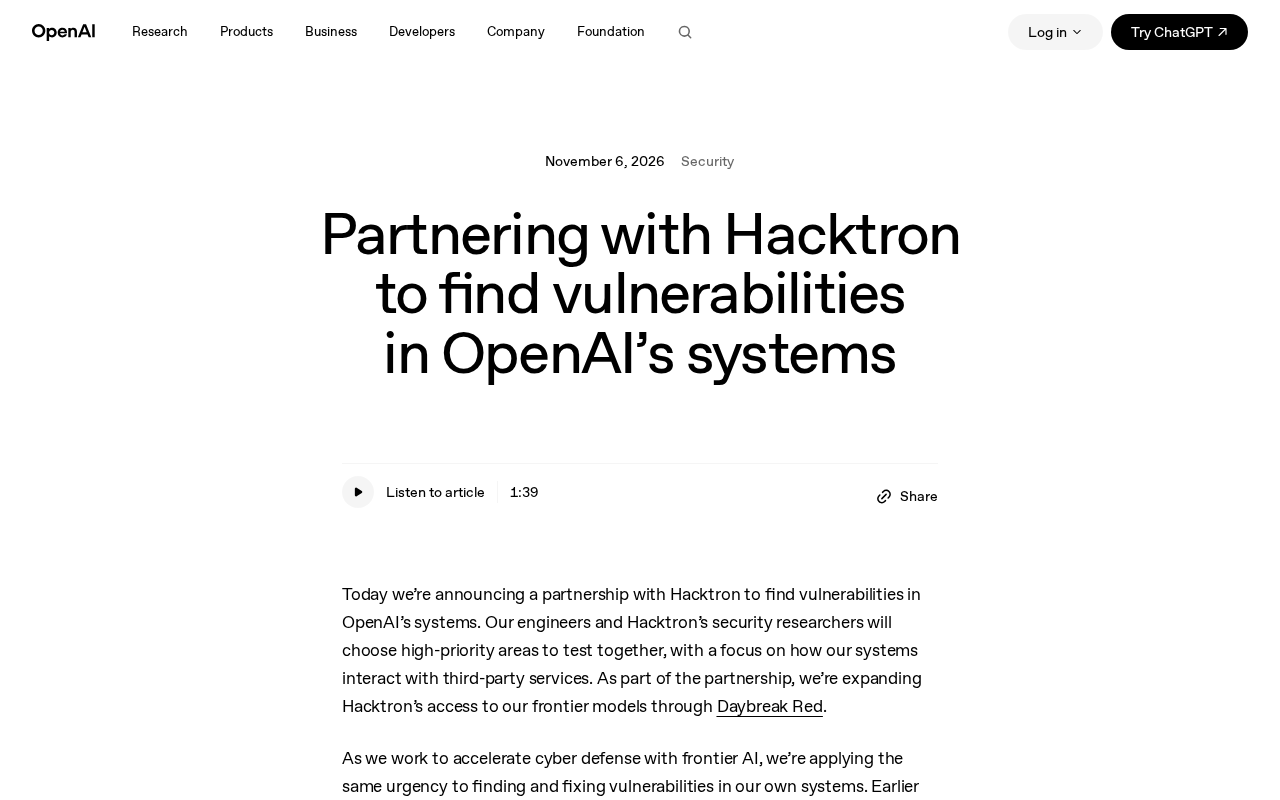
OpenAI recently posted on Hacker News announcing a partnership with security research team Hacktron to hunt for vulnerabilities in its systems. The post received 6 points and 2 comments on HN—not a hot topic—but the signal the partnership sends is worth unpacking: as AI systems become critical infrastructure, the way vulnerabilities are discovered is shifting from "closed-door patching" to "external collaboration."
Why This Partnership Deserves Attention
OpenAI's systems carry massive call traffic from developers and enterprises, and their security boundary concerns not just OpenAI itself but the entire ecosystem. Proactively bringing in an external security team for vulnerability discovery means OpenAI is exposing its attack surface to a trusted third party, using an outside perspective to fill blind spots in internal testing.
Judging from the HN discussion, the community reaction was fairly restrained. Six points suggests the news didn't spark widespread debate, and two comments hardly amount to in-depth discussion. This "low heat" may itself reflect a reality: security partnership announcements lack mass appeal, but for those watching AI infrastructure, it's an observable governance action.
The Changing Role of External Security Teams
Traditionally, bug bounty programs have been the main channel for tech companies to collect external vulnerabilities, with participation from scattered white-hat researchers. This time, however, it's a targeted partnership—OpenAI has established a relationship with one specific security research team. The difference: bug bounties cast a wide net, while targeted partnerships involve deep collaboration, potentially including more systematic attack surface mapping and longer-term follow-up.
According to the original post, the goal is to "find vulnerabilities in OpenAI's systems," but the specific scope, time window, and disclosure mechanism weren't detailed in the source material. This means outsiders can currently only confirm the intent to collaborate, not evaluate actual output.
Bug Bounty is a crowdsourced security testing mechanism: companies publicly offer rewards, and any researcher who submits a valid vulnerability receives a payout. Its advantages are broad coverage and low marginal cost; its drawbacks are that researchers work in isolation, report quality varies, and depth of investigation into complex attack chains is limited. Targeted partnerships are different—companies sign agreements with specific teams, typically including clear testing scope, access permissions, time windows, and confidentiality clauses, allowing both sides to collaborate deeply on attack surface mapping, ongoing follow-up, and fix verification. Similar industry practices include Red Teaming: simulating real attackers to conduct end-to-end testing of people, processes, and technology. Targeted partnerships sit between crowdsourced bounties and internal red teams, combining external perspective with collaboration depth.
What Makes AI System Security Different
Vulnerabilities in AI systems aren't entirely the same as traditional software vulnerabilities. Traditional vulnerabilities are mostly concentrated at the code layer—injection, privilege escalation, memory issues. AI systems add model-layer risks on top, such as prompt injection, training data leakage, and model jailbreaking. These risks often fall outside the coverage of conventional penetration testing.
By bringing in an external team, OpenAI most likely needs the partner to possess both traditional security and AI-specific attack skills. Hacktron's specific methodology wasn't disclosed in the source material, but inferring from the partnership format, both sides need to establish a collaboration process around access permissions, testing environments, and result disclosure.
The Boundary Problem of Vulnerability Disclosure
How external teams handle discovered vulnerabilities is the most sensitive part of such partnerships. Disclosing too early risks abuse; disclosing too late undermines the value of external research. How OpenAI and Hacktron have agreed on disclosure timing isn't detailed in the source material—another point worth tracking going forward.
Prompt Injection is an attack surface unique to AI systems: attackers embed malicious instructions into input content, inducing the model to deviate from its intended task or leak system prompts. It's divided into direct injection (users directly input malicious instructions) and indirect injection (malicious content hidden in web pages, documents, or other external data the model reads). Model Jailbreaking refers to bypassing a model's safety alignment through carefully crafted prompts to make it output prohibited content. Training data leakage concerns whether a model will reproduce sensitive information from its training corpus under specific prompts. What these risks share is that they don't manifest as code defects in the traditional sense but stem from uncertainty in model behavior—conventional static scanning and penetration testing struggle to cover them, requiring specialized red team methods and continuous adversarial testing.
Coordinated Disclosure is the security industry's standard framework for handling vulnerabilities: the finder notifies the vendor privately, both parties agree on a fix deadline (commonly 90 days), and details are made public after that so users can assess risk and vendors are pushed to patch promptly. In contrast, full disclosure advocates immediate public release to pressure vendors into fast fixes, but risks attackers exploiting the vulnerability first. For AI systems, coordinated disclosure is more complex: fixing model-layer vulnerabilities often involves retraining or adjusting alignment strategies, which takes longer and makes it hard to verify "complete remediation"; meanwhile, once exploitation methods for some vulnerabilities are public, they may quickly be copied to other models. As a result, targeted partnerships typically also stipulate vulnerability grading, fix verification, and timing of public disclosure.
What It Means for the Industry
Many AI companies are building their own security response mechanisms, but publicly announcing partnerships with specific security teams isn't common. If OpenAI's move sets a precedent, it could push more AI companies to make external vulnerability discovery routine rather than waiting to patch after an incident.
For developers, such partnerships won't directly change how the API is used, but they indirectly affect the foundation of trust. A platform willing to let an external team "find fault" is, at least in posture, closer to transparent governance. As for actual results, that depends on the depth of collaboration and how openly vulnerabilities are handled.
Limitations of Community Discussion
The mere 2 comments on HN can't provide meaningful community perspectives, so this article doesn't quote specific comments. Judging by its heat, the news didn't enter mainstream discussion, showing that security partnership announcements are naturally disadvantaged in terms of reach. But that doesn't change its value as an industry observation sample.
Conclusion
OpenAI's partnership with Hacktron is a targeted external security collaboration, and the core message is the act of "finding vulnerabilities" itself. Source information is limited and details haven't been made public, but the partnership model points to a trend: AI system security governance is moving from internal closed loops toward external participation. What needs watching going forward is the vulnerability disclosure mechanism and actual output, not the heat of the announcement itself.
Related articles
 Tech Frontiers
Google Omni 1.2 Flash: 15-Second AI Video at Just $0.07 per Second
Google DeepMind releases Gemini Omni 1.2 Flash: 15-second video, 720p at $0.07/sec (30% cheaper), multi-turn editing without regeneration, draft upscaling to 4K.
 Tech Frontiers
No AI Ghostwriting: Writer's Quarter Reinvents Novel Writing with a Visual Workbench
The Writer's Quarter is an AI-free novel writing and planning tool that unifies character building, story planning, and manuscript writing in one visual workbench. This article analyzes its positioning, target users, and differentiated value amid the rise of AI writing tools.
 Tech Frontiers
Fleeep: A Unified Inspiration Collection Notes App for Creatives
Fleeep is a notes app for creatives that unifies screenshots, bookmarks, saved posts, and inspiration into one calm, cross-device, offline-capable space. This article analyzes its positioning, differentiation, and target users.