OpenBot: A Free, Open-Source AI Teammate Workbench for Multi-Model Collaboration

OpenBot is an open-source AI workbench enabling multi-model access, agent role assignment, and real-time human-AI team collaboration.
OpenBot is a free, open-source, local-first AI collaboration workbench positioning itself as an alternative to closed solutions like Grok Bot. It earned 153 upvotes and ranked #4 on Product Hunt. Its core differentiators include multi-model support (Claude, ChatGPT, Grok, OpenCode, and custom agents), a role-assignment mechanism for multi-agent task delegation, and a Multiplayer mode that lets human teammates collaborate with AI agents in a shared workspace. Local deployment and open-source code also make it appealing to privacy-conscious users.
An Open-Source Workbench That Treats AI as a Team Member
In a market flooded with AI assistant tools, most products still revolve around the "one person, one chat window" interaction model. OpenBot wants to change that. It launched on Product Hunt under the label "Grok Bot alternative," highlighting four key selling points: free, local-first, open-source, and multiplayer collaboration. It earned 153 upvotes, 20 comments, and reached #4 on the daily leaderboard.
Rather than calling OpenBot just another chatbot, it's more accurate to describe it as a workspace for AI teammates. Its core philosophy is to treat AI as assignable, collaborative team members that can work alongside real human teammates — not as isolated Q&A tools.
Multi-Model Access Without Vendor Lock-In
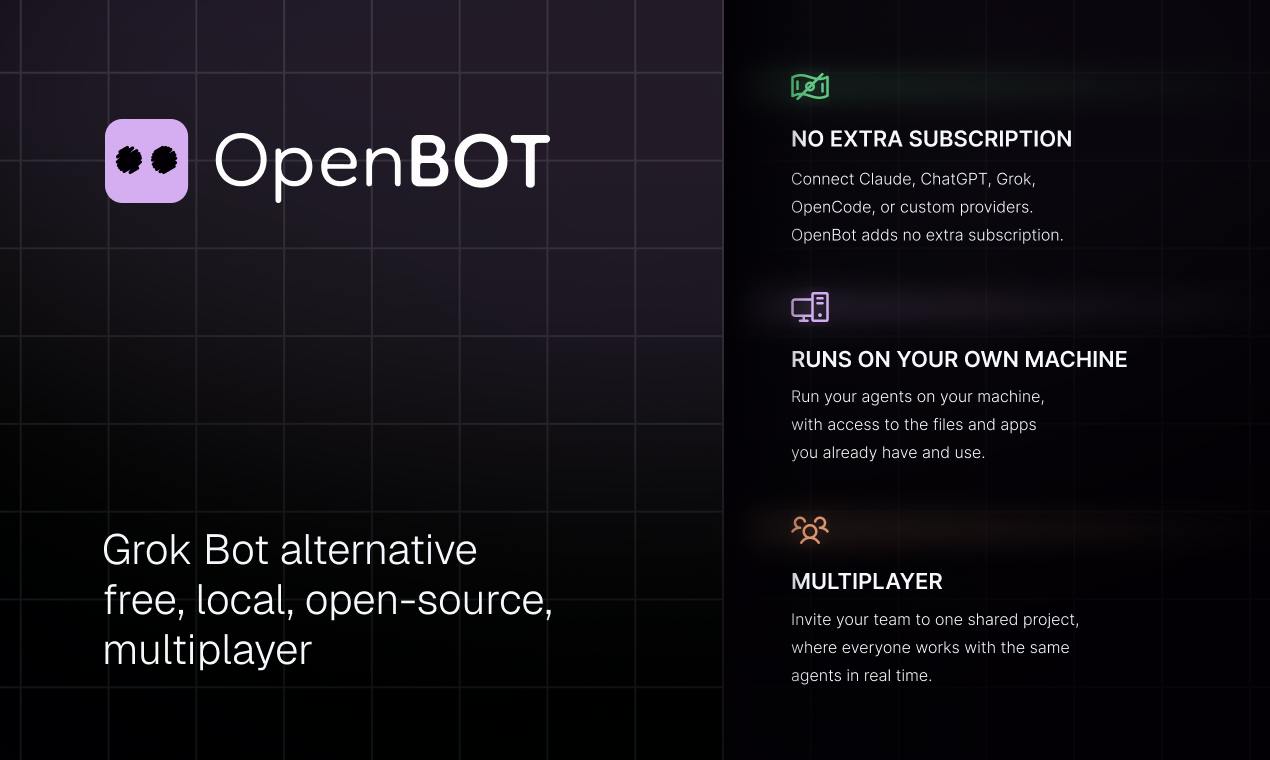
OpenBot's most immediate differentiator is model compatibility. It supports connections to Claude, ChatGPT, Grok, OpenCode, and custom agents, across Mac, Windows, and iOS. This means users aren't locked into any single vendor's ecosystem and can flexibly switch between models depending on the task at hand.
This "neutral aggregator" positioning is particularly valuable in today's landscape of intense competition among large language models, where each has its own strengths and weaknesses. Use OpenCode for coding, switch to Claude for long-form reasoning, and turn to Grok when you need real-time information — all within the same workbench, eliminating the cost of context-switching between multiple apps.
The Significance of Open Source and Local Deployment
OpenBot is labeled as open source and categorized under GitHub projects. For users and organizations that care about data sovereignty and privacy, local execution combined with open-source code means greater control and auditability. You can self-host, inspect data flows, and even build on top of it to customize your own agent logic — a level of flexibility that closed-source SaaS products simply can't offer.
Role Assignment and Task Delegation: From Monolithic Assistant to Collaborative System
Another key design element in OpenBot is its role mechanism. Users can assign clear responsibilities to different agents and have them delegate work to one another. This transforms the traditional single-turn Q&A into a multi-agent collaborative workflow.
For example, you could set one agent to handle requirement decomposition, another to focus on code implementation, and a third to perform review and validation — with tasks automatically passed between them. This orchestration approach aligns with the industry trend toward multi-agent systems, but OpenBot packages it into a visual collaborative workspace accessible to ordinary teams, significantly lowering the barrier to entry.
Background: Multi-Agent Systems (MAS) have emerged as a rapidly growing direction in AI. The core idea is to break down complex tasks and assign them to multiple specialized AI agents that collaborate to complete the work, rather than relying on a single model to handle everything. Leading organizations like OpenAI and Anthropic have already released multi-agent frameworks (such as OpenAI's Swarm and Anthropic's multi-agent research capabilities), while open-source frameworks like Microsoft AutoGen and LangGraph have accumulated significant community adoption. The advantages of these systems include: different agents can optimize prompts and model selection for specific subtasks, parallel execution improves efficiency, and "review-revise" loops reduce single-point error rates. By wrapping this orchestration logic into a visual workbench, OpenBot is attempting to bring multi-agent collaboration within reach of non-developer users.
Multiplayer Mode: Humans and AI Collaborating in the Same Space
"Multiplayer" is a concept OpenBot repeatedly emphasizes in both its name and positioning. Users can invite team members to join in real time and work alongside the same set of agents. This extends AI tools from individual productivity use cases into genuine team collaboration scenarios.
Imagine a remote team operating within the same workbench — with human members communicating while multiple AI agents execute tasks. This "human-AI hybrid" collaboration model is exactly what many enterprises are exploring as they work to deploy AI in practice. Compared to everyone independently using ChatGPT in isolation, a shared workspace allows AI-generated context and outputs to accumulate and be reused across the team.
Background: Human-in-the-loop collaboration is an important paradigm for enterprise AI deployment. Fully automated AI workflows often require human review at critical decision points, while purely manual collaboration fails to leverage AI's execution speed. The value of Multiplayer mode goes beyond sharing a workspace — it naturally creates a shared context mechanism. Team members' interaction histories with AI, task outputs, and decision processes are visible to all participants, avoiding information silos. This directly addresses a common enterprise problem: when every employee chats with ChatGPT individually, the resulting knowledge and conclusions are difficult to consolidate into shared team assets. A shared workbench model could theoretically turn AI-assisted work into a collective knowledge repository for the entire team.
Product Positioning: Clear Differentiation, But Still Needs Validation
OpenBot's product thinking addresses several genuine pain points: model lock-in, data privacy, and the difficulty of scaling individual AI tools to team use. The combination of free + open-source + local + multiplayer creates a clear positioning, which explains why it quickly attracted community attention.
That said, based on publicly available information from Product Hunt, what can be confirmed is primarily the product's positioning and feature framework. The actual effectiveness of multi-agent orchestration, the ease of local deployment, and the stability of cross-platform sync all still need real-world usage feedback to validate. For developers and small teams with multi-model needs who value data control, OpenBot is worth watching and trying out.
Summary
OpenBot represents a product trend worth paying attention to: AI tools are evolving from "one person, one model" toward "multi-person, multi-agent collaboration." It builds its differentiation on four pillars — open source, free, local, and multiplayer — positioning itself as an open alternative to closed solutions like Grok Bot. Whether it can deliver on its vision of an "AI teammate workbench" will depend on the vitality of its community ecosystem and the refinement of the actual collaborative experience.
Related articles

Gaussian Process Bandit Optimization: Exploration Strategies and Inference Regret Guarantees
Cumulative regret guarantees in Bayesian optimization fail to reflect final recommendation quality. This article examines a new study that provides inference regret guarantees for Gaussian process bandit optimization through exploration query strategies and fill distance analysis, validated on hyperparameter optimization and control tasks.

The Most Detailed Codex Guide on Bilibili: From Installation to Real-World Practice
The most detailed Codex guide on Bilibili: from app store installation to daily work mode configuration, with a real coffee shop project demonstrating file organization, data extraction, dashboard creation, and other practical tasks. Learn to use Plan Mode and desktop pets to leverage Codex efficiently.

Appearance Compensation in Volume Rendering: Why RGB Accuracy Cannot Guarantee Density Correctness
Volume rendering research reveals that volumetric data perfectly reproducing external RGB views may still contain density errors: appearance compensation can double central density and keep external rays unchanged even when L2 error exceeds 14.52%. Density recovery depends on appearance capacity, spatial resolution, and measurement design.