Openbroca: A 6.5MB AI Dictation Tool for Mac That Turns Speech into Text

Openbroca is a 6.5 MB Swift-native AI dictation tool for Mac that's lightweight, fast, and preserves your personal tone.
Openbroca is a lightweight AI dictation tool for Mac, built natively in Swift at about 6.5 MB. Press a shortcut and speak to generate text at your cursor. It emphasizes no prompt tuning, auto-removing filler words while preserving your intent and tone. The personal dictionary learns from corrections and supports Typeless dictionary imports. It also offers 28-language translation, all available in a free trial. It received 75 upvotes on Product Hunt, ranking 9th for the day.
Mac users now have a lightweight AI dictation tool called Openbroca. At just about 6.5 MB and built natively in Swift, it lets you press a shortcut, speak, and generate clean text right at your cursor. On Product Hunt, it received 75 upvotes and ranked 9th for the day in the Productivity and AI categories.
Lightweight and native — press and speak
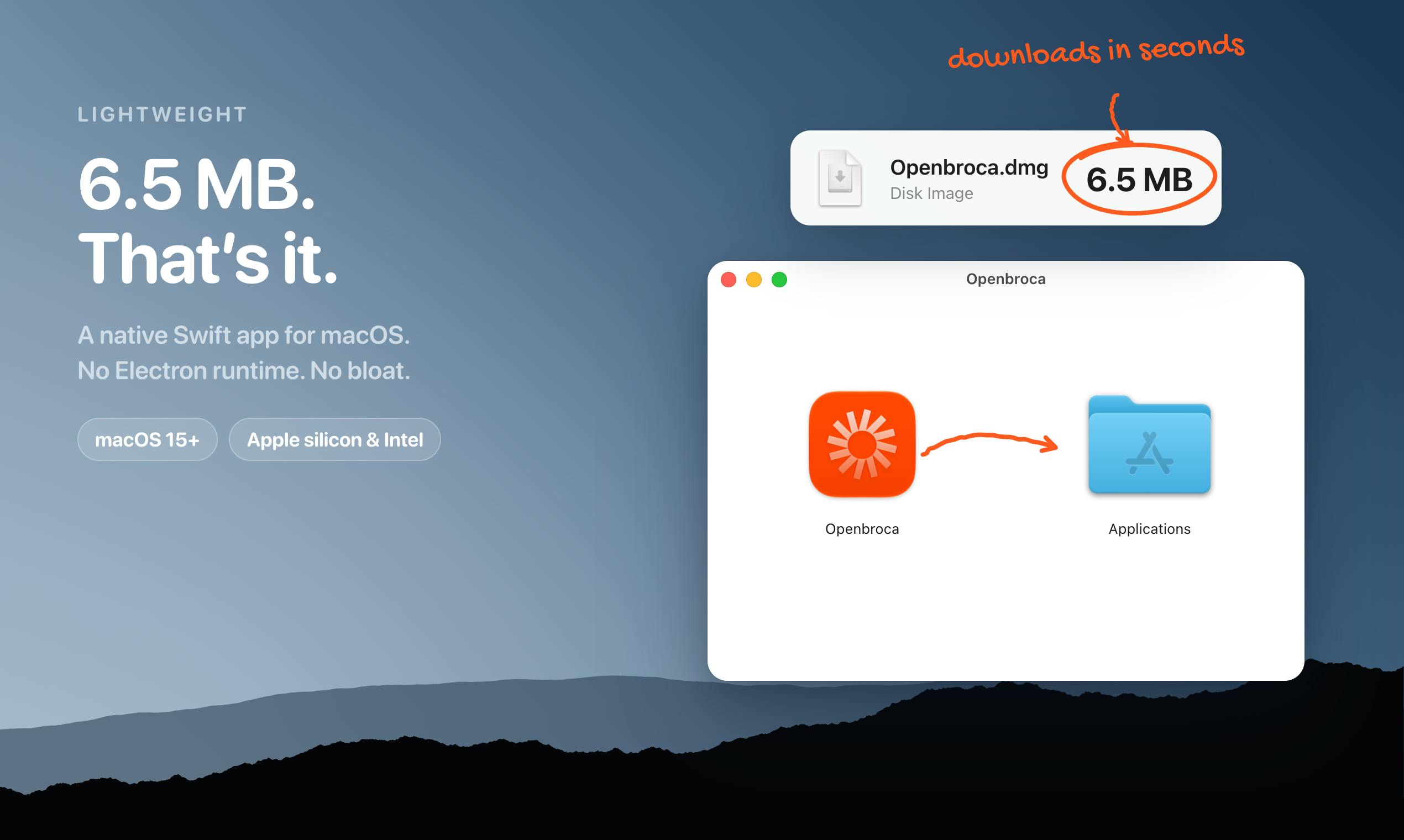
Openbroca's core experience is refreshingly direct: press the shortcut, speak naturally, and the text appears exactly where you're typing. It doesn't rely on the heavy Electron framework — it's written in Swift and the download is only 6.5 MB. That means fast startup and low memory usage, a practical advantage for a utility that lives in your menu bar.
Unlike many AI dictation solutions that require complex prompt tuning, Openbroca emphasizes "no prompt tweaking needed." You just speak normally, and it automatically removes filler words and repetition while preserving your intent and tone. The official description says it "sounds like you," which points to a key pain point: dictation tools shouldn't flatten everyone's expression into the same robotic voice.
The Electron framework is an approach that lets developers build cross-platform desktop apps using web technologies (HTML, CSS, JavaScript). Well-known software like VS Code, Slack, and Discord are built on it. Its strengths are high development efficiency and consistent UI, but the trade-off is that each app must bundle the Chromium rendering engine and the Node.js runtime, resulting in installers that are often hundreds of MB, slower cold starts, and higher resident memory usage. For menu-bar utilities, these overheads are amplified. In contrast, native Swift development directly calls system UI frameworks and speech recognition APIs, achieving small size, fast startup, and deep macOS integration — the technical prerequisite that lets Openbroca deliver a smooth experience at just 6.5 MB.
Cleaning up redundancy while preserving tone
In everyday speech, we often include filler words like "um," "uh," "you know," or repeat the same sentence. Openbroca removes this redundancy during transcription without over-editing the content. It tries to strike a balance between "clean" and "faithful" — which can significantly reduce cleanup time for users who need to quickly capture ideas, write emails, or draft documents.
This approach is especially well-suited to content creators and knowledge workers. Spoken first drafts tend to be logically jumpy and repetitive, and Openbroca's cleanup can turn them into usable text while retaining personal tone and avoiding the generic feel of AI-generated writing.
Personal dictionary and learning capabilities
Openbroca includes a built-in personal dictionary that learns from your corrections. If you correct a proper noun or industry term several times, it gradually remembers your preference. It also supports importing Typeless dictionaries, making it easy for users migrating from other dictation tools to keep their custom vocabulary.
For users who frequently use specific terminology — such as developers, doctors, lawyers, or product managers — this feature is very practical. A dictation tool's accuracy depends not only on the speech recognition model but also on whether it understands the user's personal vocabulary. Through its learning mechanism, Openbroca gets better the more you use it.
Personal dictionaries and adaptive learning in speech recognition: General-purpose speech recognition models are trained on large-scale corpora and achieve high accuracy on common words, but they tend to make errors on long-tail terms like names, product names, and professional abbreviations. A personal dictionary mechanism allows users to maintain a custom word list and gives those words higher language model weights during recognition; learning capabilities go further by analyzing users' edits to transcription results, inferring which words are frequently corrected, and dynamically adjusting recognition preferences. This "learn-as-you-go" loop improves the tool's accuracy over time without relying on the vendor to push out unified model updates.
Translation in 28 languages
Beyond dictation, Openbroca also offers translation supporting 28 languages. You can get text in your target language directly after speaking, skipping the step of copying it into a translation tool. All features are available in a free trial, lowering the barrier to trying it out.
However, there are no publicly available detailed evaluations of translation quality yet. For scenarios requiring high-precision translation, users are advised to test the performance of their specific language pairs themselves.
A pragmatic approach to lightweight AI tools
Openbroca doesn't aim to pile on every possible feature; instead, it focuses on three things: speed, lightness, and preserving personal style. In the AI dictation space, products like Wispr Flow and Superwhisper already exist, and Openbroca's differentiation lies in its extremely small size and native Swift performance.
For Mac users who want a dictation tool that doesn't hog resources, starts quickly, and learns personal vocabulary, Openbroca is worth a try. Its free trial policy also lets users verify at zero cost whether it fits their workflow.
Wispr Flow and Superwhisper are currently among the more closely watched AI dictation tools on the Mac platform. Wispr Flow focuses on cross-app dictation and automatic polishing, emphasizing the organization of spoken content into structured text; Superwhisper supports switching between multiple local and cloud speech models, balancing privacy and accuracy. Both are relatively feature-rich, but their install size and resource usage are generally higher than Openbroca's. Openbroca's choice to differentiate on size, startup speed, and preservation of personal style reflects how the AI tool space is shifting from "feature stacking" to focused, scenario-specific competition.
One-line Summary
Openbroca is a 6.5 MB Swift-native AI dictation tool for Mac that's lightweight, fast, and preserves your personal tone.
Paragraph Summary
Openbroca is a lightweight AI dictation tool for Mac users, built natively in Swift at just about 6.5 MB. Press a shortcut, speak, and text appears at your cursor. It emphasizes no prompt tuning, automatically removing filler words and repetition while preserving your intent and tone and avoiding a robotic feel. The built-in personal dictionary learns from your corrections and supports importing Typeless dictionaries. Beyond dictation, it offers translation in 28 languages, and all features are available in a free trial. The product received 75 upvotes on Product Hunt, ranking 9th for the day, positioned as a productivity tool.
Related articles

macOS Is No Longer UNIX: Apple Didn't Renew Certification, But the Technology Is Unchanged
Apple did not renew macOS's UNIX certification, and the Open Group has removed Apple's entry. This article analyzes the technical reality behind the expiration, Apple's possible intentions, and the practical impact on developers.

Building Stateful Multi-Agent Systems with Azure Cosmos DB
Based on the official Azure Cosmos DB tutorial, this article explains how to use the Agent Memory Toolkit to add shared persistent memory to a multi-agent travel planner, covering short-term, long-term, episodic, and semantic memory plus cross-session state continuity.

Production AI Agent Operations: A Three-Step Framework for Observing, Evaluating, and Optimizing
Azure Cosmos DB team proposes a three-step framework for production AI Agent operations: observe trace tracking, evaluate with LLM as a judge and regression testing, optimize cost across RU, retrieval, memory, and LLM layers.