OpenCharm: Giving Your Existing AI Agents an Open-Source "Body"

OpenCharm gives AI coding agents like Claude Code an open-source voice body via push-to-talk interaction.
OpenCharm is an early-stage open-source tool that serves as an "interaction body" for AI coding agents. Running near the Mac notch, it uses push-to-talk so developers can speak to Claude Code, Codex, or any agent without typing — the agent responds in voice and proactively asks follow-up questions. Its core value lies in three areas: PTT design avoids always-on listening privacy issues; open-source architecture maintains compatibility with any agent backend; and a roadmap toward wearable hardware (keychain form factor). It doesn't replace the underlying agent — it gives it the sensory and expressive channels it's been missing.
When AI Agents Break Free from the Screen
Most developers today rely on some form of AI coding assistant — whether it's Claude Code, Codex, or another command-line agent. But these tools still interact through typing and reading. OpenCharm wants to change that. It positions itself as an "open-source body for the AI agent you already run," aiming to move agents beyond pure text interfaces toward voice and physical interaction.
The project recently appeared on Product Hunt, earning 82 upvotes and landing at #11 for the day, under tags like Open Source, Developer Tools, Artificial Intelligence, and GitHub. Creator Michael describes the core experience simply: hold down a key, talk to your agent.
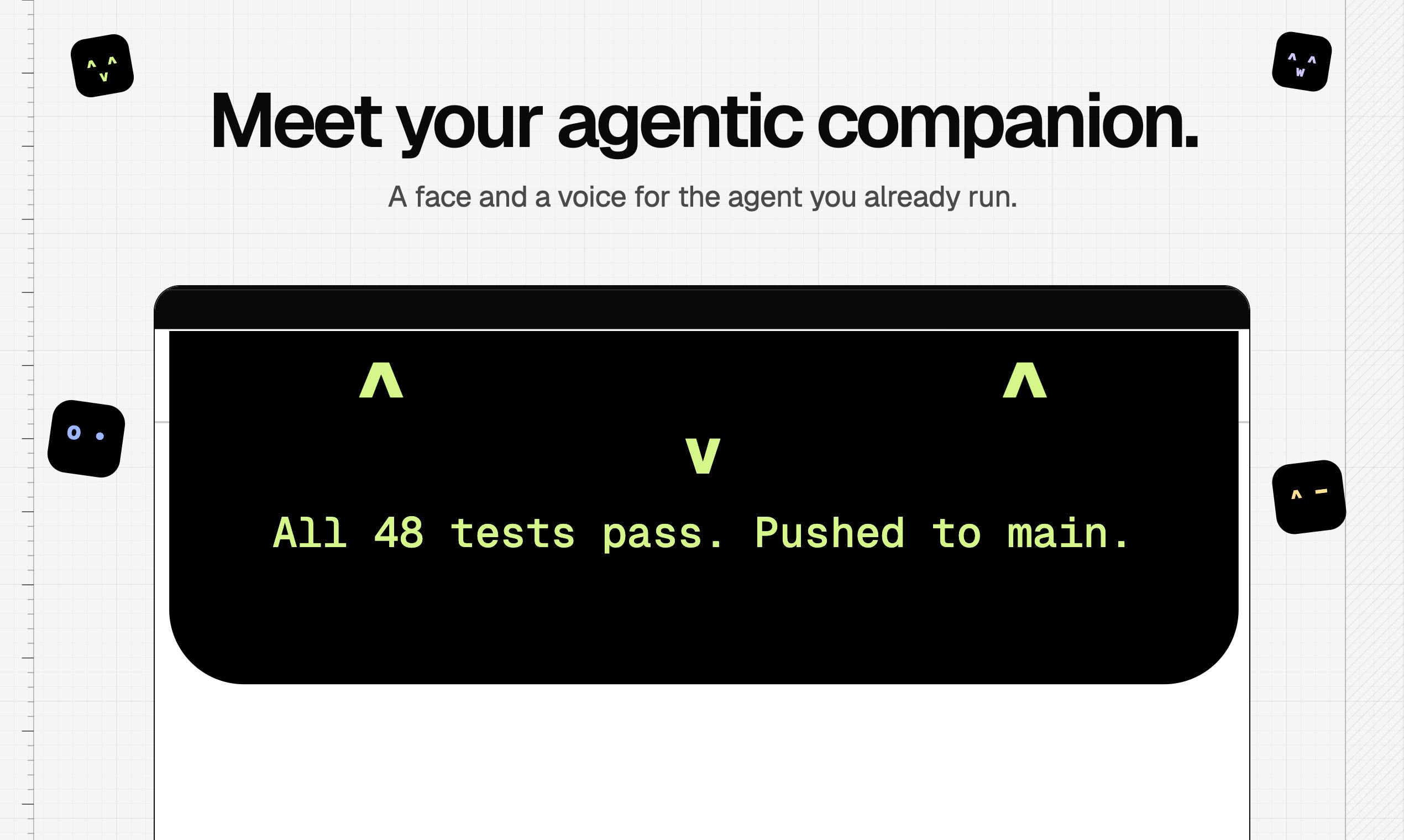
Core Interaction: Hold to Talk, Speak to Command
OpenCharm's most compelling design choice is that it lives near the Mac notch. You hold down a key to start speaking, your underlying Claude Code, Codex, or any other agent gets to work, reads the result back to you in voice, and proactively asks follow-up questions when it needs clarification.
This push-to-talk (PTT) model feels intuitive — like a walkie-talkie — and sidesteps the privacy and accidental-trigger problems of always-on listening. More importantly, it gives agents a two-way voice channel: not just letting you speak, but letting the agent "speak back" and ask questions when it lacks enough information. This back-and-forth conversational rhythm is far closer to genuine collaboration than a one-way command-output loop.
Push-to-talk (PTT) technology originated in radio communication systems, where the core idea is to use deliberate triggering instead of continuously occupying a channel. In voice AI assistants, this design is especially important. Always-on listening requires devices to continuously capture ambient audio and run voice activity detection (VAD) either locally or in the cloud — creating privacy risks and false-trigger problems. PTT defines a clear "interaction window" through explicit physical action, fundamentally avoiding these issues. In AI coding agent workflows, developers are often in deep focus mode; accidental triggers or background monitoring are disruptive. PTT's "press to start, release to stop" model naturally fits the intermittent, high-intent nature of developer interaction.
The "Body" Metaphor and Wearable Vision
There's an imaginative line in the product description: next, it hangs from your keychain. This signals that OpenCharm's vision goes beyond a software panel docked near the Mac notch — it's evolving toward a portable physical form factor.
The "body" metaphor is worth unpacking. Today's AI agents are often described as "brains" — powerful reasoning and generation capabilities, but lacking a shell for interacting with the physical world. OpenCharm aims to be that shell: it doesn't replace your existing agent, but acts as an external carrier that gives the agent hearing (voice input), a voice (voice output), and even a tangible, portable presence. It's a pragmatic "don't reinvent the wheel, just build the interface" approach.
Embodied AI is a significant research direction in the field, built on the premise that intelligence doesn't exist purely in abstract reasoning — it also depends on the physical loop of perception and action. Traditional AI assistants, including most command-line agents, exist only in digital interfaces and cannot perceive the state of the physical environment. OpenCharm's "body" metaphor resonates with this idea, but takes a more pragmatic path: rather than building a complete robotic perception system, it focuses on supplementing pure-software agents with the most basic interactive channels — voice input and output. The value of this "lightweight embodiment" approach is that it can be layered on top of existing agent capabilities at low cost, without rebuilding the underlying model or inference engine. The wearable form factor (such as keychain hardware) further extends this "channel augmentation" from the desktop to mobile contexts, freeing the agent from being anchored to a screen.
Why Open Source Matters Here
Making this interaction layer open source is what sets OpenCharm apart from the many closed voice assistant products out there. For developers, open source means the freedom to connect any agent backend of their choosing — Anthropic's Claude Code, OpenAI's Codex, or any other agent — without being locked into a single vendor's voice solution.
This neutrality is especially valuable in today's highly fragmented AI tooling landscape. Developers don't want to learn a different interaction model for every agent; they want a single unified "body" that can carry different "brains." Open source also lets the community audit, extend, and adapt the tool to more platforms and hardware form factors, laying the groundwork for future physical experiments like the keychain wearable.
In the AI tooling ecosystem, vendor lock-in is a real risk developers face. Current mainstream voice interaction solutions — Apple's Siri, Amazon's Alexa SDK, and even the voice interfaces bundled with major model providers — are typically tightly bound to specific model backends or cloud services, making switching costly. An open-source interaction layer fully decouples "how to speak" from "who does the thinking," allowing developers to freely swap the underlying agent without changing their frontend habits. This architecture also aligns with the emerging concept of "model routing" — keeping the frontend stable while dynamically dispatching the most appropriate model or agent on the backend. For developers already context-switching between multiple AI services, a unified open-source interaction layer significantly reduces switching friction and opens the door for community-contributed adapter layers.
Who Does It Help
OpenCharm targets developers who have already deeply integrated AI agents into their workflows. For them, the constant cycle of typing in the terminal, waiting, and reading output breaks their concentration. Voice interaction lets you keep pushing work forward while your hands are busy elsewhere, and the "agent asks follow-up questions" mechanism reduces the back-and-forth rework caused by unclear instructions.
That said, based on publicly available information, this product is still in early stages. The 82 upvotes show the direction resonates with a segment of users, but real-world voice accuracy in coding contexts, latency performance, and what the keychain hardware will actually look like all need further validation. The vision of "giving an agent a body" is compelling — whether it can be delivered remains to be seen.
Summary
OpenCharm represents an interesting direction in the evolution of AI tooling: as underlying models and agent capabilities mature, the interaction layers around them are becoming the new frontier for innovation. Replacing typing with one-button voice, letting agents speak their answers and proactively ask follow-ups, and maintaining open-source neutrality across any backend — these design choices collectively reflect a clear conviction: the value of an agent lies not only in having a "smarter brain," but also in having a "more natural body."
Related articles

Amphibious Transforming Drone: Beyond 100x Power Savings, What Are the Real Needs?
Is the amphibious transforming drone just a gimmick? Starting from the 100x power difference of the M4 Morphobot, explore real application scenarios and thesis topic ideas, analyzing boundary conditions where pure drones and pure ground robots both fail.

Warhound Raises $200 Million: Genetically Engineered "War Dogs" Paired with Anduril Gear
Warhound raises $200M, backed by Ben Lamm and Palmer Luckey, to genetically engineer dogs for military and law enforcement use and equip them with Anduril gear. This article analyzes its technology direction, funding logic, and ethical controversy.

Claude API Comes to Google Cloud: IAM Integration and SDK Access Guide
Anthropic hosts the full Claude API on Google Cloud with IAM-controlled permissions and unified billing. This guide covers the Vertex AI and Anthropic-hosted entry points, IAM role configuration, and SDK access.