OpenClaw Getting Started Guide: From LLMs to AI Agents — The Practical Logic

OpenClaw is a Skill-powered AI Agent framework — powerful, but costly and risky in practice.
This article breaks down OpenClaw based on a Bilibili creator's livestream. It starts with two core LLM limitations — no persistent memory and a knowledge cutoff — then explains how Agents address these through memory, tool-calling, and ReAct-based planning. OpenClaw's key differentiator is its Skill mechanism, which chains tools into fixed workflows to reduce tool-selection confusion and lowers development friction by allowing direct reuse of existing scripts. Despite its practical value in DevOps and similar scenarios, the creator honestly flags three major pain points: extreme token consumption, serious security risks (including machine compromise and API key leakage), and real-world intelligence that falls well short of the hype.
OpenClaw has been generating a lot of buzz lately, leaving many people both excited and confused: is it just another overhyped AI tool? A Bilibili content creator recently broke down the underlying logic of OpenClaw in plain language during a livestream — starting from the limitations of large language models, moving through the Agent framework, and into the practical value of the Skill mechanism. He also honestly shared three real pain points from hands-on use. This article synthesizes those insights to outline the core concepts and real-world application logic behind OpenClaw.
Starting with LLMs: Why They're Not Enough on Their Own
To understand OpenClawAd, you first need to grasp two fundamental limitations of large language models (LLMs).
The first is no persistent memory. Every conversation is treated as an independent interaction. You might tell the model "my name is Li Si" at the start of a session, but a few exchanges later, it may no longer remember. This stateless nature makes LLMs poorly suited for sustained, complex tasks.
The second is knowledge has a temporal cutoff. A model's knowledge is frozen at the point when its training data ends. A model trained earlier will have no awareness of events or news that occurred after that cutoff. Ask it about recent international affairs, and it can only answer based on outdated training data.
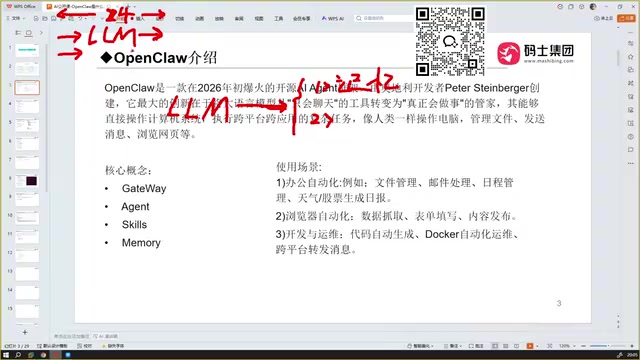
These two characteristics mean that a standalone LLM is limited to simple question-and-answer interactions — it can't truly integrate into real enterprise workflows. Getting AI to work inside a company requires additional capabilities.
AI Agents: Memory, Tools, and Autonomous Planning
Agents exist precisely to fill the gaps left by LLMs. The creator emphasized that understanding Agents comes down to three key points.
First: Memory. An Agent can retain the history of your conversation, enabling coherent, multi-turn interactions.
Second: The ability to call tools. This was repeatedly highlighted as "one of the key reasons LLMs can be deployed in enterprise settings." Tools can be anything — a web search script, an email sender, a document generator. With tools, an Agent can connect to internal company data and answer user questions using real business data, rather than just reciting generic knowledge from the internet. Even an older model can access up-to-date information through web-enabled tools.
Third: Autonomous reasoning and planning. Once you equip an Agent with multiple tools, it independently decides which tools to call, whether to call them iteratively, and when to stop. This autonomous decision-making loop is commonly known as the ReAct pattern.
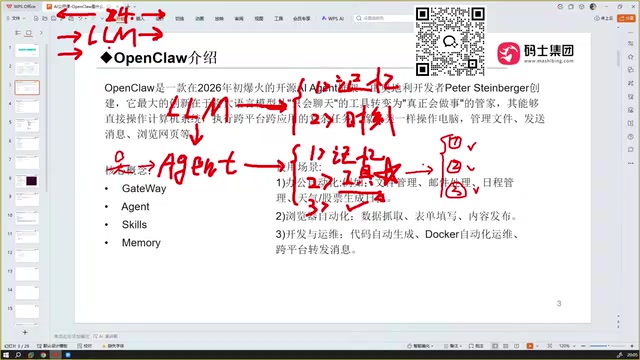
In short: Agent = LLM + Memory + Tools + Autonomous Planning. It transforms a model that "only knows how to chat" into one that can actually get things done.
What is ReAct? ReAct (Reasoning + Acting) is the core operational paradigm of most mainstream Agent frameworks, originally proposed by a Google research team in 2022. The basic idea is to have the LLM perform "Reasoning" before each action — outputting its thought process — then decide on the next "Acting" step. The result of that action is fed back to the model, triggering a new round of reasoning, and so on until the task is complete. This alternating reasoning-action loop allows models to handle complex tasks requiring multiple steps and multiple tools, rather than generating a final answer in one shot. Compared to pure Chain-of-Thought prompting, ReAct adds real interaction with the external environment, allowing the model's reasoning to be corrected by tool outputs — significantly reducing error accumulation from hallucinations.
The Skill Mechanism: OpenClaw's Core Advantage
Having too many tools creates its own problems. The creator pointed out a real-world issue: when enterprises configure an Agent with a very large number of tools, it tends to get confused — calling the wrong tools and missing the right ones.
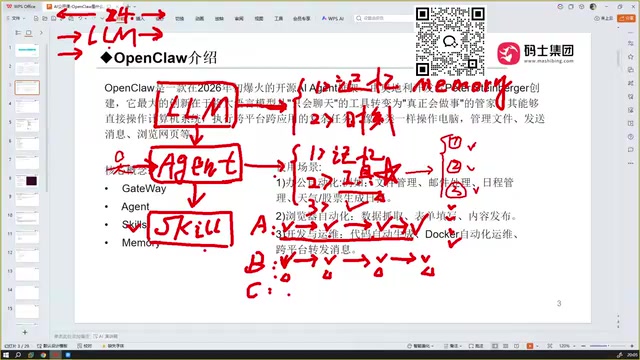
This is where Skills come in. A Skill is essentially a predefined workflow that chains together multiple existing tools in a fixed sequence to accomplish a complex task.
For example, a "Computer Health Check" Skill might be designed like this:
- Step 1: Check memory usage
- Step 2: Check disk space
- Step 3: Check CPU status
- Step 4: Aggregate the above data
- Step 5: Generate a report document
Each step maps to a call to an existing tool or script. By encoding the workflow into a Skill, the Agent's task accuracy improves dramatically — no more "choice paralysis" from having too many tools.
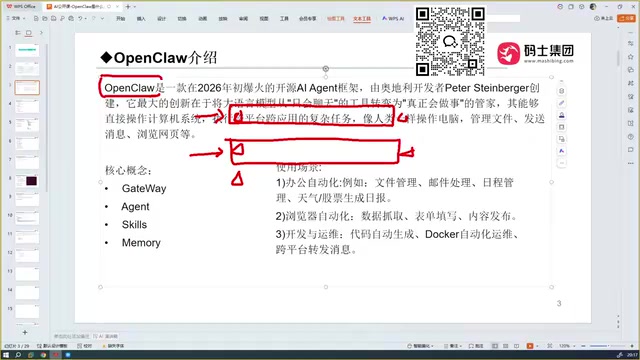
As an Agent framework, OpenClaw can invoke both tools and Skills. The creator considers Skills to be its strongest differentiator: there are tens of thousands of free Skills available online (the official site claims this), and the barrier to building your own Skills is extremely low.
Unlike the MCP era — where defining tools required verbose schema definitions — OpenClaw Skills can directly invoke scripts or commands on your local machine. Write your business logic in Python, TypeScript, or even a shell script, wrap it as a Skill, and you're done. No extra tool definitions required.
A Practical Use Case: DevOps
The creator described a highly practical scenario: DevOps engineers frequently handle routine operations late at night — deployments, shutdowns, log checks. These workflows can be fully implemented in code and packaged as Skills for OpenClaw.
Paired with OpenClaw's multi-channel integration (Channels) — such as connecting to DingTalk or WeCom — you can simply say a sentence to a chatbot on your phone and trigger a script to run on a remote machine. True remote control.
What is MCP? MCP (Model Context Protocol) is an open protocol released by Anthropic in late 2024 to standardize the interface definition between LLMs and external tools or data sources. Developers must declare each tool's name, parameter types, return format, and other metadata according to the protocol spec, allowing the model to decide whether and how to call it. While structured, this approach requires engineers to write substantial descriptive metadata — especially when they just want to quickly reuse existing scripts. OpenClaw's Skill mechanism bypasses this abstraction layer, allowing existing Python, shell, or other scripts to be wrapped directly as callable units. For teams that already have a library of automation scripts, the migration path is much shorter and the onboarding friction is much lower.
Three Drawbacks You Can't Ignore
To his credit, the creator didn't just hype OpenClaw. Based on his own experience and feedback from students, he honestly outlined three significant pain points.
First: Enormous token consumption. This is the most important issue to be aware of. With a regular LLM conversation, ten dollars' worth of API credits might last half a year. But in OpenClaw — calling tools, browsing the web, summarizing results — that same ten dollars can vanish in minutes. One developer reported that their team burned through millions of tokens just writing code for a single morning during an internal trial. The costs are staggering.
Second: High security risk. One student reported that the balance on their API platform account was mysteriously wiped out, most likely because the machine running OpenClaw had been compromised and turned into a "bot" for attackers. Because the framework comes with high-privilege tools built in by default — including file system access, browser data reading, and network requests — once a machine is compromised, user data is essentially fully exposed. This is especially dangerous when paid API keys are configured on the same machine.
Third: Not as intelligent as advertised. After testing it on his own computer, the creator bluntly said that OpenClaw sometimes "acts like it's completely clueless" — far from the godlike intelligence it's been hyped up to be.
What is a "bot" (肉鸡) in cybersecurity? In cybersecurity contexts, a "bot" or compromised host refers to a victim machine that has been remotely taken over by an attacker but continues to operate normally, with the owner completely unaware. The attacker can reside on it long-term and exploit its computing power, bandwidth, or storage. OpenClaw's security risks are particularly worth taking seriously because the framework opens up high-privilege capabilities by default — file system read/write, browser data access, network requests — all of which, if maliciously exploited, can lead not only to API key leakage and financial loss, but also turn the host machine into a pivot point for attacking other systems on the internal network. It is strongly recommended to deploy OpenClaw in an isolated environment (such as a dedicated virtual machine or container) and follow the principle of least privilege — only enabling the tools actually required for the task.
A Rational Take on OpenClaw
So, back to the original question: what exactly is OpenClaw? It's an AI Agent framework — one that can call tools, invoke Skills, and support multi-channel integration. Without tools and Skills, it "is nothing."
Its capability ceiling is entirely determined by how powerful the Skills you configure for it are. Skills make its potential seem limitless, but the three hurdles of token cost, security risk, and intelligence ceiling are unavoidable for anyone looking to deploy it in a real enterprise environment.
Rather than treating it as a universal magic wand, think of it as an automated execution framework that needs to be carefully fed and cautiously authorized. Understanding what it truly is — and isn't — is the only way to actually use it well.
Related articles

Agent Skills Beginner's Guide: From Concepts to Multi-Agent Collaboration in Practice
A comprehensive guide to Agent Skills: core concepts, components, the importance of Description, standardization, beginner learning paths, and multi-agent collaboration.

One Neuron Detects Both Cats and Cars? We Reproduced It and Found a New Explanation
The cat-car neuron reinterpreted: researcher Cammarata argues it distinguishes pointy from round, not cats from cars. We reproduced the experiment and found the new explanation holds on most inputs—but cars are the exception. The interpretability debate continues on language models.

MCP Server + Python Assistant: A MicroStation Design Efficiency Revolution
Explore the early preview of the MCP Server and Python Assistant in MicroStation 2026: custom tools in five minutes, intelligent sheet index checks, and how AI is reshaping drawing workflows to unleash design creativity.