OpenFrame: AI Agents Take Over IT Operations, Every Fix Requires Approval
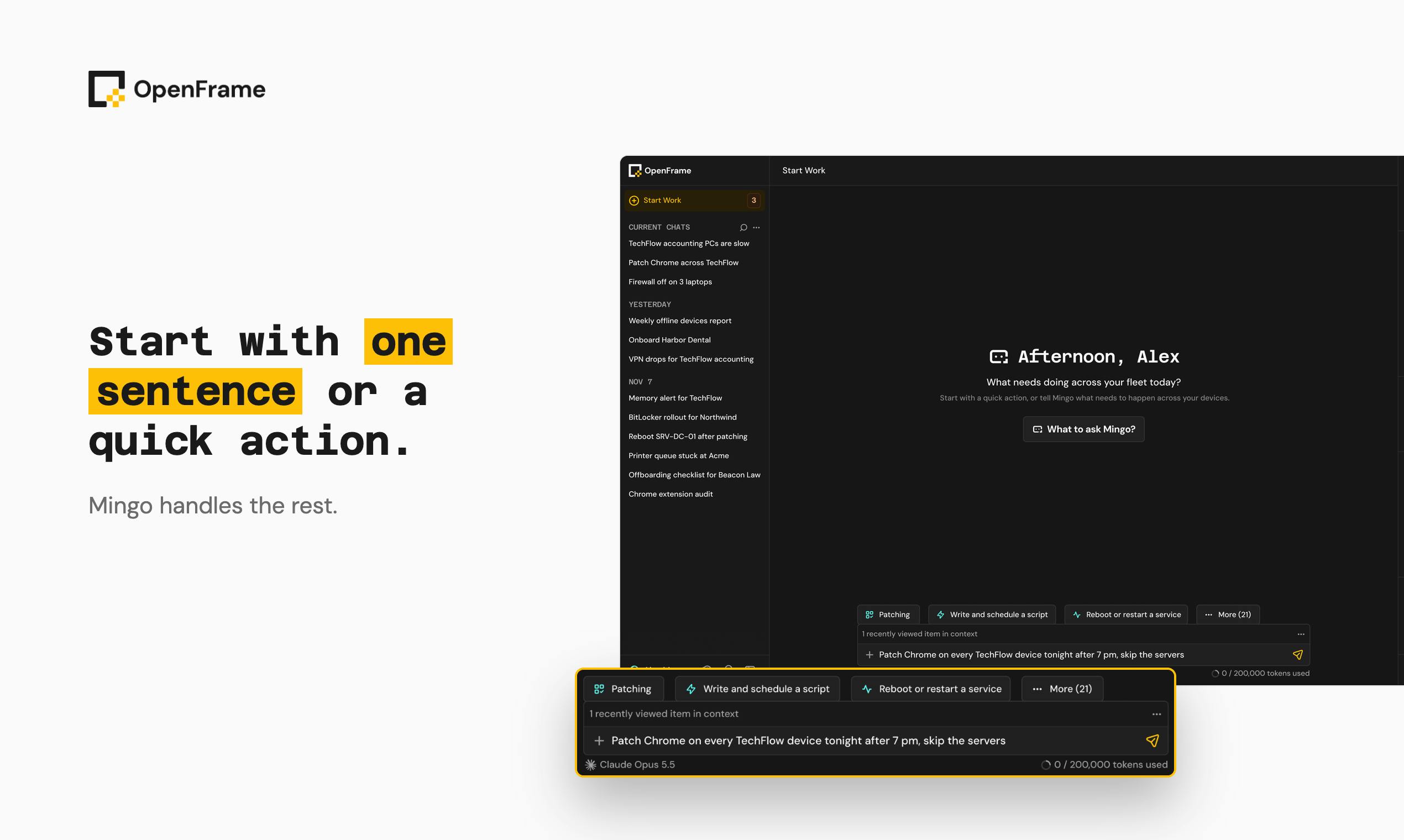
OpenFrame uses two AI agents, Mingo and Fae, to take over small-team IT operations while keeping human approval, at $1 per device.
OpenFrame, launched on Product Hunt, targets small IT teams with tight staffing, proposing two AI agents to share operations work. Mingo handles device-level patching, fixes, and routine tech tasks, while Fae answers employee IT requests and reduces interruptions. Every fix requires admin approval, balancing automation speed with human judgment. The platform integrates endpoint management, AI agents, and IT support at $1 per device.
The pain point of IT operations for small teams is that the task list never ends: device patches, incident fixes, and employee requests keep piling up, while staffing is limited. OpenFrame, launched on Product Hunt, proposes using two AI agents to take over this work while keeping a human approval step, priced at $1 per device.
Division of labor between two AI agents
OpenFrame's core is two AI agents with clearly defined roles: Mingo and Fae.
Mingo handles device-level technical work, including patching, fixing issues, and handling routine technical tasks. Its key design is that every change requires administrator approval, meaning automation never escapes human control. Fae, on the other hand, faces employees, answering IT requests and reducing how often team members get interrupted. Together, they cover the main IT workflows from back-end maintenance to front-line support.
The logic behind this division is that device maintenance is cyclical and predictable work, well suited for agent execution; employee requests are fragmented, high-frequency interruptions, well suited for agent filtering.
AI Agent refers to a software system capable of perceiving its environment, making autonomous decisions, and executing actions to accomplish specific goals, distinct from traditional scripts or chatbots that only respond to single instructions. In IT operations scenarios, agents are typically granted permissions to access devices, read status, and execute changes, so the design of their capability boundaries and safety guardrails is critical. OpenFrame splits responsibilities into device-side and employee-side agents, essentially a vertical split based on task predictability and interaction frequency: cyclical maintenance suits autonomous agent loops, while high-frequency interpersonal requests suit agent-based pre-filtering and triage—consistent with the classic "incident vs. request" separation in IT Service Management (ITSM).
Approval mechanism is key to trust
OpenFrame emphasizes "you approve every fix," which addresses the biggest obstacle to AI automation in IT—trust.
Letting AI directly modify production devices is high-risk, while fully manual operations don't scale. OpenFrame's middle path is: the agent proposes a fix, and the administrator approves it before execution. This leverages AI's processing speed while retaining human judgment. For small teams, this model is more realistic than either full automation or fully manual work.
Weekly reports summarize completed work for management, letting leadership see the IT team's actual output and addressing the "done but invisible" problem of operations work.
Human-in-the-loop (HITL) is a design pattern in automated systems where humans intervene at key decision points, widely used in high-risk domains. In IT operations, it typically takes the form of a change request approval workflow: the system generates a fix plan, and it is only executed after administrator confirmation. The value of this pattern goes beyond safety—it also accumulates approval records to form an audit trail, facilitating retrospective tracing and compliance checks. The cost is added latency, so the usability and batch-processing capability of the approval interface directly determine whether this model is viable for small teams—if every fix requires cumbersome confirmation, the efficiency gains from agents are offset.
Integrated platform and pricing
OpenFrame integrates endpoint management, AI agents, and IT support into a single platform, priced at $1 per device.
This pricing clearly targets small IT teams with limited budgets. Traditional endpoint management tools, AI operations tools, and help desk systems often need to be purchased and integrated separately; OpenFrame's approach is to offer them bundled, lowering the adoption barrier. Its Product Hunt result of 93 votes and 5th place shows it hits a real need for some users.
However, whether the $1-per-device model is sustainable depends on device scale and the agents' actual processing capability, which requires real-world use to verify.
Endpoint Management refers to the ability to uniformly configure, distribute patches, push security policies, and inventory assets for terminals such as laptops, desktops, servers, and mobile devices, commonly found in MDM/UEM products. Traditionally, endpoint management, AI operations, and help desk are three separate systems with high integration costs, especially burdensome for small teams. OpenFrame bundles these capabilities, essentially using a unified data foundation so agents simultaneously understand device status and employee request context, reducing cross-system switching. Per-device pricing is a common pricing model for IT tools, making budgets predictable, but it may not be economical for teams with few devices and low usage intensity.
The automation boundary of small-team IT
OpenFrame's positioning raises a question worth considering: how much of small-team IT work can be handed over to AI agents?
Patch management and routine fixes are relatively standardized and suitable for agent execution; but when it comes to security policies, compliance requirements, and complex failures, human judgment remains irreplaceable. OpenFrame's approval mechanism is precisely an acknowledgment of this boundary.
From a product philosophy perspective, it doesn't promise "unmanned IT" but offers "supervised automation." This restrained positioning may be more readily accepted by small teams than aggressive full-automation solutions.
For teams with tight IT staffing and severe task backlogs, OpenFrame offers a choice between outsourcing and building in-house. Its actual effectiveness depends on the fix accuracy of Mingo and Fae in real environments, and whether the approval workflow is smooth enough.
One-line Summary
OpenFrame uses two AI agents, Mingo and Fae, to take over small-team IT operations, retaining human approval, at $1 per device.
Paragraph Summary
OpenFrame, launched on Product Hunt, targets small IT teams with tight staffing, proposing two AI agents to share operations work. Mingo handles device-level patching, fixes, and routine technical tasks, while Fae answers employee IT requests and reduces interruptions. Its core design is that every fix requires administrator approval, balancing automation speed with human judgment, and weekly reports show IT output to management. The product integrates endpoint management, AI agents, and IT support into one platform, priced at $1 per device, lowering procurement and integration barriers. The article argues that this "supervised automation" is more acceptable to small teams than full automation, but its sustainability and fix accuracy still need real-world verification.
Related articles

Hands-On with the Genie 4 World Model: Directing Worlds in Real Time Like a Puppeteer
Google DeepMind's Genie 4 world model in depth: Special Guest X's hands-on demo of real-time scene direction via prompts, custom interactive apps in Project Genie, and prompts-as-seeds reproducibility.

Nvidia RTX Spark Mini PCs Go on Sale, Asus, Dell, and MSI Lead the Launch
Nvidia's RTX Spark N1X chip expands to desktops, with Asus, Dell, and MSI launching the first mini PCs, followed by Acer, Gigabyte, HP, and Microsoft's Surface Dev Box, accelerating the desktop AI PC ecosystem.

If Jensen Huang Steps Down, What Happens to Nvidia's AI Empire?
Is Nvidia's AI dominance overly dependent on Jensen Huang? This article analyzes Silicon Valley's CEO personality cult phenomenon, explores Nvidia's technical moat and organizational risks, and why the AI industry must shed the savior narrative.