OpenGNS: The First Open Dataset of Gradient Noise Scale Spanning Vision, Language, and Diffusion Models
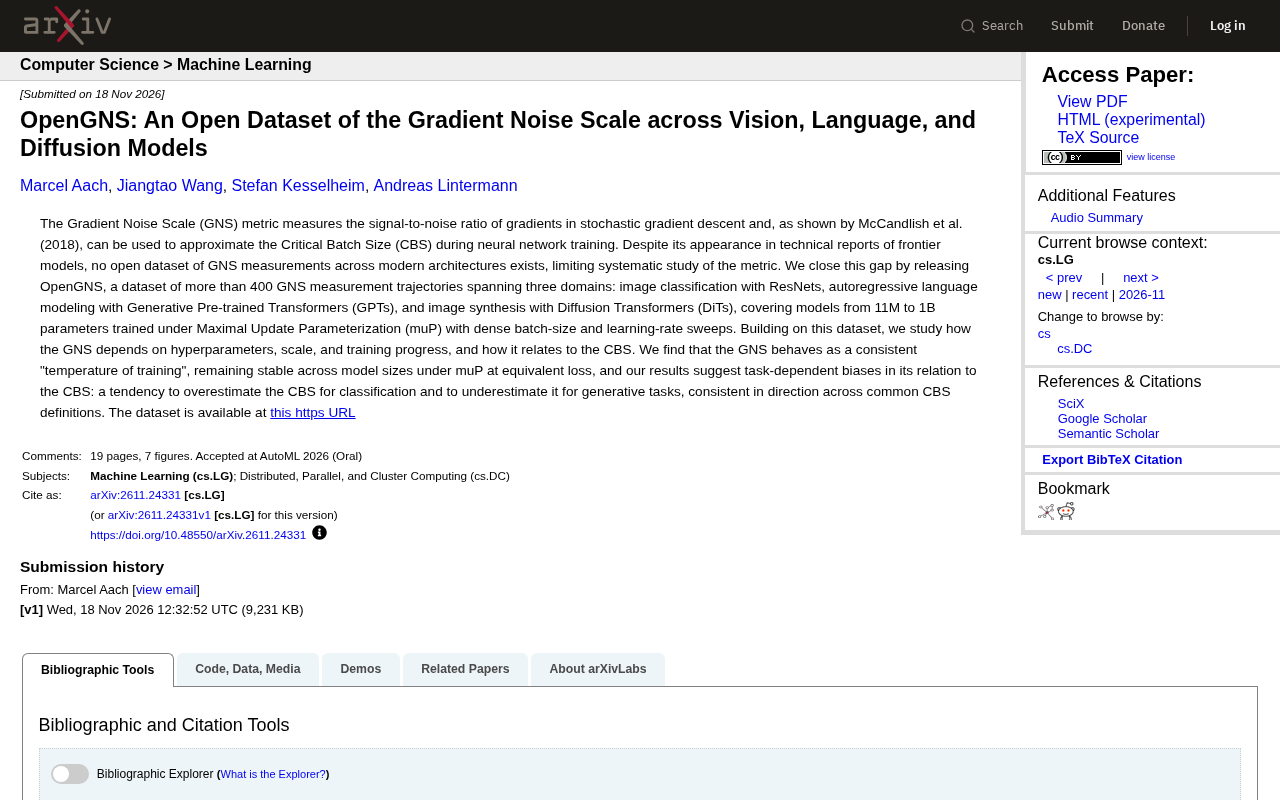
OpenGNS releases the first public gradient noise scale dataset covering vision, language, and diffusion models, revealing GNS stability and task bias.
OpenGNS is the first public gradient noise scale (GNS) measurement dataset covering modern architectures, with over 400 trajectories spanning ResNet image classification, GPT language modeling, and DiT image synthesis, models from 11M to 1B parameters, all under muP with dense batch size and learning rate sweeps. Based on this data, the authors find that GNS behaves like a training "temperature" under muP: stable across model scales at the same loss, suggesting it is a scale-independent metric that may extrapolate from small models. Meanwhile, the relationship between GNS and critical batch size (CBS) has task bias: classification tasks tend to overestimate CBS, generative tasks tend to underestimate it. The dataset elevates GNS from scattered empirical observations to an object of systematic study, providing a public foundation for batch size selection and parametrization research.
Gradient Noise Scale (GNS) is a key metric for understanding the signal-to-noise ratio in stochastic gradient descent. Back in 2018, McCandlish et al. pointed out that GNS can be used to approximate the Critical Batch Size (CBS) in neural network training. Although this metric occasionally appears in the technical reports of frontier models, there has long been a lack of a public GNS measurement dataset covering modern architectures, which has limited systematic research. The release of OpenGNS fills this gap.
What the OpenGNS Dataset Contains
OpenGNS provides over 400 GNS measurement trajectories, covering three major domains: image classification using ResNet, autoregressive language modeling using GPT, and image synthesis using Diffusion Transformer (DiT). Model sizes range from 11M to 1B parameters, all trained under Maximal Update Parametrization (muP), with dense batch size and learning rate sweeps. The dataset is hosted on Hugging Face for researchers to download and use directly.
This cross-architecture, cross-scale design allows researchers, for the first time, to compare the behavior of GNS across different tasks under unified experimental conditions. Compared with scattered technical report data, the dense sweeps in OpenGNS provide a solid foundation for analyzing the effects of hyperparameters, model scale, and training progress on GNS.
Maximal Update Parametrization (muP) is a neural network parametrization scheme proposed by Greg Yang et al. in 2021. Its core goal is to keep the output variance of each layer stable at initialization when model width changes, and to scale the learning rate of each layer with width according to a specific ratio, so that hyperparameters (especially the learning rate) can be transferred losslessly from small models to large models.
Under standard parametrization, the optimal learning rate usually drifts as model width changes, causing hyperparameters tuned on small models to fail when directly applied to large models. muP adjusts initialization variance and per-layer learning rate scaling so that training dynamics are approximately invariant along the width dimension. OpenGNS chooses to perform all measurements under muP precisely to exclude confounding factors introduced by parametrization when comparing GNS across models of different scales, making the conclusion that "GNS is stable across scales at the same loss" more comparable.
GNS Acts Like a Training "Temperature"
Based on this data, the authors focused on how GNS changes with hyperparameters, scale, and training progress, as well as its relationship with CBS. A core finding is that GNS behaves like a training "temperature": under muP, at the same loss, GNS remains stable across different model scales.
This means that GNS may be a scale-independent stable metric capable of reflecting the "thermodynamic state" of training. For researchers who need to transfer hyperparameters across scales, this property is valuable—it suggests that GNS measured on small models may be extrapolatable to larger models, thereby reducing tuning costs.
Critical Batch Size (CBS) refers to the threshold beyond which further increasing batch size no longer brings proportional convergence acceleration, i.e., computational efficiency begins to decline. Intuitively: with small batches, gradient noise is large, and increasing batch size is equivalent to reducing noise and improving the effective learning signal per step; but once the batch is large enough that noise has been sufficiently averaged out, further increasing batch size merely repeats computation of similar information.
McCandlish et al. proposed that there is an approximate relationship between CBS and the gradient noise scale GNS. GNS characterizes the ratio of gradient signal to noise and can therefore serve as a proxy for CBS. Since directly measuring CBS requires running multiple batch sizes and comparing convergence curves, which is costly, while GNS can be obtained by estimating gradient variance within a single training run, approximating CBS with GNS is attractive from an engineering perspective. OpenGNS is built around this relationship and examines its directional bias across different tasks.
Relationship with Critical Batch Size Has Task Bias
The relationship between GNS and CBS is not entirely neutral. The authors found that this relationship has task-dependent bias: for classification tasks, GNS tends to overestimate CBS; for generative tasks, it tends to underestimate CBS. Moreover, this directionality remains consistent under several common definitions of CBS.
This finding reminds practitioners that when using GNS to approximate CBS, correction should be made according to task type. Differences in gradient noise structure between classification and generative tasks may stem from differences in loss function shape, data distribution, or model output layers, but OpenGNS at least provides a quantifiable starting point.
Significance for Training Efficiency Research
The value of OpenGNS lies not only in the data itself. It elevates GNS from scattered empirical observations to an object of systematic study. With public measurement trajectories covering multiple architectures, the community can reproduce, validate, and extend theories about batch size selection, and can also more carefully test the practical performance of parametrization schemes such as muP across different tasks.
For teams concerned with training efficiency, this dataset can help determine how batch size should be adjusted over the course of training for a given model and task. However, it should be noted that the current conclusions are based on muP training settings, and whether GNS behavior remains similarly stable under other parametrization schemes still requires further research.
Dataset address: https://huggingface.co/datasets/olympique-marcel/OpenGNS
Hugging Face Datasets is a public dataset hosting and loading library provided by the Hugging Face platform, supporting online loading, streaming reads, or local caching through a unified interface via the datasets library. Researchers can obtain the dataset with one line of code and directly integrate it with training frameworks such as PyTorch and TensorFlow. OpenGNS being hosted here means low barriers to use, and it is also convenient for the community to reproduce experiments, submit new measurement trajectories, or extend the range of covered architectures, thereby forming a cumulative GNS benchmark.
One-line Summary
OpenGNS releases the first public gradient noise scale dataset covering vision, language, and diffusion models, revealing the stable properties and task bias of GNS.
Paragraph Summary
OpenGNS is the first public GNS measurement dataset covering modern architectures, containing over 400 trajectories spanning ResNet image classification, GPT language modeling, and DiT image synthesis, with model sizes from 11M to 1B parameters, all under muP with dense batch size and learning rate sweeps. Based on this data, the authors find that GNS behaves like a training "temperature" under muP: it remains stable across model scales at the same loss, suggesting it can serve as a scale-independent metric and may extrapolate from small models. At the same time, the relationship between GNS and Critical Batch Size (CBS) has task bias: classification tasks tend to overestimate CBS, while generative tasks tend to underestimate CBS. The dataset elevates GNS from scattered empirical observations to an object of systematic study, providing a public foundation for research on batch size selection and parametrization schemes.
Related articles
New Claude Sonnet Model Tested: Performance Approaches Opus with Less Thinking
Anthropic quietly tests a new Sonnet model in Claude Code—performance approaches Opus 5.5 with far fewer thinking tokens, plus Codex transfer optimization, xAI's low-level rewrite, Google Antigravity updates, and the AI science understanding gap.

Building a Reasoning Model from Scratch: Making Complex AI Algorithms Accessible
Mike Finley, author of Build a Reasoning Model from Scratch, shows how a few hundred lines of code, single-sample training, and code reuse make complex AI algorithms like RL and verifiers accessible to all.

11-Hour Free Course: Build a Reasoning AI from Scratch, Runs on an Ordinary Laptop
Sebastian Raschka released an 11-hour free video course teaching you to build a reasoning AI from scratch in Python. Covers verifiers, sampling, self-refinement, RL, and distillation; early chapters run on a laptop.