OpenHands Agent Canvas: The Central Control Console for Managing All AI Agents

OpenHands Agent Canvas is a control plane for orchestrating multiple AI Agents, not just another coding tool.
OpenHands Agent Canvas positions itself as a central control console for managing multiple AI Agents like Claude Code, Codex, and Gemini. Rather than being another AI coding assistant, it serves as a "control plane" that enables unified orchestration, event-driven automation workflows via Slack/GitHub integration, hot-swappable backends from local to cloud, and full observability. Best suited for teams running multiple AI Agents simultaneously rather than individual developers.
When we're still debating whether to choose Cursor or Claude Code as our AI programming assistant, OpenHands has already elevated the game to an entirely new dimension — it's not trying to be another AI coding tool, but rather the central control console for managing all AI Agents. Imagine this: Slack receives an issue, and AI automatically breaks down the task; GitHub reports a bug, and AI automatically invokes Claude Code to fix it and submit a PR. This is the vision OpenHands Agent Canvas aims to realize: a 24/7 AI engineering team that never clocks out, permanently stationed on your servers.
From Open Source Project to Company: The Origin Story of OpenHands
OpenHands was formerly known as OpenDevin, and it made quite a splash when it was open-sourced in 2024. It positioned itself against the then-hot commercial product Devin — an AI software engineer capable of autonomously writing code. Devin was released by startup Cognition Labs in March 2024 and was dubbed "the world's first AI software engineer." It could autonomously complete the entire development workflow from requirements understanding, code writing, and debugging to deployment, demonstrating capabilities far beyond other AI coding tools of the time on the SWE-bench benchmark. Devin's emergence sent shockwaves through the software engineering field and spawned multiple open-source alternatives. The community took Devin's philosophy and forked OpenHands as an open-source version, driven by a core motivation: such critical infrastructure capabilities should not be monopolized by a single commercial company. The team later incorporated under the name All Hands AI, launching Cloud and Enterprise paid versions.
Today, OpenHands' flagship product is Agent Canvas, repositioned from a simple AI programming assistant to an AI Agent control center Dashboard. The logic behind this transformation is worth noting: when the market is already flooded with AI coding tools, the real pain point is no longer "is there an AI to help me write code" but rather "how do I manage and orchestrate these AI tools."

Agent Canvas's Core Positioning: The Agent of Agents
The most clever aspect of Agent Canvas is its positioning — it's not another Agent framework, but the control center for Agents. Your OpenHands Agent, Claude Code, Codex, Gemini — all can be mounted onto Canvas for unified conversation and unified orchestration.
In other words, Canvas is the "Agent of Agents" — the Dashboard is the manager, and the various AI Agents are the workers. The benefits of this decoupled architecture are obvious: you can mix and match the most suitable AI Agent based on the characteristics of different tasks. For example, use a lightweight model for simple code completion, hand complex architectural refactoring to Claude Code, and let Gemini handle frontend UI generation.
Automated Workflows: From Chatbot to Digital Employee
The most exciting aspect is Agent Canvas's pre-built automation capabilities. It deeply integrates with mainstream development tools like Slack, GitHub, Linear, and Notion to enable event-driven automated workflows.
The "event-driven" concept here is far from hollow. Event-Driven Architecture (EDA) is a mature software design pattern where systems trigger subsequent operations by listening to and responding to events, rather than relying on polling or manual invocation. Webhooks are a common implementation of EDA — when a specific event occurs (such as a new issue being created on GitHub), the source system sends an HTTP callback request to a pre-registered URL, and the receiver triggers the corresponding processing logic accordingly. This pattern is already very mature in DevOps and CI/CD domains. OpenHands introducing it to AI Agent orchestration essentially incorporates AI Agents into the existing automation infrastructure ecosystem.
Two typical application scenarios illustrate this well:
- Automatic Weekly Report Generation: Automatically scans code repository commit records and changes weekly, generates progress reports, and pushes them to Slack channels
- Automatic Issue Handling: When a new issue comes in on GitHub, the Agent automatically reads the issue content, plans the fix, writes code, and submits a PR

This means AI Agents no longer need you to manually trigger them — they can work autonomously on scheduled tasks or Webhook events. This is the key upgrade from "conversational AI assistant" to "digital employee" — AI begins to possess initiative and autonomy.
Flexible Deployment Architecture: From Laptop to Cloud
OpenHands provides multi-tiered Backend options for deployment, meeting the needs of teams of different sizes:
- Entry-level: Run directly on a local laptop, suitable for individual experimentation
- Intermediate: Local Docker container deployment, with better isolation
- Advanced: Remote VM or company intranet server, suitable for team collaboration
- Maximum: OpenHands Cloud or Enterprise Backend, fully managed service
What's even more interesting is that these Backends support hot-switching. You can develop and debug on your local laptop during the day, then migrate to the Cloud Backend with one click before leaving work, letting AI Agents continue working overnight. The next morning, the PR is already submitted.
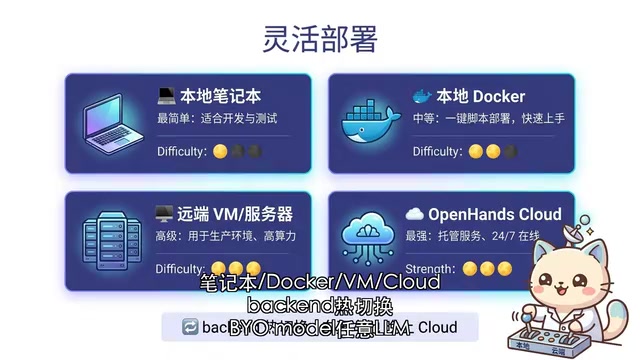
For model support, OpenHands adopts a BYO (Bring Your Own) Model strategy, supporting any LLM integration — OpenAI, Anthropic, or even locally deployed Ollama. Ollama is an open-source local LLM runtime framework that allows users to run open-source models like Llama, Mistral, and Gemma on their own hardware without sending data to external APIs. For industries with strict data sovereignty requirements such as finance, healthcare, and government, locally deployed models are a rigid compliance necessity. OpenHands' support for Ollama means the entire chain — from Agent orchestration to model inference — can be completed within the enterprise intranet, with data never leaving the firewall. This openness is especially important for enterprise users who prioritize data security.
Differentiation from Other Tools: The Control Plane Mindset
Understanding OpenHands' positioning requires distinguishing its hierarchical difference from existing tools:
| Tool | Positioning | Core Capability |
|---|---|---|
| Claude Code | Single Agent | Provides a powerful AI programming assistant |
| Cursor | IDE Integration | Embeds AI capabilities within the editor |
| OpenHands Canvas | Control Plane | Manages, orchestrates, and observes all Agents |
The Control Plane concept wasn't invented by OpenHands — it's a classic architectural concept from networking and distributed systems. It was first widely applied in SDN (Software-Defined Networking): the control plane is responsible for deciding "where data should go," while the Data Plane handles actual data forwarding. Kubernetes also adopts a similar layered design — the control plane (API Server, Scheduler, Controller Manager) handles global cluster scheduling and state management, while worker Nodes are responsible for actually running containers. OpenHands migrates this concept to the AI Agent domain: Canvas serves as the control plane responsible for orchestration and observation, while individual AI Agents serve as the data plane responsible for actually executing coding tasks.
When you only have one AI Agent, Claude Code or Cursor is perfectly sufficient. But when your team has multiple developers, multiple Agents, and multiple automated Workflows running simultaneously, you need a unified control plane — to see the running status of all Agents, manage their scheduling strategies, and track the execution results of automated tasks. This is the core problem OpenHands aims to solve.
A Sober Assessment: Who Should Use It, Who Shouldn't

To be honest, OpenHands Agent Canvas is not for everyone. If you're an individual developer who occasionally uses Claude Code to write some code or fix bugs, Agent Canvas is most likely over-engineering. The complexity of introducing a management platform far exceeds the benefits you'd gain.
But if your team fits the following profile, OpenHands is worth serious evaluation:
- The team has multiple developers using various AI Agents daily
- There's a need to uniformly manage and observe the running status of multiple Agents
- You want to implement event-driven automated workflows (automatic issue fixing, automatic weekly report generation, etc.)
- You have requirements for Observability and need to track AI Agent behavior and output
The concept of observability here deserves further explanation. Observability is a core concept in the cloud-native domain, typically comprising three pillars: Logs, Metrics, and Traces. In traditional software systems, observability helps engineers understand internal system state and locate root causes of failures. When AI Agents begin autonomously executing tasks, observability becomes even more critical — you need to know what decisions the Agent made, which files it modified, and why it chose a particular implementation approach. An AI Agent without observability is like a "black-box employee" — you can only see the final output without being able to audit the process, which is an unacceptable risk in production environments.
One-line summary: Individual users are fine with Claude Code; team users should look at OpenHands.
The Bigger Trend: Platform Evolution of AI Tools
What OpenHands shows us is a clear evolutionary path for AI Agent tools: from point solutions to central control consoles, from manual triggering to automated workflows, from personal assistants to team infrastructure.
This path is not unfamiliar to us. Recall the development of cloud computing: initially everyone used single servers, then came virtualization, and later came container orchestration platforms like Kubernetes. Kubernetes (often abbreviated as K8s) was born in 2014, open-sourced by Google based on their experience with their internal container management system Borg, and has since become the de facto infrastructure standard of the cloud-native era. Its core value lies in this: when the number of containers grows from a few to hundreds or thousands, manual management becomes impossible, and you need an automated orchestration layer to handle complex problems like scheduling, scaling, and failure recovery. AI Agent tools are following the same path — when there are enough Agents and scenarios become sufficiently complex, an "orchestration layer" for unified management becomes inevitable.
Whether OpenHands will become the "Kubernetes" of the AI Agent domain is too early to conclude. But the direction it represents — AI tools evolving from point solutions to platforms — is almost certainly a definitive trend. For technical teams, starting to pay attention to this direction now, building cognition and practice around Agent orchestration, is a long-term bet worth making.
Related articles

Disaster and Glory of the Apollo Program: The History We Must Revisit Before Returning to the Moon
From the fatal Apollo 1 fire to Apollo 8's daring lunar orbit to Apollo 11's successful landing—revisiting the disasters, fears, and compromises of the Apollo program and their lessons for today's return to the Moon.
Netflix Trust Exercise Turns Into Firing Trap: Where Are the Boundaries of Corporate Trust?
A Netflix employee was fired after sharing private info in a trust exercise. We analyze the risks of corporate trust exercises and how employees can protect themselves.

AMD CDNA5 Architecture Deep Dive: Technical Evolution and the AI Computing Competition Landscape
Deep analysis of AMD's CDNA5 architecture covering Chiplet packaging upgrades, HBM memory evolution, and low-precision compute optimization, examining how AMD challenges NVIDIA's AI chip dominance.