OpenLogi: An Open-Source Alternative to Logitech Drivers, Rewritten in Rust
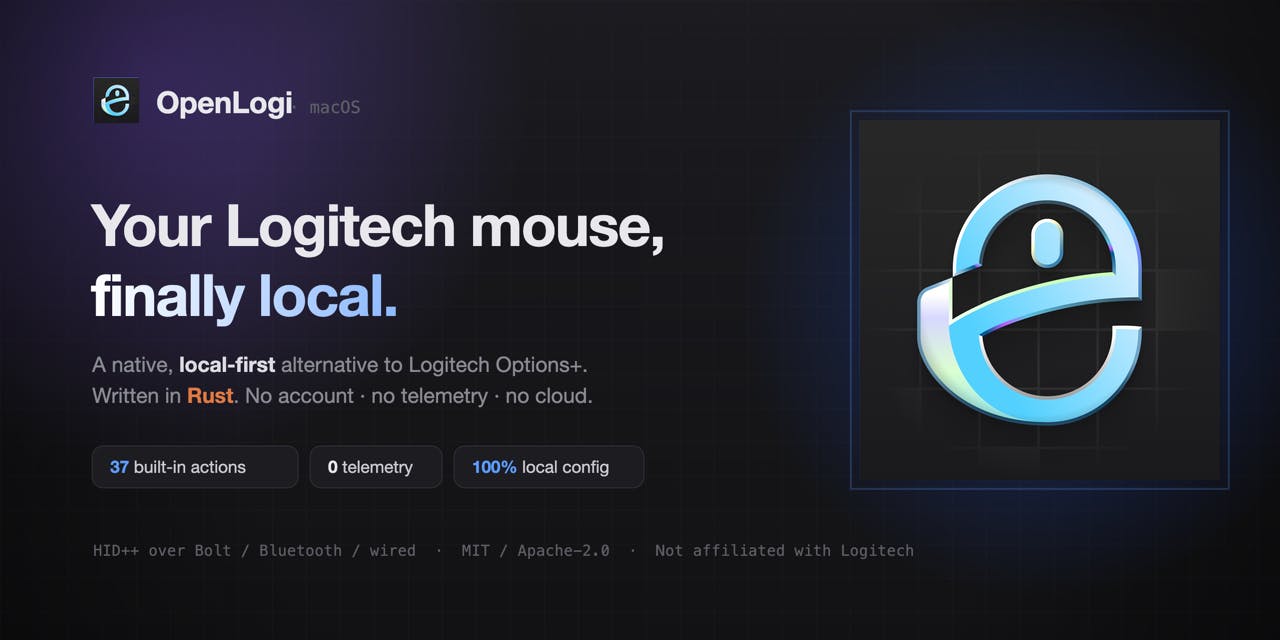
OpenLogi is a Rust-based, local-first open-source replacement for Logitech Options+ with zero telemetry.
OpenLogi is a new open-source alternative to Logitech Options+ built in Rust. It supports key remapping, DPI adjustment, and SmartShift control via the HID++ protocol — all without requiring account login or telemetry. Designed with a local-first philosophy, it appeals to privacy-conscious users and Linux users who lack official Logitech support, offering a lightweight and transparent driver experience.
When Peripheral Software Becomes a Burden
For users of Logitech's high-end mice and keyboards, Logitech Options+ is practically the mandatory companion software. It handles core functions like key remapping, DPI adjustment, and SmartShift scroll wheel toggling. Yet for years, the software has drawn relentless criticism from power users for its bloated size, forced account login, persistent background processes, and questionable telemetry behavior.
Logitech Options+ is Logitech's next-generation peripheral management software, launched in 2021 to replace the earlier Logitech Options and Logitech Gaming Software (LGS). However, this "unification" hasn't won universal praise. Built on the Electron framework, the installer exceeds 300MB, and runtime memory usage hovers between 200–400MB — absurdly heavy for what is essentially a driver tool that just needs to communicate with hardware. Even more controversial, Logitech later introduced a mandatory Logi ID account login requirement, meaning users must complete online registration even for something as basic as adjusting mouse DPI. Many users view this coupling of hardware functionality with cloud services as unnecessary friction.
It's against this backdrop that an open-source tool called OpenLogi appeared on Product Hunt, earning 108 upvotes to claim the #3 spot for the day, categorized under "Productivity, Open Source, Hardware." Its positioning is crystal clear — a local-first alternative to Logitech Options+.
OpenLogi's Core Features: Local-First and Zero Telemetry
OpenLogi was built by developer Xuan Zhang, and its biggest selling point can be distilled into a single phrase: "no account, no telemetry."
A Native Driver Experience Built with Rust
The project is written in Rust, a technology choice that sends a clear signal — pursuing performance, memory safety, and minimal runtime overhead. Compared to Electron or other peripheral software packaged with web-based tech stacks, native applications built in Rust typically mean lower resource consumption and faster response times. This is especially critical for a driver-class tool that needs to run in the background long-term.
Rust is a systems programming language initiated by Mozilla Research in 2010 and reached version 1.0 in 2015. Its most fundamental innovation is the "ownership system" — a mechanism that checks memory safety at compile time, avoiding common C/C++ pitfalls like null pointers, buffer overflows, and data races, all without introducing the runtime performance costs of garbage collection (GC). This makes Rust particularly well-suited for building system-level tools that run in the background for extended periods and are sensitive to resource usage. In recent years, the Linux kernel, Windows driver frameworks, and Android low-level components have all begun incorporating Rust code. For a driver-level application like OpenLogi that needs to communicate directly with USB devices and parse binary protocols, Rust delivers performance close to C while dramatically reducing the risk of system crashes or security vulnerabilities caused by memory errors.
Direct Communication via Logitech's HID++ Protocol
OpenLogi's functionality is built on the HID++ protocol. HID++ is Logitech's proprietary extension of the standard HID (Human Interface Device) protocol. Advanced features on Logitech devices — such as programmable buttons, granular DPI settings, and SmartShift scroll wheel damping — all communicate through it.
To appreciate the value of HID++, some technical context is helpful. HID (Human Interface Device) is a device protocol defined within the USB standard that governs basic communication between input devices like keyboards, mice, and gamepads and computers. The standard HID protocol is limited in functionality, covering only basic key input and pointer movement. To support advanced features in premium peripherals, Logitech developed the HID++ extension protocol on top of it. HID++ has evolved to version 2.0 (and subsequent minor versions), adopting a modular "Feature Page" architecture — each advanced function (such as adjustable DPI, SmartShift scrolling, onboard memory profiles, battery status queries, etc.) is encapsulated as an independent feature ID. Although HID++ is Logitech's proprietary protocol, parts of its specification have been documented by the reverse engineering community, and several open-source projects (such as Solaar and libratbag) have achieved third-party control of Logitech devices based on these reverse-engineered findings. OpenLogi similarly relies on this protocol knowledge to achieve device communication without the official driver.
OpenLogi currently offers the following core capabilities:
- Remap buttons: Customize the function of each mouse button
- DPI adjustment: Directly control pointer sensitivity
- SmartShift control: Toggle scroll wheel behavior between "ratchet mode" and "free-spin mode"
Regarding SmartShift, this is a signature scroll wheel technology introduced by Logitech in its MX Master series mice, and it's worth understanding in more detail. Traditional mouse scroll wheels have only one scrolling mode, but SmartShift uses an electromagnetically controlled mechanical switching mechanism to enable intelligent toggling between two modes: "ratchet mode" provides step-by-step tactile feedback, ideal for precise web page or document browsing; "free-spin mode" releases the ratchet resistance, allowing the wheel to spin continuously at high speed like an inertial flywheel, ideal for rapidly scrolling through long documents or large spreadsheets. The "smart" aspect of SmartShift is that it can automatically switch modes based on the force the user applies to the wheel — gentle flicks maintain the ratchet feel, while forceful spins automatically engage free-scroll mode. The force threshold for this transition is configured via parameters in the HID++ protocol, and this is one of the core adjustment capabilities that OpenLogi provides.
These are precisely the features most users actually need from the official software, and OpenLogi extracts them in a lighter, more transparent way.
Why "Local-First" Design Matters So Much for Driver Software
"Local-first" isn't just a marketing buzzword — it represents a software design philosophy that is gaining increasing recognition. Under this approach, all configuration and computation happens on the user's local device; data is never uploaded to the cloud, nor does it depend on vendor servers.
This concept was formally articulated and systematized in a 2019 research paper by Ink & Switch lab titled Local-first software: You own your data, in spite of the cloud. The paper proposed seven core principles for evaluating software: fast responsiveness, multi-device collaboration, offline availability, secure collaboration, long-term accessibility, user privacy, and user ownership of data. The rise of this philosophy has deep roots: over the past decade, the sweeping expansion of SaaS (Software as a Service) has led to more and more user data and core functionality being locked away on vendor cloud servers. If a vendor discontinues service, changes terms, or suffers a security incident, users risk losing control of their own data.
For peripheral drivers, this translates into several tangible benefits:
- Privacy control: No usage data collection, no telemetry reporting concerns
- No account binding: Skip the hassle of registration and login, and avoid the additional dependencies that come with account systems
- Offline availability: All features work normally even without an internet connection
- Less background overhead: No need for multiple persistent processes to sync cloud-based configurations
In the peripheral driver space, these concerns are particularly concrete — Razer's Synapse, SteelSeries GG, Corsair's iCUE, and other vendor software all require cloud accounts and network connectivity to varying degrees. Users' key mappings, lighting configurations, and other personalized settings are essentially hosted on vendor servers. In recent years, from consumer electronics to productivity tools, more and more users have grown resistant to the "everything must go to the cloud" model. OpenLogi is a concrete manifestation of this "return to local" movement in the hardware peripheral space.
The Complementary Value of the Open-Source Ecosystem
As an open-source project, OpenLogi's significance also lies in its transparency and sustainability. Official software is a black box — users have no way of knowing what it's actually doing in the background. Open source means anyone can audit the code and verify whether the "no telemetry" promise truly holds up.
This resonates particularly strongly in the Linux community — Logitech has always offered weak official support for the Linux platform, and the community has long relied on third-party open-source projects like libratbag and Solaar to fill the gap. On Linux, third-party support for Logitech devices mainly depends on these two community projects: Solaar is a Python-based Linux device manager specifically targeting Logitech's Unifying, Bolt, and Lightspeed receiver devices, offering device pairing, battery monitoring, function key configuration, and more, with over 4,600 GitHub Stars to date. libratbag is a lower-level C library that provides cross-brand mouse configuration capabilities (not limited to Logitech), used alongside its graphical frontend piper. These two projects have been lifelines for Linux Logitech users for years, but they each face their own limitations — Solaar's Python tech stack incurs overhead in performance-sensitive scenarios, and libratbag's development activity has declined in recent years.
OpenLogi joins this ecosystem with Rust as its technical foundation, bringing advantages in performance and safety while also representing a trend of a new generation of developers using modern toolchains to reexamine old problems, providing yet another option implemented in a modern language.
OpenLogi's Current State and Future Outlook
To be objective, as a newly launched tool, OpenLogi is still in its early stages. Judging by the modest engagement of just 2 comments on Product Hunt, it hasn't yet generated large-scale user discussion. Its compatibility across different Logitech device models and its feature completeness compared to the official software still need to be validated through real-world community usage.
That said, the direction it represents is worth affirming: reimplementing the core features users actually need in a lightweight, transparent, privacy-respecting way. For Logitech users who are fed up with bloated official software, who care about privacy, or who use Linux, OpenLogi is undoubtedly a new open-source option worth watching and trying.
As more users participate and contribute, whether these kinds of "local-first" open-source alternatives can truly challenge the dominance of official vendor software will be a fascinating development to watch.
Related articles

United Airlines CEO Calls for a National Wealth Tax: A Tech and Business Perspective
United Airlines CEO Scott Kirby calls for a national wealth tax, sparking Hacker News discussion. A tech and business analysis of the debate's core divides, tech industry reactions, and potential impact on aviation.

High School Student Builds 3D Open-World Game Hedra from Scratch
High school student builds 3D open-world game Hedra from scratch, drawing attention on Hacker News. This article analyzes its technical challenges, indie dev insights, and lessons for the AI coding era.

AI and the Enclosure of the Scientific Commons
Starting from a Hacker News discussion, this article analyzes how AI is changing the public nature of scientific knowledge, exploring enclosure risks facing the scientific commons and possible institutional responses across data privatization, model opacity, and evaluation shifts.