OpenObserve AI Observability: Track Every Cent and Call Chain of Your Agents
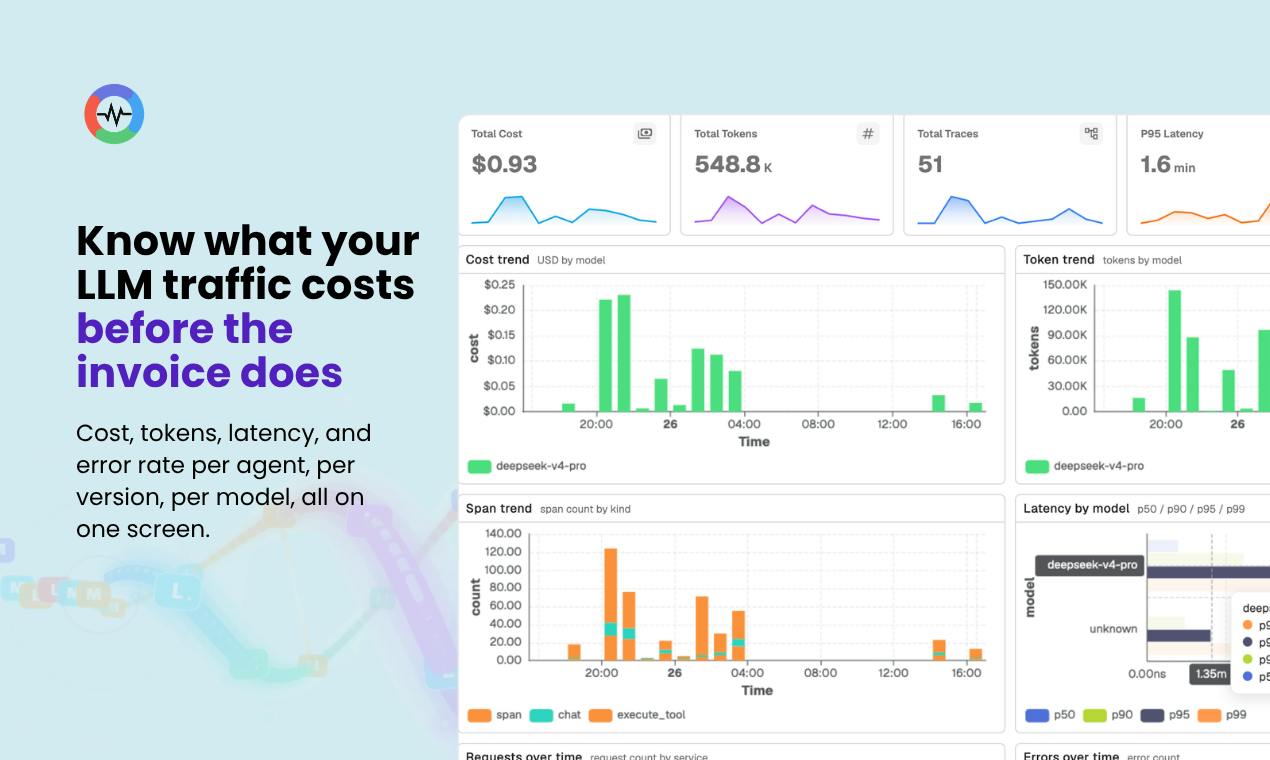
OpenObserve brings OTel-native AI observability to agents, making costs, latency, and output quality fully transparent.
As LLMs and agent systems move from experimentation to production, developers face complex call chains, opaque cost attribution, and inconsistent output quality. OpenObserve addresses these pain points with an OpenTelemetry-native AI observability product that unifies LLM calls, tool executions, backend services, and database queries into a single OTel tracing framework. Core capabilities include granular cost and latency attribution, infinite loop detection, and online evaluation of output quality in production — making AI observability a critical piece of infrastructure for scaling agents reliably.
When AI Agents Become a "Black Box," We Need New Observability Tools
As large language models (LLMs) and autonomous agents move from experimentation into production, a pressing question has emerged: the inner workings of these systems are becoming an impenetrable "black box." A single agent session might span multiple model calls, tool executions, backend services, and database queries — ultimately costing $40 and taking 34 seconds — yet developers often can't answer the most basic question: Why?
Recently landing second on Product Hunt with 167 upvotes, an AI observability tool from the OpenObserve team takes direct aim at this pain point. Built around an "OpenTelemetry-native" approach, it aims to extend the traditional observability paradigm into the complex call chains of AI applications.

What Is OpenTelemetry-Native AI Observability?
From Traditional Monitoring to AI Trace Tracking
In traditional software engineering, observability rests on three pillars: Logs, Metrics, and Traces. OpenTelemetry (OTel), as the open-source standard in the cloud-native space, has become the de facto specification for collecting telemetry data.
OpenObserve's core idea is to bring agent and LLM calls into this same mature OTel ecosystem. Rather than building a separate, siloed monitoring system for AI applications, developers can analyze LLM calls alongside backend services, databases, logs, metrics, and traces — all within a single unified platform.
Tracing Complete Agent Sessions
According to official documentation, OpenObserve can trace every agent session across models, tools, services, data stores, and user sessions. Developers can pinpoint exactly where time, money, and quality are being consumed — starting from a single LLM call and tracing all the way down to backend services and the database layer, reconstructing the complete failure path.
This end-to-end visibility directly addresses one of the core challenges in agent development: call chains are long, dependencies are complex, and when performance bottlenecks or cost overruns occur, tracking them down feels like searching for a needle in a haystack.
Core Capabilities: Cost Attribution, Loop Detection, and Online Evaluation
Granular Attribution of Cost and Latency
The product's most compelling selling point is its fine-grained attribution of cost and latency. The earlier example — "$40 and 34 seconds" — is highly representative. In multi-step agent workflows, cost and time sinks can hide anywhere: a model consuming too many tokens, a tool call timing out, or an unnecessary repeated inference. By tracing the details of every session, OpenObserve makes these hidden costs impossible to ignore.
Detecting Infinite Agent Loops
A classic failure mode in agent systems is getting "stuck in a loop" — where the agent repeatedly executes similar actions without converging, wasting compute and driving up costs. OpenObserve includes loop detection as a built-in capability, helping developers quickly identify and interrupt such anomalous behavior before it burns unnecessary resources.
Online Evaluation for Output Quality
Beyond performance, the product also supports Online Evals — continuously monitoring the quality of AI outputs in production. This is especially critical because LLM application failures often aren't outright crashes; they're cases where the system quietly delivers a bad answer. Combining quality evaluation with traditional performance monitoring is what sets AI observability apart from conventional monitoring.
Why AI Observability Tools Are Becoming Essential
An Inevitable Choice in the AI Engineering Wave
The LLM observability space is heating up rapidly, with a wave of dedicated tools like LangSmith, Langfuse, and Helicone emerging in quick succession. OpenObserve's differentiated bet on an "OTel-native" approach is fundamentally about leveraging the existing cloud-native ecosystem to reduce the migration cost for enterprises integrating AI monitoring into their existing infrastructure.
For engineering teams already running an OpenTelemetry stack, this "seamless integration" approach means a lower learning curve and a unified operational view — without having to introduce yet another standalone AI-specific monitoring system.
Critical Infrastructure for Production-Grade Agents
As more enterprises attempt to deploy agents in real-world business scenarios, cost controllability, reliability, and quality assurance have become non-negotiable requirements. Observability tooling is no longer a "nice to have" — it's essential infrastructure for scaling agents to production. OpenObserve's strong showing on Product Hunt also reflects a broad consensus within the developer community around this need.
Conclusion
OpenObserve's AI observability product represents an important direction in the AI engineering journey: extending mature cloud-native observability principles into the unpredictable world of LLMs and agents. As AI applications graduate from demo to production, the ability to "see clearly" into the cost, latency, and quality of every call will directly determine whether they can be trusted and scaled. For teams building agent systems, tools like this are well worth considering in your technology evaluation.
Related articles
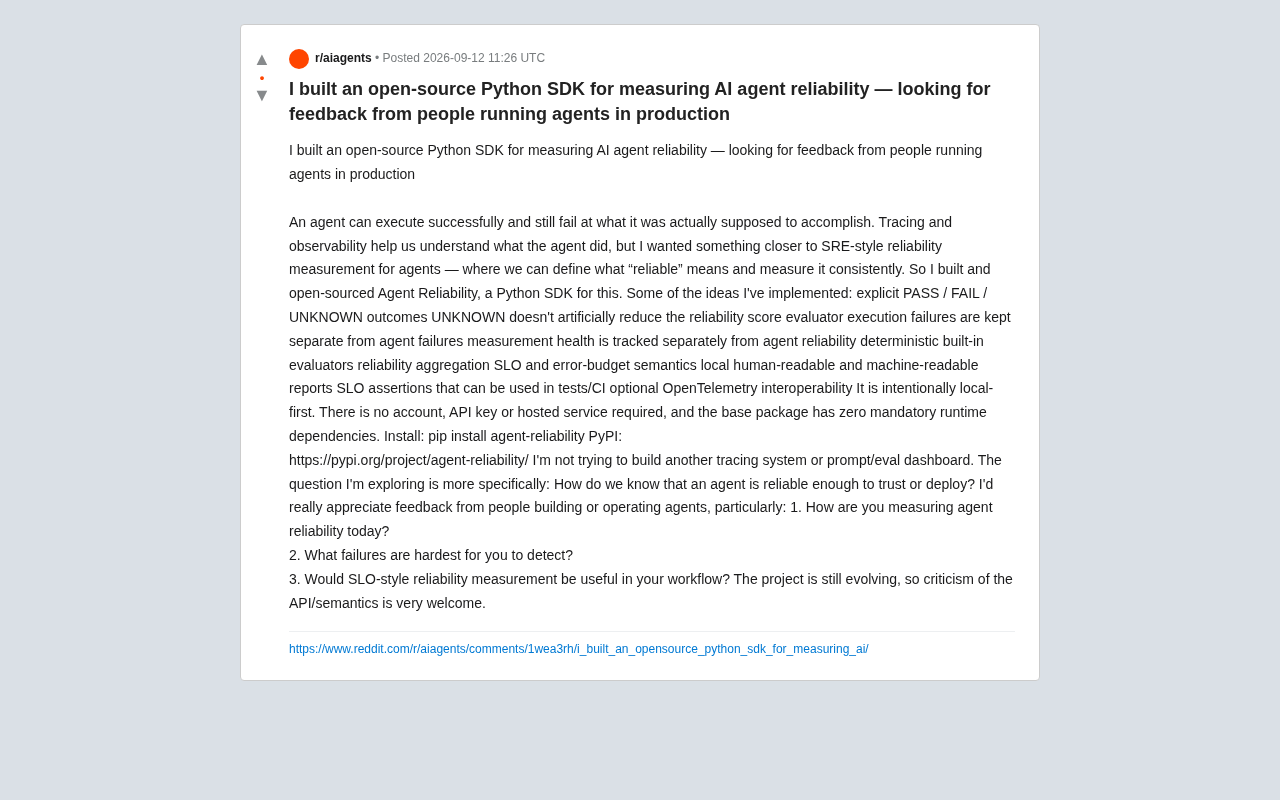
Open-Source Python SDK: Measuring AI Agent Reliability with SRE Principles
Agent Reliability is an open-source Python SDK that applies SRE's SLO and error budget concepts to AI Agent evaluation, with PASS/FAIL/UNKNOWN states, CI assertions, and zero forced dependencies.
MiniMax RefMod: A Complete Guide to Training-Free Reusable Identity Workflows
MiniMax RefMod offers training-free reusable identity workflows for image, video, and audio generation. Includes Runpod template and tutorial for quick setup.

Invalid Source Material Notice
The source material provided lacks substantive information and is unrelated to AI/tech topics, making it impossible to produce a complete professional article.