OpenRouter Data Reveals: DeepSeek Captures 53% of Traffic, Open-Source Models Exceed 75% Share

DeepSeek takes 53% of OpenRouter's 27T daily tokens, open-source models over 75%, revealing a traffic shift on aggregation platforms.
OpenRouter's latest data shows DeepSeek alone accounts for 53% of 27 trillion daily tokens, with open-weight models exceeding 75% combined, whereas 8 months ago OpenAI and Anthropic were the largest providers. Community discussion attributes this shift to models like DeepSeek offering near-frontier reasoning at extremely low cost. Users choose OpenRouter over official APIs for unified key management, flexible switching, data retention policies, and pay-per-use. However, DeepSeek's official endpoint on OpenRouter has only a fraction of direct-connection throughput and clearly lower priority. These numbers indicate open-source model competitiveness has entered the actual usage validation stage, and the core value of aggregation platforms lies in reducing the friction cost of multi-model experimentation.
OpenRouter's latest data has sparked heated discussion in the community: of 27 trillion tokens in a single day, DeepSeek alone accounts for 53%, and open-weight models collectively exceed 75% of traffic. Behind these numbers lies a subtle interplay between API aggregation platform usage habits and model competitiveness.
Data Interpretation: Open-Source Models Are Dominating Aggregation Platforms
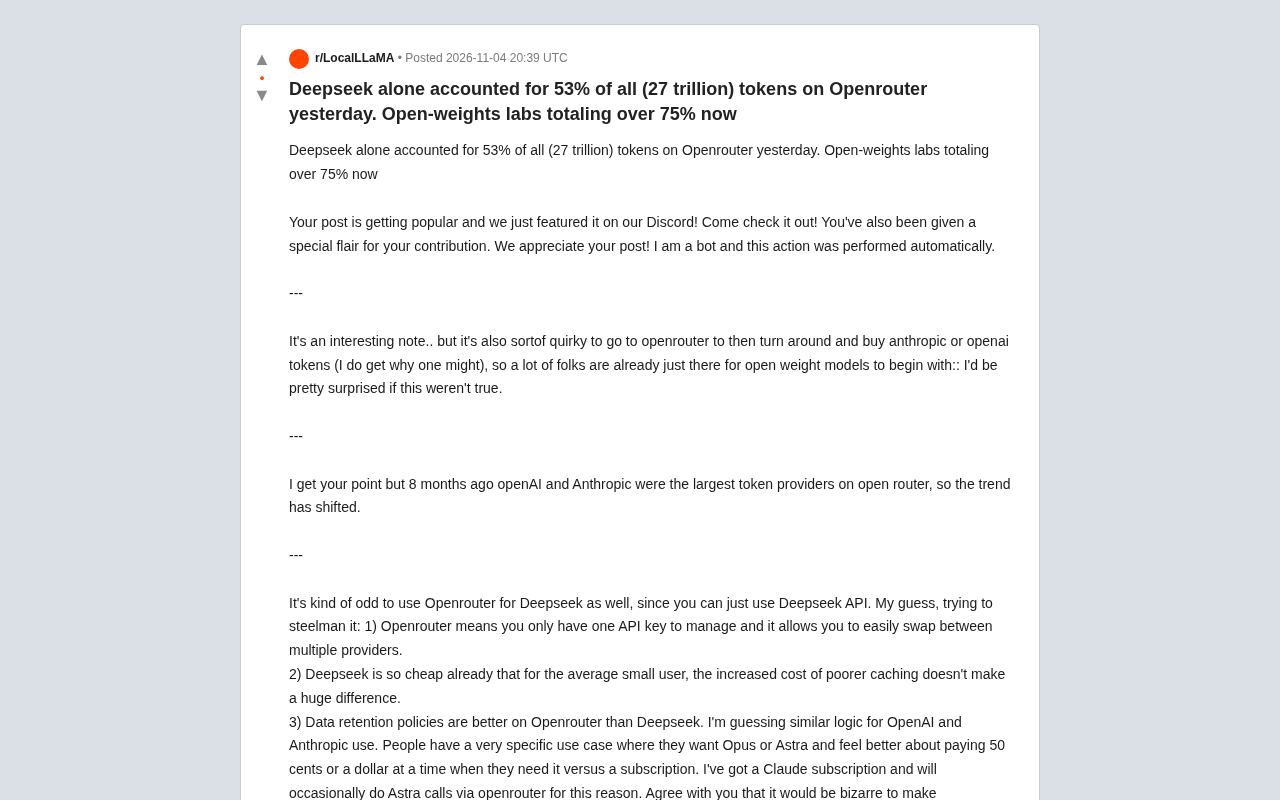
According to a Reddit community share, OpenRouter consumed a total of 27 trillion tokens the previous day, with DeepSeekAd alone taking 53% and all open-weight labs combined exceeding 75%. This means that on OpenRouter, a major aggregation gateway, the traffic share of closed-source giants OpenAI and Anthropic has been significantly squeezed by the open-source camp.
Some commenters noted that 8 months ago OpenAI and Anthropic were still the largest token providers on OpenRouter, but the trend has clearly shifted. This change is no accident—models like DeepSeek offer near-frontier reasoning capabilities at extremely low cost, creating strong appeal for price-sensitive developers and small-to-medium teams.
It's worth noting that OpenRouter's user base itself skews toward open-source model early adopters, so the 75% share cannot be directly equated with the overall market landscape. But it at least shows that in the typical scenario of "multi-model switching," open-weight models have become the default choice.
OpenRouter is an API aggregation platform where developers can call models from multiple providers such as OpenAI, Anthropic, and DeepSeek through a single interface. The platform bills by token usage and supports automatic routing, fallback, and cost optimization. Its traffic data is often used as a window into actual model usage trends, but note that its user base skews toward tech early adopters and multi-model developers—it is not a random sample of the entire market.
Open-weight models refer to models whose parameters are publicly downloadable and allow self-deployment or fine-tuning, such as DeepSeek and the Llama series. Unlike fully closed-source GPT-4 and Claude, open-weight models can be offered via API by third-party hosting services, and traffic on OpenRouter represents the collection of such hosted calls.
Why Do Users Choose OpenRouter Over Official APIs?
A direct question: since DeepSeek has its own API, why go through OpenRouter? Community discussion offers several practical reasons.
Unified key management and flexible switching is the primary factor. OpenRouter lets developers maintain just one API key to quickly switch between multiple providers, saving the hassle of registering, topping up, and managing keys on each platform individually.
Cost vs. caching trade-offs. Some users pointed out that DeepSeek itself is extremely cheap, so for ordinary small users, the extra cost from slightly worse caching efficiency on OpenRouter is almost negligible.
Data retention policies. Some users believe OpenRouter's data retention policy is more friendly than using DeepSeek directly, making this a practical consideration for choosing the aggregation platform.
Additionally, for users who occasionally need to call expensive models like Claude Opus, pay-per-use is more cost-effective than a subscription—one user mentioned having a Claude subscription but occasionally making single calls through OpenRouter.
Caching efficiency in the API aggregation context refers to an upstream provider's ability to hit cache on repeated prompt prefixes. When connecting directly to an official API, caching strategy is uniformly managed by that provider, typically yielding higher hit rates; when forwarding through OpenRouter, requests may pass through additional routing layers, potentially diluting caching benefits. For users who frequently repeat the same system prompt, caching differences directly affect actual costs—though DeepSeek's extremely low unit price makes this impact insignificant at small-to-medium usage levels.
Experience Gap: Official Endpoints Get Higher Priority
Discussion also raised concerns about DeepSeek's official endpoint on OpenRouter. One user bluntly stated that DeepSeek's official endpoint on OpenRouter is a "second-class citizen": throughput is only a fraction of direct connections, availability is unstable, and it clearly prioritizes its own direct users.
Another user shared their migration experience: they tried DeepSeek on OpenRouter a few months ago, then switched to direct connection, achieving daily decoding speeds of 250–350 t/s and gaining first access to new models. They also mentioned receiving $50 in service credits, of which $26 remained after a month—indirectly confirming how low DeepSeek's pricing is.
However, some users added that OpenRouter allows forwarding personal API keys to upstream services, and with proper configuration, users can achieve an experience close to direct connection.
Official endpoint refers to the API access point provided directly by the model vendor on an aggregation platform, distinct from endpoints of the same model provided by third-party hosts. Vendors typically prioritize throughput and availability for their own direct channels, allocating relatively limited resources to aggregation platforms—which explains the "second-class citizen" phenomenon observed by the community. Users can bypass the platform's shared pool by configuring personal API key forwarding on OpenRouter, thereby achieving an experience close to direct connection.
Signals Behind the Data
These numbers convey at least two signals. First, the competitiveness of open-weight models has moved from "parameter parity" to the "actual usage validation" stage—the results of developers voting with tokens are more direct than benchmarks. Second, the value of aggregation platforms lies not in replacing official APIs but in reducing the friction cost of multi-model experimentation—unified billing, flexible switching, and pay-as-you-go are real needs.
As for how long the 75% open-source share can be maintained, it depends on whether closed-source models can re-establish a gap in price or capability. At least for now, OpenRouter's traffic distribution has given a clear answer.
One-line Summary
Of OpenRouter's 27 trillion daily tokens, DeepSeek accounts for 53% and open-source models over 75%, revealing a traffic shift on aggregation platforms.
Paragraph Summary
OpenRouter's latest data shows that of 27 trillion tokens consumed in a single day, DeepSeek alone accounts for 53%, open-weight models over 75% combined—whereas 8 months ago OpenAI and Anthropic were the largest providers. Community discussion attributes this shift to models like DeepSeek offering near-frontier reasoning at extremely low cost. Users choose OpenRouter over official APIs mainly for unified key management, flexible switching, data retention policies, and pay-per-use. However, in terms of experience, DeepSeek's official endpoint on OpenRouter has only a fraction of direct-connection throughput and clearly lower priority. These numbers indicate that open-source model competitiveness has entered the actual usage validation stage, and the core value of aggregation platforms lies in reducing the friction cost of multi-model experimentation.
Related articles
 Tech Frontiers
Google Omni 1.2 Flash: 15-Second AI Video at Just $0.07 per Second
Google DeepMind releases Gemini Omni 1.2 Flash: 15-second video, 720p at $0.07/sec (30% cheaper), multi-turn editing without regeneration, draft upscaling to 4K.
 Tech Frontiers
No AI Ghostwriting: Writer's Quarter Reinvents Novel Writing with a Visual Workbench
The Writer's Quarter is an AI-free novel writing and planning tool that unifies character building, story planning, and manuscript writing in one visual workbench. This article analyzes its positioning, target users, and differentiated value amid the rise of AI writing tools.
 Tech Frontiers
Fleeep: A Unified Inspiration Collection Notes App for Creatives
Fleeep is a notes app for creatives that unifies screenshots, bookmarks, saved posts, and inspiration into one calm, cross-device, offline-capable space. This article analyzes its positioning, differentiation, and target users.