OpenScience: The Open-Source AI Research Workbench That Lets Agents Run Experiments Autonomously

OpenScience is an open-source AI agent that autonomously handles the full research pipeline from reading papers to running cluster experiments.
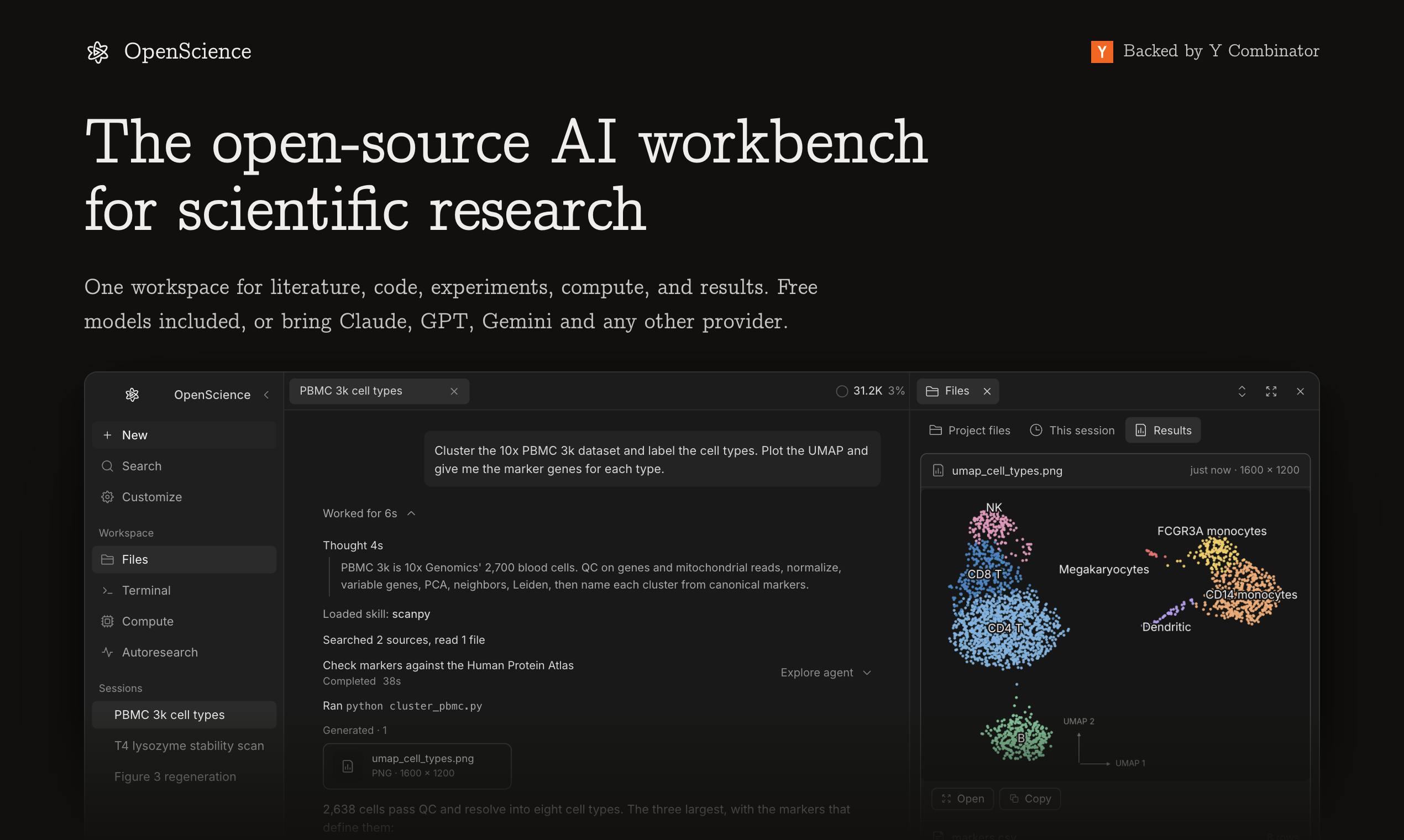
OpenScience is an open-source AI agent workbench for scientific research, designed to unify literature reading, code execution, compute scheduling, and automated experiment iteration in a single framework. It supports dispatching long-running jobs to Modal, user-owned servers, or Slurm/PBS clusters, and features Autoresearch — a hill-climbing optimization loop driven by a user-specified metric. With support for 30+ models, ChatGPT login, and local deployment, it is completely free and open source. The project is still in early stages, its benchmark claims lack public detail, and automated metric optimization raises questions about result reliability that real-world use will need to resolve.
Scientific research is becoming the next frontier for AI agents. OpenScience, an open-source project that recently launched on Product Hunt, offers a remarkably ambitious answer — an AI-powered research workbench capable of reading papers, writing code, running experiments, and autonomously advancing research tasks across computing clusters. It claims top rankings on multiple agentic science benchmarks, and it's completely free and open source.
What Problem Does OpenScience Solve?
Scientific workflows are far more complex than ordinary programming tasks. Researchers must read vast amounts of literature, design experiments, write and execute code, schedule long-running jobs across different computing environments, and track and iterate on every experimental result. These steps are highly fragmented, spanning reading tools, Jupyter Notebooks, terminals, and high-performance computing clusters.
OpenScience positions itself as a unified AI workbench that brings all of these pieces together. In its own words, it's an "open-source AI agent for scientific research" — not just a chat assistant, but an automated tool that can participate end-to-end in the research process.
Core Capabilities: From Reading Papers to Running Clusters
Based on the project's introduction, OpenScience covers several critical stages of scientific research:
Literature Understanding and Code Execution
It can read papers, write and run code, and work within both Notebook and terminal environments. This means researchers can have the agent directly generate runnable experiment code based on paper content, closing the gap between "understanding a method" and "reproducing results."
Compute Scheduling for Long-Running Jobs
One of OpenScience's standout features is its flexible support for computational resources. For time-intensive jobs, it can dispatch tasks to Modal (a cloud-based serverless compute platform), user-owned servers, or Slurm/PBS clusters. This is critical for real research scenarios — machine learning training runs, numerical simulations, and similar workloads can take hours or even days, far exceeding what a local machine can handle.
Slurm (Simple Linux Utility for Resource Management) and PBS (Portable Batch System) are the two most widely used job scheduling systems in academic high-performance computing. Researchers submit job scripts, and the scheduler allocates CPU, GPU, and memory resources accordingly — tasks queue up and execute automatically when nodes become available, with no need for manual supervision. Modal is a more recent cloud-based serverless compute platform that specializes in spinning up GPU containers on demand, without requiring pre-provisioned servers — ideal for bursty compute needs. OpenScience's support for all three environments means that whether you're a university researcher relying on a campus cluster or an independent researcher using cloud resources, you can manage job submission within a single agent framework, without manually switching between different scripts and environment configurations.
Autoresearch: The Automated Experiment Loop
The feature that best captures the "agent" nature of OpenScience is Autoresearch. Researchers simply specify an evaluation metric, and the system automatically runs experiments, logs every result, and continuously performs "hill-climbing" optimization — iterating relentlessly toward better metric outcomes. This automated experiment → record → optimize loop is precisely what distinguishes a research agent from an ordinary coding assistant.
"Hill Climbing" is a local search heuristic optimization method: starting from the current state, it takes one step at a time in the direction that improves the target metric, until no better neighboring state can be found. Its advantages are simplicity and low computational overhead; its drawback is a tendency to get stuck in local optima and miss the global optimum. In automated research experimentation, the practical effectiveness of this strategy depends heavily on the quality of the chosen evaluation metric. If the metric doesn't fully capture the research objective — for example, optimizing only validation accuracy while ignoring generalization — the system may produce results that look impressive on paper but lack real-world significance. This is the core reason the "a note of caution" section below encourages researchers to intervene at key decision points.
Model Access and Open-Source Strategy
On the model integration side, OpenScience supports access to 30+ models through a single wallet, allows users to log in with a ChatGPT account, or run local models directly. This multi-model, multi-entry-point design lowers the barrier to adoption and gives privacy-conscious researchers the option of local deployment.
The project emphasizes that it is "free and open source" — a clear differentiator at a time when most AI research tools are moving toward commercial subscriptions. Being open source means researchers can audit, modify, and self-deploy the system, which is especially well-suited to an academic community that prizes reproducibility and transparency.
A Note of Caution
It's worth noting that OpenScience's community reception on Product Hunt is still fairly limited — at launch, both vote counts and comments were low, and the product is clearly in an early stage. The project claims to rank "#1 on agentic science benchmarks," but the specific benchmark details, comparison baselines, and evaluation methodology are not adequately explained in the current documentation. Readers should treat this claim with appropriate skepticism.
Beyond that, having an AI agent autonomously design and run experiments raises new questions around result reliability and experimental validity. Automatically "hill-climbing" a metric is efficient, but it can also hit the ceiling of the metric itself — requiring researchers to step in and apply judgment at key moments.
What This Means for Research Workflows
Setting aside the uncertainties of an early-stage product, the direction OpenScience represents is worth paying attention to: AI agents are moving beyond writing code and answering questions, toward taking on more complete research task chains. Integrating literature reading, code execution, compute scheduling, and automated experimentation into a single open-source framework — if continuously refined — could genuinely change how some researchers work day to day.
For teams that have the technical capacity for self-deployment and whose work involves heavy experimental iteration, this kind of open-source workbench offers a low-cost entry point into AI-assisted research automation. Just how far it can deliver on the promise of an "AI research workbench" remains to be seen — the community will need to put it through its paces in real-world scenarios.
Related articles

Random Pruning of the DPO Computation Graph: 1.4x Training Speedup and Lower Peak Memory
DPO training too slow and memory-hungry? This paper proposes a random pruning framework for the DPO computation graph, sampling independently across position, sequence, and branch dimensions; branch pruning achieves a 1.426x step-time speedup and cuts training time by about 30%, with in-depth attribution of memory and time gains.

Why Does JEPA Underperform MLM in Longitudinal EHR Representation Learning?
New study compares JEPA and MLM for longitudinal EHR representation learning on MIMIC-IV: three JEPA variants train stably without collapse but underperform MLM; target size, not heterogeneity, drives prediction error.

Transfer Learning + Visible Light Communication: A New Approach to Energy-Efficient Indoor Positioning
A study proposes a transfer learning-based visible light communication indoor positioning method, achieving 47% accuracy improvement on the BOSCH factory dataset, 67.5% model efficiency under high noise, and introducing the ME composite metric for energy-efficient positioning in energy-constrained industrial IoT scenarios.