OpenSSL: The Veteran TLS and Crypto Library with 31k Stars — Why Is It Irreplaceable?
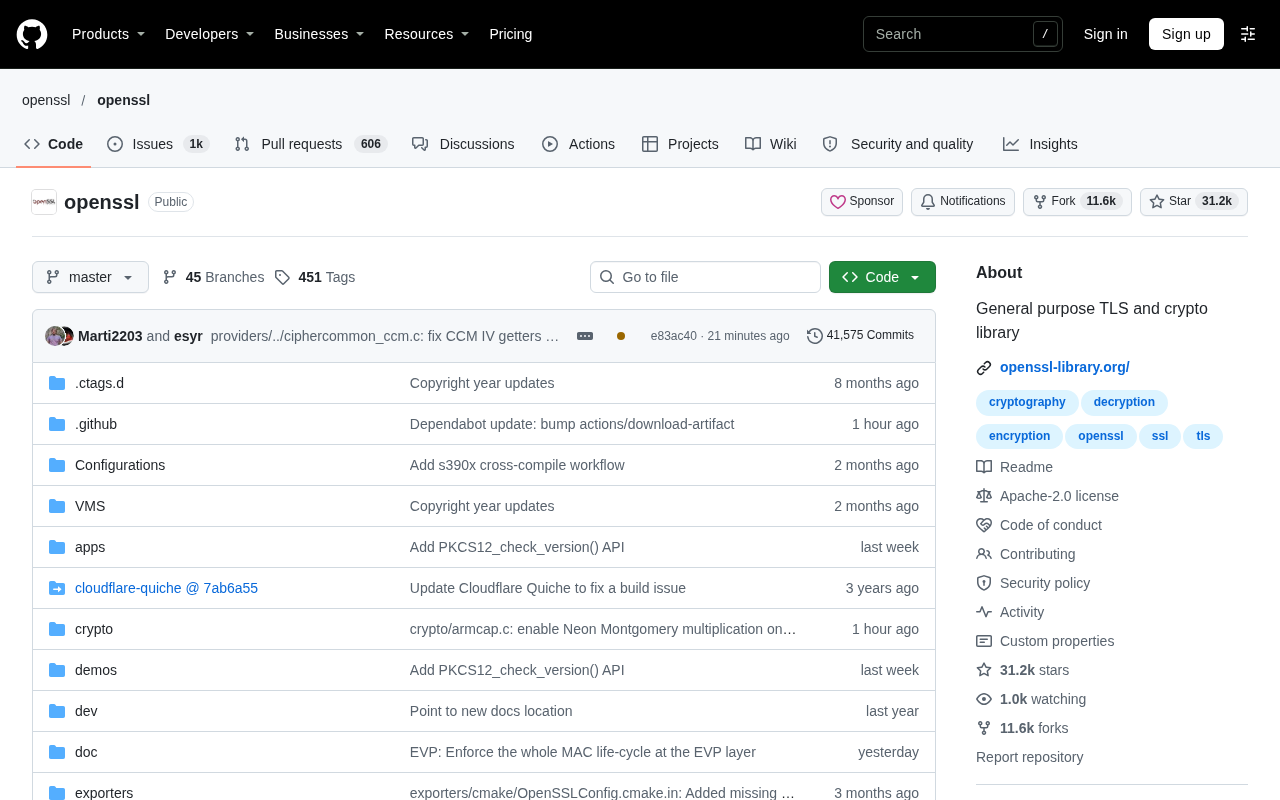
OpenSSL's 31k stars reflect its irreplaceable long-term value as the trust foundation of internet encryption.
Using OpenSSL's 31,202 GitHub stars and 11,579 forks as a starting point, the article argues that this number reflects the weight of "being trusted" in cryptographic infrastructure rather than short-term popularity. As a general-purpose TLS and cryptography library, OpenSSL implements a full set of primitives from the handshake protocol to symmetric and asymmetric encryption, hashing, and certificate management, and its interfaces and behavior have become a de facto standard. The article analyzes why OpenSSL is still needed in the Rust era — high compatibility costs for existing systems, breadth of algorithm and platform coverage that is hard to match quickly, and long-term auditing and compliance credentials — and highlights its battle-tested governance as a scarce asset, while listing areas users should watch: version lifecycle, build configuration, key and certificate policy, and security advisory follow-up.
OpenSSL has accumulated over 31,000 stars and more than 11,000 forks on GitHub, and it is still gaining a steady twenty-plus stars per day. For an old-school project written in C whose core mission is simply "a general-purpose TLS and cryptography library," that number is itself a statement: in the extremely conservative field of cryptographic infrastructure, being trusted is harder than being admired.
An Internet Trust Foundation Held Up by a Single Library
OpenSSL's positioning is very plain — a general-purpose TLS and cryptography library. But behind the word "general-purpose" is the fact that virtually every piece of software that needs encrypted communication may be connected to it: web servers, mail systems, embedded devices, command-line tools, and the TLS backends of language runtimes. What it implements is not just the handshake protocol, but a whole set of cryptographic primitives including symmetric encryption, asymmetric encryption, hashing, certificate and key management, and random number generation.
The result of this foundational nature is that OpenSSL's interface stability and behavioral consistency have effectively become a de facto standard. Many developers have never directly written SSL_CTX_new, yet their code depends on this library at runtime. The C implementation allows it to be linked by virtually any tech stack, at the cost of memory safety having to be guarded manually.
Cryptographic primitives refer to the foundational algorithmic building blocks that make up cryptographic protocols, such as AES in symmetric encryption, RSA/ECC in asymmetric encryption, the SHA-256 hash function, the HMAC message authentication code, and key exchange algorithms. OpenSSL is called a "general-purpose cryptography library" precisely because it implements this entire set of primitives, not just the TLS handshake itself. Developers can call these primitives individually to perform signing, signature verification, encryption, digest computation, and other operations, or the TLS layer can combine them into a complete communication protocol. Understanding the layering of primitives and protocols helps determine the scope of a vulnerability's impact: implementation flaws in low-level primitives often affect all upper-layer protocols, while logic issues at the protocol layer are relatively contained.
Why It Is Still Needed in the Rust Era
In recent years, quite a few modern cryptography implementations and TLS libraries have emerged in the Rust ecosystem, and they have a head start on memory safety. But this has not pushed OpenSSL off the stage, for several reasons.
The first layer is legacy compatibility. A large number of existing systems and protocol stacks have already been built around OpenSSL's APIs and certificate formats, and the cost of replacement is far higher than "rewriting a module." The second layer is breadth of coverage. A mature general-purpose cryptography library needs to encompass a huge number of algorithms, platform adaptations, and backend acceleration options, and this kind of accumulation is hard for new projects to match in the short term. The third layer is certification and compliance — many scenarios require implementations that have undergone long-term auditing and widespread deployment, and history itself is a kind of credential.
So the more realistic picture is coexistence: new projects choose modern alternatives where the boundaries are clear, while OpenSSL continues to play the role of a cross-platform, cross-language general-purpose layer.
Memory safety is one of Rust's core selling points compared with C: through compile-time mechanisms such as ownership and borrow checking, Rust eliminates common memory errors such as dangling pointers, buffer overflows, and use-after-free in safe code. OpenSSL, written in C, must rely on code review, static analysis, and testing to guard against such errors, and several of OpenSSL's historically high-severity vulnerabilities (such as Heartbleed) fall precisely into the memory-safety category of out-of-bounds reads. However, memory safety is not the same as cryptographic correctness — whether an algorithm implementation is constant-time, whether random numbers are adequate, and whether the protocol state machine is rigorous remain independent dimensions. This also explains why, despite their security advantages, Rust implementations cannot rapidly replace all of OpenSSL's functions on the strength of language features alone.
The Governance Signal Behind 31k Stars
The star count itself does not equal code quality, but it reflects a project's visibility and community scale. 31,202 stars and 11,579 forks mean that a large number of downstream branches, mirrors, and experimental changes are built around this codebase; the twenty-plus new stars each day show that new users continue to arrive.
For infrastructure projects like this, what deserves more attention is the governance structure: who can merge code, how changes are reviewed, and how security vulnerabilities are disclosed and fixed. OpenSSL has been through the baptism of major security incidents, and its processes have been repeatedly patched under pressure; this "battle-tested by reality" governance experience is something new projects cannot quickly acquire.
What Users Should Care About
If you introduce or maintain OpenSSL in your project, several areas deserve sustained investment.
- Versions and lifecycle: old branches lack fixes for a long time, and upgrade cadence needs to be part of the operations plan rather than handled only after something goes wrong.
- Build configuration: OpenSSL is highly configurable, and different compile options directly affect available algorithms and the attack surface, so build parameters should be treated as security configuration.
- Key and certificate management: the library only provides mechanisms; policy lies with the caller. Decisions such as certificate rotation, private key protection, and minimum protocol versions are ultimately the responsibility of the application side.
- Following security advisories: include OpenSSL's security notices in your regular subscriptions rather than relying on passive relay.
Configurability means that OpenSSL can enable or disable specific algorithms, protocol versions, engine backends, and functional modules at compile time through configuration options. For example, insecure legacy protocols can be turned off, unneeded algorithms removed to reduce the attack surface, or hardware acceleration enabled for a specific CPU. This feature is especially important for embedded and container scenarios, because binary size and dependency surface directly affect security maintenance costs. But trimming also means that the behavior of different build artifacts may be inconsistent, and if build parameters are poorly managed, it is easy to run into the problem of "algorithms available in the test environment but missing in production." Therefore, bringing build configuration into version management and the security baseline is an easily overlooked yet crucial part of using OpenSSL.
The Value of Infrastructure Work
OpenSSL is not the kind of project that gets repeatedly demoed at tech conferences; it is more like water, electricity, and gas — nobody notices it when it works, but when something goes wrong it becomes a global event. The 31k stars are less a measure of popularity than a record of consensus: this general-purpose cryptography library written in C remains a node on the internet's trust chain that is hard to bypass. The practical takeaway for developers is that understanding its boundaries and operational essentials has more long-term value than chasing alternatives.
One-line Summary
With 31k stars, OpenSSL demonstrates its irreplaceable long-term value as the trust foundation of internet encryption.
Paragraph Summary
Starting from OpenSSL's 31,202 GitHub stars and 11,579 forks, the article points out that this number reflects the weight of "being trusted" in the field of cryptographic infrastructure rather than short-term popularity. As a general-purpose TLS and cryptography library, OpenSSL implements a full set of cryptographic primitives, from the handshake protocol to symmetric encryption, asymmetric encryption, hashing, and certificate management, and its interfaces and behavior have become a de facto standard. The article analyzes why OpenSSL is still needed in the Rust era: the high compatibility cost of existing systems, the breadth of algorithm and platform coverage that is hard to match in the short term, and the moat formed by long-term auditing and compliance credentials. It also emphasizes that its governance experience is a scarce asset honed through security incidents, and lists the areas users should keep watching, including version lifecycle, build configuration, key and certificate policy, and security advisory follow-up, ultimately positioning OpenSSL as a node on the internet's trust chain that is hard to bypass.
Related articles
 Tech Frontiers
Stylome Bot Slammed as Useless Junk: Why Do AI Detection Tools Keep Failing?
Reddit users test the Stylome AI detection bot: Gemini-rewritten text judged human-written, consistently low confidence. An analysis of AI text detection's technical dilemmas, privacy concerns, and credibility crisis in community governance.
 Tech Frontiers
When AI Becomes a Productivity Divide: Clarity or "AI Psychosis"?
A civil engineer's deep use of agentic AI boosted efficiency but bred contempt for peers who refuse to learn. Is this clarity or AI psychosis? An analysis of the cognitive and psychological challenges behind the AI productivity divide.
 Tech Frontiers
Opus 5.5 Benchmark Scores Climb, Community Says Its "Weights Are Blessed"
Reddit community discusses Opus 5.5's rising scores on the Benchmaxxing Bench, with users describing its performance as "weights are blessed." This article interprets the community reaction and cautions against conflating benchmark scores with real capability.