OpenSwarm: The AI-First Operating System That Hands Your Entire Machine Over to Agents
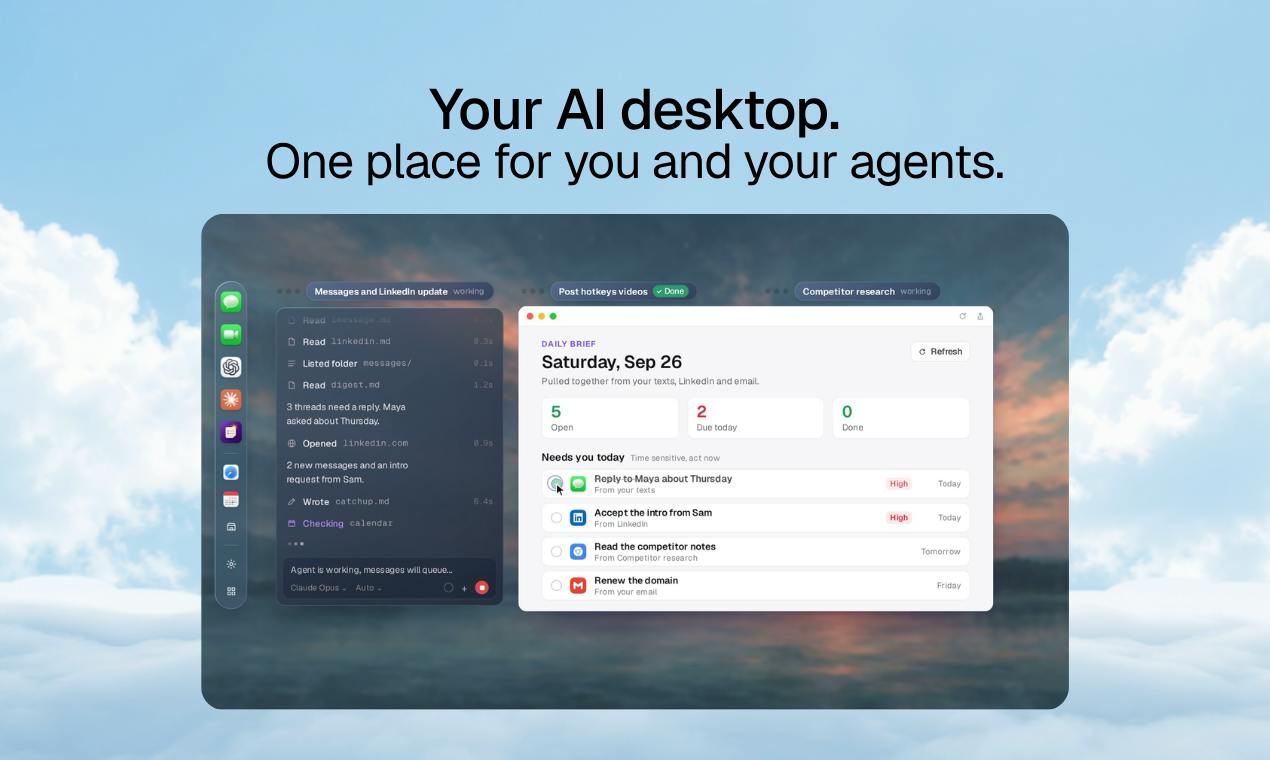
OpenSwarm positions itself as an AI-first OS where multi-agent swarms replace traditional human-computer interaction.
OpenSwarm is an early-stage product positioning itself as an "AI-first operating system," topping Product Hunt's daily chart with 194 upvotes. Its core claim is to upend the traditional OS paradigm — not by layering AI on top of existing systems, but by letting multiple agents directly run the entire machine. Its three headline capabilities are self-generating apps, self-driving browsers, and coordinated multi-agent collaboration, aiming to shift users from hands-on executors to high-level commanders orchestrating dozens of parallel tasks on an "infinite canvas." The article also strikes a cautious note: multi-agent coordination stability, security, and access control remain unsolved engineering challenges, and OpenSwarm currently showcases vision more than a proven, production-ready product.
From "Adding AI to Your Computer" to "AI Is the Computer"
For the past two years, AI tools have mostly entered our workflows as add-ons — browser extensions, sidebar assistants, chat windows. They're clever, but fundamentally they're still patches stuck on top of a traditional operating system. OpenSwarm wants to do the exact opposite: instead of cramming AI into a computer, it aims to redefine what an operating system is.
This product, which topped Product Hunt's daily rankings with 194 upvotes, positions itself as an "AI-first operating system." Its core proposition comes down to one sentence — let agents run the entire machine. Apps create themselves, browsers control themselves, and swarms of agents work together.
Core Philosophy: From Sequential to Parallel Work
OpenSwarm's most ambitious claim is that it wants to change the fundamental paradigm of how humans use computers. Traditional workflows are sequential — you open a document, work through it, then switch to the next task. OpenSwarm proposes a model where you orchestrate dozens of tasks simultaneously.
In its vision, the user's role shifts from "executor" to "commander" (at the helm). You simply tell the system what you want, and a swarm of agents fans out and gets the work done together. The team describes this experience as an "infinite canvas" — your operating system is no longer a collection of isolated windows, but an endlessly expandable workspace where multiple agents operate in parallel.
The "swarm" metaphor is no accident. It draws on the concept of swarm intelligence: individual agents have limited capability, but large numbers of agents collaborating and dividing labor can complete tasks far more complex than any single agent could handle alone.
Three Key Capabilities
Based on the product description, OpenSwarm leads with three core capabilities:
Apps That Create Themselves
"Apps create themselves" — applications can generate themselves on demand. This means that when you need a particular function, the system can directly generate a temporary app to meet that need, rather than having you search, install, and configure something from an app store. This aligns with the emerging trends of "Generative UI" and "Software on Demand."
Background: Generative UI and Software on Demand are emerging directions that have gained traction as large language models have grown more capable. Generative UI refers to systems that generate interface components in real time based on user intent, rather than invoking pre-built static interfaces. Software on Demand goes further, proposing that software itself can be written, executed, and discarded on the fly for a specific task — completely breaking the traditional "install first, use later" paradigm. Vercel's v0, Anthropic's Claude Artifacts, and various code generation tools have already validated this possibility in limited contexts. However, bringing this capability to the operating system level raises the bar considerably: on-demand generated apps need to run safely in sandboxed environments, permission boundaries must be strictly enforced, and generation quality must meet a trustworthy production standard. A failure in any one of these areas could affect the stability of the entire machine.
Browsers That Control Themselves
"Browsers control themselves" — browsers can operate autonomously. This points toward the currently booming field of browser automation, where agents can independently handle web browsing, information retrieval, form filling, and more — no step-by-step human clicking required.
Background: Browser automation is not a new concept — tools like Selenium and Playwright have been used by developers for testing and web scraping for years. What's new is the large-scale push to combine AI with browser automation for everyday users: the "AI browser agent" direction, with notable products including Anthropic's Computer Use, Google's Project Mariner, and the standalone product Browser Use. These systems have large language models directly "see" the browser screen or parse DOM structures to autonomously plan sequences of clicks, inputs, and scrolls — completing web interaction tasks that would otherwise require human effort. The core challenges are: the high diversity and constant change of web page structures; the difficulty of reliably tracking intermediate states in multi-step tasks; and how to prevent agents from accessing sensitive data or triggering irreversible actions (such as submitting forms or confirming payments) during automated operation.
Agents Working Together
"Swarms of agents work together" — multiple agents team up to get things done. This is the soul of the entire product. A single agent solving a single problem is nothing new; the real difficulty lies in getting multiple agents to divide labor, communicate, avoid conflicts, and aggregate results.
Background: Multi-Agent Systems (MAS) are an important branch of distributed artificial intelligence, with the core idea of decomposing complex tasks and distributing them to multiple agents capable of autonomous decision-making for parallel processing. Each agent has independent perception, reasoning, and action capabilities, coordinating with one another through message passing or shared state. The difficulty of this architecture lies not in any individual agent's capability, but in the design of the "orchestration layer" — which must solve problems of task allocation, conflict arbitration, result merging, and failure rollback. Currently, the most representative multi-agent frameworks in the industry include Microsoft's AutoGen, LangChain's LangGraph, and OpenAI's Swarm (an experimental framework). All are exploring how to get multiple LLM-driven agents to safely and efficiently collaborate on real-world tasks, but reliability in production environments remains a widely acknowledged challenge. OpenSwarm's ambition to use multi-agent collaboration as the underlying logic of an entire operating system far exceeds the application scope of these frameworks.
What Space Is It Playing In?
OpenSwarm is categorized under Task Management, Developer Tools, and Artificial Intelligence — a combination that itself reveals its target user profile. It aims both at knowledge workers who need to orchestrate tasks efficiently and at developers with a strong appetite for automation.
The concept of an "AI-first operating system" has been generating significant buzz in the industry recently. Several companies are attempting to deeply integrate OS-level capabilities with AI, rather than staying at the application layer. OpenSwarm has chosen "multi-agent collaboration" as its differentiating angle, trying to carve out a clear narrative in a crowded AI tools market.
A Sober Look: The Gap Between Vision and Reality
It's worth staying grounded: as of its launch, OpenSwarm is more of a set of ideas and a vision than a mature, battle-tested product. The 194 upvotes and top-of-day ranking reflect the appeal of the concept, but the stability, reliability, and security of capabilities like "apps that create themselves" and "browsers that control themselves" in real-world use still need time to prove out.
The biggest engineering challenge in multi-agent systems is precisely the "collaboration" part — how agents communicate efficiently, how they handle conflicting decisions, and how to prevent cascading failures when something goes wrong. These are problems the industry has not yet fully solved. Handing an entire machine over to agents to run also means imposing extremely high demands on error tolerance and access control.
That said, OpenSwarm's direction has genuine value. When AI capabilities are strong enough, there's no good reason for operating systems to remain stuck in a decades-old paradigm of mouse and window. Built by developers Haylli Weintraub, Alex Dakhli, and Eric F Zeng, whether the team can translate this grand narrative into a truly usable product is the most compelling thing to watch going forward.
Summary
OpenSwarm represents a bold vision of what computing could look like: an operating system that no longer passively waits for human input, but is actively driven by a swarm of agents, with humans stepping back into a commanding role. This vision is exciting, but there is still a considerable distance to travel from concept to a reliable everyday productivity tool. For anyone following the convergence of AI and operating systems, it at minimum provides a fascinating case worth tracking.
Related articles

Anthropic IPO Countdown: The Compute Cost Ledger Behind a $2 Trillion Valuation
Anthropic's IPO targets up to $2 trillion — double its Series H valuation. We break down the timeline, compute cost logic, and the key question investor day must answer.

Anthropic IPO Prospectus Revealed: Behind 12x Revenue Growth, the Twin Tests of Compute Costs and Customer Concentration
Anthropic filed its IPO prospectus: 2025 revenue up 12x to $4.6B, net loss $42B including $34B non-cash. Breaking down compute costs, $2T valuation logic, customer concentration risks, and founder control.

Xteink X4 Pro Review: A Mini E-Reader That Fits in Your Pocket, Now More Affordable
Xteink X4 Pro is a 4.26-inch mini e-reader, smaller and thinner than a 6-inch Kindle, magnetically attachable to phones, and cheaper than ever. We analyze its screen, design, use cases, and value.