OpenTrade: A Deep Dive into the Open-Source Framework That Lets Claude Code Trade Automatically

OpenTrade is an open-source framework that lets Claude Code and Codex execute stock trades via Robinhood MCP.
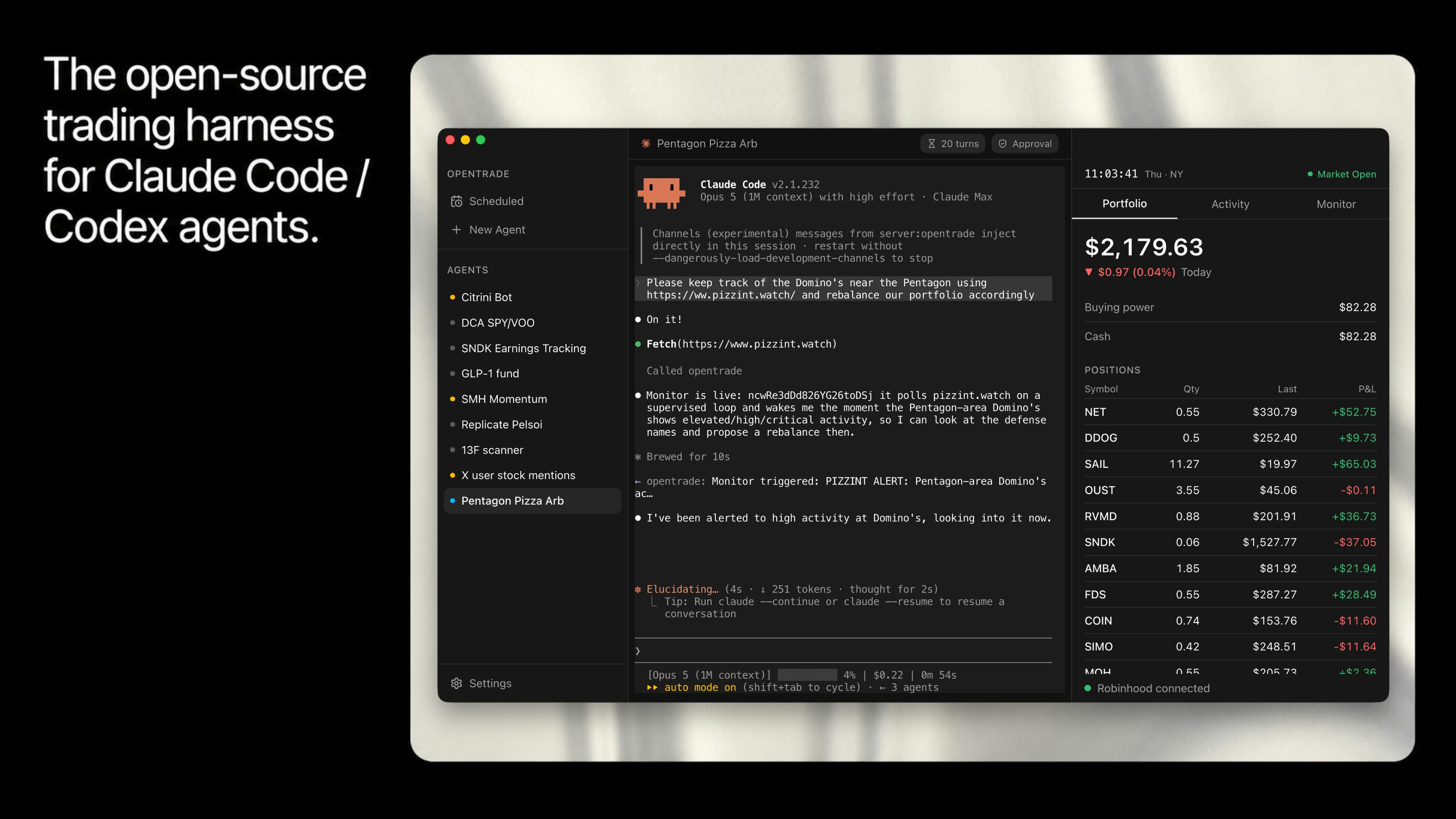
OpenTrade is an open-source trading harness designed for AI coding agents like Claude Code and Codex. It leverages Robinhood's official MCP interface to enable automated stock trading, featuring cron scheduling, persistent background sessions, and custom notifications — all running locally. The framework emphasizes guardrails and safety mechanisms as much as execution capabilities, and its open-source nature ensures full auditability. It's best suited for technically proficient users willing to experiment cautiously with small amounts.
When AI Coding Assistants Meet Quantitative Trading
As AI Agent capabilities evolve rapidly, more and more developers are asking a compelling question: since coding agents like Claude Code and Codex can already write code and execute tasks autonomously, can they be given the ability to operate in the real world? OpenTrade offers a bold answer — letting AI Agents participate directly in stock trading.
This open-source project, which earned 106 upvotes and ranked 7th on its launch day on Product Hunt, positions itself as an "open-source trading harness for Claude Code / Codex." Its core value isn't about providing some mysterious trading strategy — it's about building a set of tools and guardrails that enable AI Agents to execute trades safely and effectively.
Core Features of OpenTrade
Trading Capabilities via Robinhood's Official MCP
OpenTrade connects to brokerages through Robinhood's official MCP (Model Context Protocol) interface. MCP is a standard protocol championed by Anthropic that establishes standardized connections between large language models and external tools or data sources. This means OpenTrade doesn't rely on reverse engineering or unofficial APIs to connect to brokerages — it follows an officially supported, compliant path. This is especially important in scenarios involving real money.
Through this MCP connection, agents like Claude Code or Codex gain the ability to place orders, query positions, manage holdings, and perform a full range of trading actions. Developers don't need to write brokerage integration code from scratch — OpenTrade has already wrapped that layer.
Scheduled Tasks and Persistent Background Sessions
One of OpenTrade's key features is providing the infrastructure for agents to "run autonomously." According to the official documentation, out-of-the-box capabilities include:
- Cron Scheduling: Agents can automatically execute trading or analysis tasks on a preset schedule — for example, checking market conditions before market open or generating summaries after market close.
- Custom Notification Scripts: Agents can write scripts to send reminders to themselves (or users), creating an information feedback loop.
- Persistent Background Sessions: Trading tasks often require long-running processes and state persistence. OpenTrade supports maintaining persistent background sessions on local machines, so agents don't "lose their memory" when a conversation ends.
It's worth emphasizing the "all on your machine" aspect — all of these capabilities run on the user's own machine, not inside some cloud-based black box. This provides much stronger control over data privacy and fund security.
Guardrails: Safety Design That Matters More Than Trading Capabilities
Why AI Trading Must Emphasize Guardrails
Letting AI trade autonomously sounds exciting, but it's also unsettling. An agent with flawed logic or one that's been misled could cause irreversible financial losses in seconds. OpenTrade repeatedly emphasizes "tools and guardrails" in its positioning, showing that the team clearly understands: in financial scenarios, constraint mechanisms are every bit as important as execution capabilities.
Guardrails typically include trading amount limits, operation confirmation mechanisms, and anomalous behavior interception. These designs aim to keep an agent's autonomy within safe boundaries and prevent runaway chain reactions. For any developer considering such tools, the robustness of these guardrail mechanisms should be the primary evaluation criterion.
Open Source Enables Auditability
OpenTrade's decision to release as open source is particularly valuable in a trading context. The last thing you want from financial automation tools is a "black box" — where users can't verify what the software will actually do with their accounts. Open source allows community code review, putting trading logic, permission boundaries, and data flows out in the open, which dramatically reduces the cost of trust.
The project is available on GitHub, which also means developers can customize it to their needs — integrating custom strategies or additional risk control rules.
A Realistic View of OpenTrade: Opportunities and Risks Coexist
This Is an Execution Framework, Not a Money Printer
It's essential to understand clearly that OpenTrade is fundamentally an execution framework and toolset — it does not include any trading strategy capable of generating consistent profits. It solves the engineering problem of "how to let an AI Agent safely execute trades," not the far more difficult problem of "how to make money in the markets."
If you hand over trading decisions entirely to a general-purpose LLM, the results will likely disappoint — large language models weren't designed for financial prediction and are prone to hallucinations and misinterpreting market signals. It's more accurate to think of OpenTrade as a "capability amplifier": it can amplify the execution efficiency of a good strategy, but it can also amplify the destructive power of a bad one.
Who Is This For?
This type of tool is currently best suited for technically proficient users who understand financial risk and are willing to experiment with small amounts. For average investors, letting AI manage real capital is still something that requires extreme caution. The recommended approach is to start with paper trading or very small amounts, thoroughly validate the agent's behavioral stability and the reliability of the guardrails, and only then gradually consider scaling up.
A Textbook Example of AI Agents Entering the Real World
Setting aside trading itself, what makes OpenTrade truly noteworthy is its significance as a textbook example of AI Agents moving from "writing code" to "operating real-world systems." Connecting to external services via the MCP standard protocol, achieving autonomous operation through scheduled tasks, and controlling risk through guardrail mechanisms — this pattern can be replicated in virtually any domain requiring automated execution, from DevOps to e-commerce, from data processing to content publishing.
Trading is simply the first high-risk, high-value scenario to be validated. As the MCP ecosystem matures and agent autonomy grows, we can expect to see more and more frameworks like OpenTrade that "give AI hands and feet." And the real technical challenge and commercial value lies precisely in those seemingly modest yet critically important guardrails.
Related articles

Amphibious Transforming Drone: Beyond 100x Power Savings, What Are the Real Needs?
Is the amphibious transforming drone just a gimmick? Starting from the 100x power difference of the M4 Morphobot, explore real application scenarios and thesis topic ideas, analyzing boundary conditions where pure drones and pure ground robots both fail.

Warhound Raises $200 Million: Genetically Engineered "War Dogs" Paired with Anduril Gear
Warhound raises $200M, backed by Ben Lamm and Palmer Luckey, to genetically engineer dogs for military and law enforcement use and equip them with Anduril gear. This article analyzes its technology direction, funding logic, and ethical controversy.

Claude API Comes to Google Cloud: IAM Integration and SDK Access Guide
Anthropic hosts the full Claude API on Google Cloud with IAM-controlled permissions and unified billing. This guide covers the Vertex AI and Anthropic-hosted entry points, IAM role configuration, and SDK access.