OpenVINO: An Open-Source AI Inference Optimization and Deployment Toolkit
OpenVINO is Intel's open-source AI inference optimization toolkit for efficient cross-platform deployment.
The article introduces OpenVINO, Intel's open-source AI inference optimization toolkit. Its core value is cross-platform inference optimization through model conversion, graph optimization, and hardware acceleration while maintaining accuracy, targeting Intel CPUs, integrated GPUs, VPUs, and ARM. The workflow has three stages—model conversion, optimization, and deployment—with components including Model Optimizer, Inference Engine, OpenVINO Runtime, and Benchmark Tool. It also covers applications in computer vision, NLP, and edge computing, plus an active GitHub community with over 11,000 stars.
What is OpenVINO?
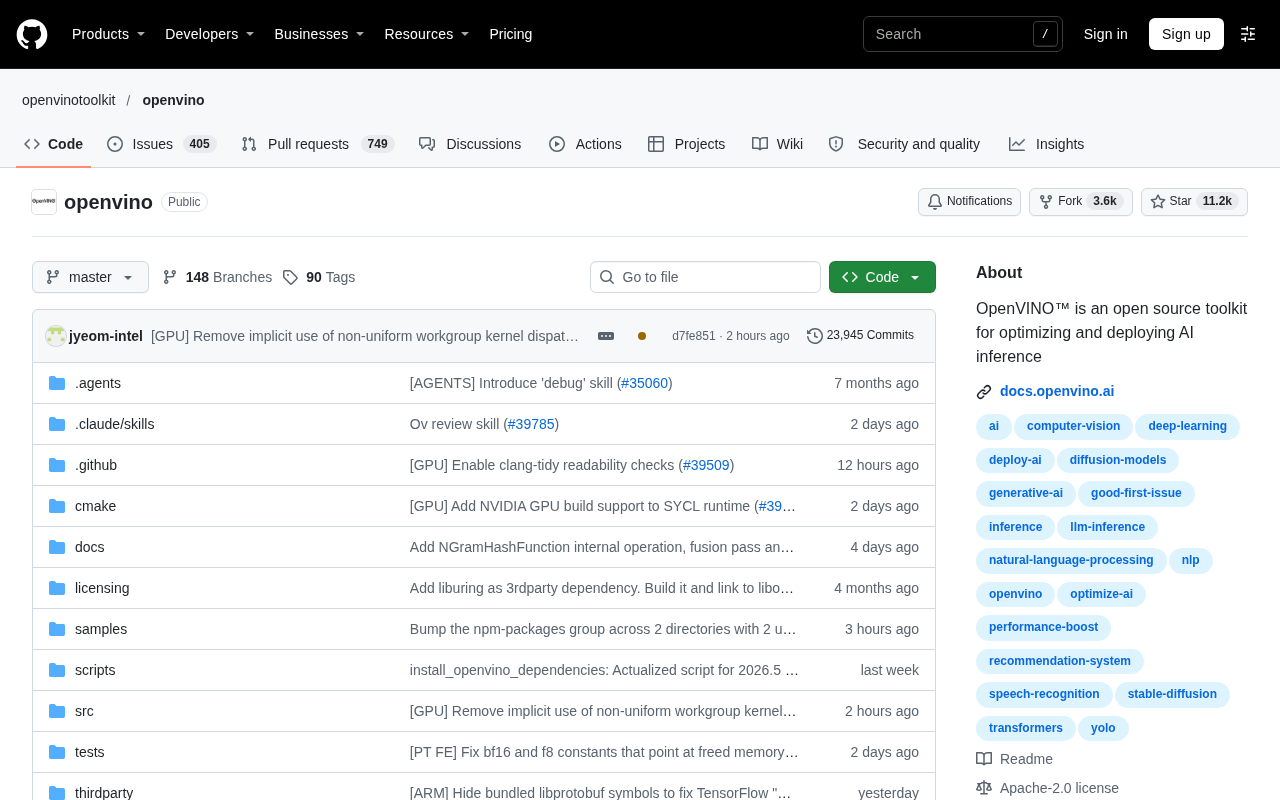
OpenVINO™ is an open-source toolkit led by Intel, designed specifically for optimizing and deploying AI inference. It supports a wide range of hardware, from edge devices to the cloud, helping developers efficiently bring trained models into production. According to GitHub data, the project has earned over 11,000 stars and more than 3,500 forks, demonstrating active community interest.
The core value of OpenVINO lies in cross-platform inference optimization. Through model conversion, graph optimization, and hardware acceleration, it significantly improves inference performance while maintaining model accuracy. For teams that need to deploy AI applications on Intel CPUs, integrated GPUs, or VPUs, OpenVINO provides a complete toolchain.
Core Features and Workflow
The OpenVINO workflow typically consists of three stages: model conversion, optimization, and deployment. Developers can use the Model Optimizer to convert models from training frameworks (such as TensorFlow and PyTorch) into OpenVINO's IR format, then use the Inference Engine to execute inference on the target hardware.
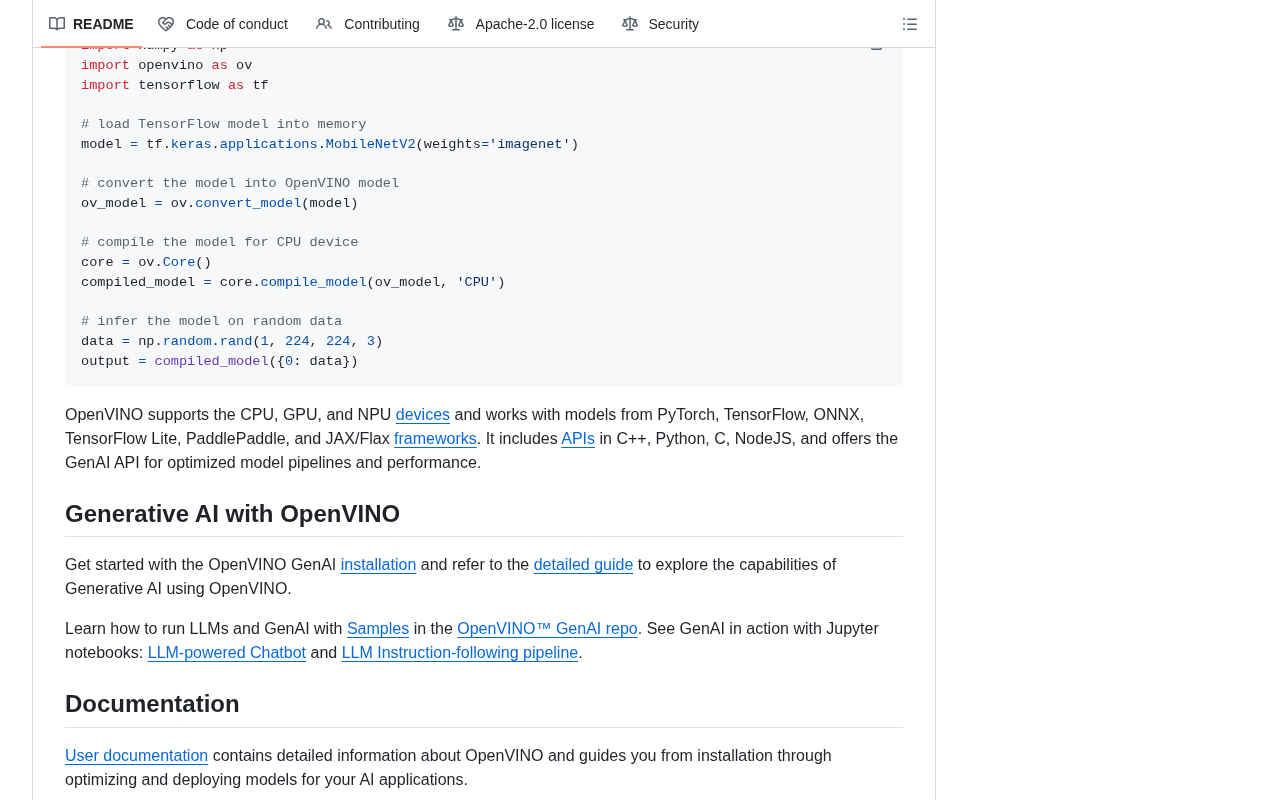
The toolkit includes several components:
- Model Optimizer: Converts models to IR format and performs graph optimization.
- Inference Engine: Provides a unified API with support for heterogeneous computing.
- OpenVINO Runtime: A lightweight inference engine supporting Python, C++, and other languages.
- Benchmark Tool: Used for performance evaluation and hardware tuning.
These components work together to enable developers to quickly deploy models across different hardware platforms without needing to dive into low-level details.
IR (Intermediate Representation) is OpenVINO's proprietary model format, typically consisting of two files: .xml (describing the network topology) and .bin (storing weights). Converting models from frameworks like TensorFlow, PyTorch, and ONNX to IR serves two purposes: on one hand, it removes the runtime dependencies of the training framework, making the inference environment more lightweight; on the other hand, the conversion process performs graph-level optimizations such as operator fusion, constant folding, and precision calibration, making the model better suited to the target hardware's instruction set and memory layout. IR also supports multiple precisions including FP32, FP16, and INT8. Developers can use post-training quantization (PTQ) to compress models to lower precision, trading controlled accuracy loss for significant throughput gains. For this reason, IR is the key hub for understanding the OpenVINO workflow—both the output of the Model Optimizer and the input of the Inference Engine / Runtime revolve around it.
Heterogeneous Computing refers to scheduling different types of compute units—such as CPU, integrated GPU, VPU, and NPU—within the same system to jointly complete inference tasks. OpenVINO abstracts these devices through a unified API. Developers only need to specify a target device string (such as CPU, GPU, AUTO, or MULTI:CPU,GPU), and the runtime will automatically select or parallelize hardware usage. The AUTO mode selects the most suitable execution unit based on the model and device status, while the MULTI mode distributes inference requests across multiple devices to improve throughput. The value of this mechanism lies in the fact that different hardware excels in different areas (CPUs are versatile, GPUs offer high parallelism, VPUs provide excellent energy efficiency), and heterogeneous scheduling can fully exploit the machine's compute power without modifying application code—this is also the underlying foundation of OpenVINO's cross-platform adaptability.
Application Scenarios and Ecosystem
OpenVINO is widely used in computer vision, natural language processing, recommendation systems, and other fields. In edge computing scenarios, it helps devices achieve low-latency, high-energy-efficiency inference. For example, in smart cameras, industrial quality inspection, and medical image analysis, OpenVINO can significantly improve processing speed.
In addition, OpenVINO is deeply integrated with Intel hardware, fully leveraging CPU instruction sets and GPU parallel capabilities. It also supports ARM architecture and heterogeneous computing, enhancing cross-platform adaptability. On the community side, OpenVINO provides a rich collection of sample code, tutorials, and pre-trained model libraries, lowering the barrier to entry for developers.
INT8 Quantization and Post-Training Quantization (PTQ) are commonly used performance techniques in OpenVINO edge deployments. Edge devices are generally constrained by power consumption, heat dissipation, and memory bandwidth, and FP32 models often struggle to meet real-time requirements. OpenVINO's POT (Post-training Optimization Tool) and NNCF (Neural Network Compression Framework) can collect activation value distributions on a small calibration dataset and quantize weights and activations to 8-bit integers, typically achieving several times inference speedup and significantly reducing memory footprint. The quantization process requires attention to accuracy regression issues. Common practices include per-channel quantization, mixed precision (retaining FP16 for sensitive layers), and accuracy-aware layer-by-layer comparison. Understanding the quantization mechanism helps assess the practical benefit boundaries of OpenVINO in low-latency scenarios such as smart cameras and industrial quality inspection.
Community and Development Updates
As an open-source project, OpenVINO maintains active updates on GitHub. The current repository shows 11,206 stars and 3,573 forks, with 18 new stars added today, indicating sustained interest in the project. The project uses C++ as its primary development language and also provides Python bindings, making it accessible to developers from different backgrounds.
OpenVINO's contributors come from Intel and the external community. Versions are iterated frequently, continuously adding support for new models and new hardware. For developers interested in contributing to open source, they can start with documentation improvements, sample additions, or bug fixes.
Summary
OpenVINO is a comprehensive, mature AI inference optimization toolkit, particularly well-suited for deploying high-performance inference applications on Intel hardware. Its open-source nature and active community provide developers with reliable support. Whether for edge devices or cloud deployment, OpenVINO helps teams shorten the path from model to product.
One-line Summary
OpenVINO is Intel's open-source AI inference optimization toolkit for efficient cross-platform deployment.
Paragraph Summary
The article introduces OpenVINO, an open-source AI inference optimization toolkit led by Intel. Its core value lies in cross-platform inference optimization, improving performance while maintaining accuracy through model conversion, graph optimization, and hardware acceleration, suitable for Intel CPUs, integrated GPUs, VPUs, and ARM architecture. The workflow consists of three stages—model conversion, optimization, and deployment—with core components including the Model Optimizer, Inference Engine, OpenVINO Runtime, and Benchmark Tool. The article also covers its applications in computer vision, natural language processing, and edge computing, as well as the active community ecosystem with over 11,000 GitHub stars and frequent releases.
Related articles
Claude Code Hands-On Tutorial: Installation in China and AI Coding Productivity Guide
Bilibili Claude Code tutorial breakdown: installation in China, PyCharm and other IDE integration, hands-on examples, memory mechanisms, three permission modes, MCP tools and skill configuration — helping developers understand the usage path and token cost constraints of AI coding productivity tools.

AI Wrote 90% of the Code—How Do You Prove It Runs? The Claude Code Team Publishes a 39-Item Incident Checklist
The Claude Code team reveals how to verify AI-written code: 39-item incident checklist, end-to-end, property-based, and differential testing, plus a three-tier commit gate.
Appwrite: The Open-Source Cloud Built for AI Agents
Appwrite is an open-source cloud platform offering Auth, databases, storage, functions, messaging, hosting, realtime, and WAF for AI agents and developers. With 58K+ GitHub stars, it supports self-hosting.