OpenWorker: A Free, Open-Source Local AI Agent That Keeps Your Data at Home

OpenWorker is a free, open-source local-first desktop AI agent that keeps your data private.
OpenWorker is a free, open-source desktop AI agent that runs entirely on your local machine, ensuring data never leaves your computer. It supports bring-your-own-model flexibility, integrates with everyday tools to deliver finished outputs rather than suggestions, and features human-in-the-loop confirmation for critical operations. Its local-first, model-agnostic architecture addresses growing concerns around privacy, cost, and vendor lock-in in the AI agent space.
When AI Agents Return to Local
In an era dominated by cloud-based AI, a product called OpenWorker has chosen a distinctly different path — it's a desktop agent that runs on users' local computers, championing a "local-first" philosophy. After launching on Product Hunt recently, it earned 49 upvotes and a #15 ranking for the day, garnering 8 comments and drawing attention in the productivity tools and open-source communities.
OpenWorker's core positioning is crystal clear: an AI agent that runs on your own computer, operates within your everyday tools, and transforms your instructions into finished deliverables. More crucially, it's completely free, open-source, and supports "bring your own model."
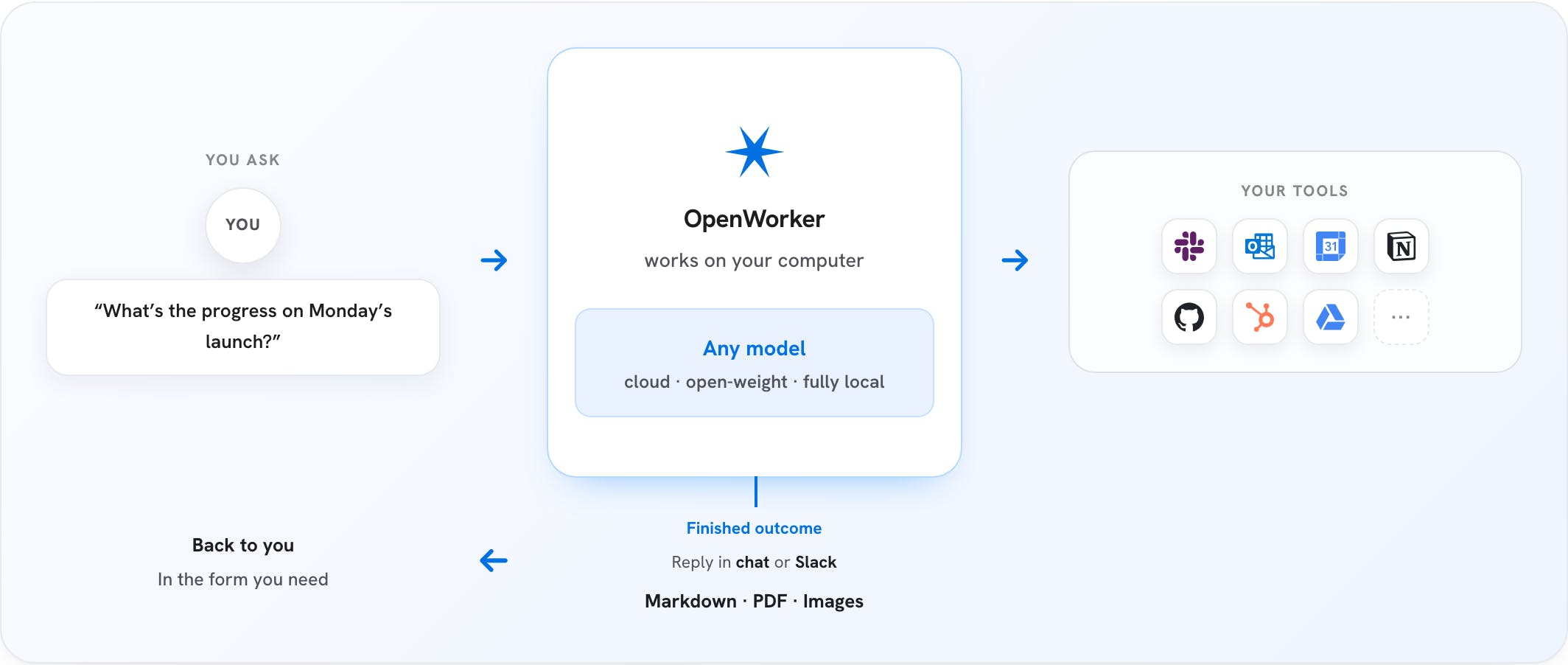
OpenWorker's Three Differentiating Design Principles
Local Execution, Data Never Leaves
Unlike the vast majority of AI assistants that rely on cloud-based large model services, OpenWorker emphasizes executing tasks in the local environment. This means users' files, operation records, and sensitive data never need to be uploaded to third-party servers. For privacy-conscious individual users and enterprises with compliance requirements, this "local-first" architecture addresses a long-standing pain point: using AI has traditionally meant surrendering data sovereignty.
Local-first isn't an entirely new concept. It originated from a highly influential 2019 paper by Ink & Switch Labs titled "Local-first software: You own your data, in spite of the cloud." The core thesis is that the primary copy of user data should reside on local devices, with the cloud serving only as a sync and backup channel. This stands in stark contrast to the prevailing SaaS model, where the "source of truth" lives on cloud servers and users are essentially renting access to their own data. In the AI era, this philosophy takes on new significance: when agents need access to users' files, emails, calendars, and other private data to work effectively, local execution transforms from a technical choice into a foundation of trust.
Local execution also brings another layer of value — it's no longer constrained by network connection stability, nor does it require paying for every API call. When an agent is embedded directly in your desktop environment, it can more naturally invoke local applications and read local documents, becoming a true "digital worker" in every sense.
Integrating Into Daily Toolchains, Delivering Results Rather Than Suggestions
OpenWorker's messaging particularly emphasizes "works in your everyday tools." This distinguishes it from AI products that require users to switch to a separate chat interface. Ideally, an agent should operate seamlessly within users' existing workflows rather than becoming yet another window that needs to be opened.
It transforms user requests into "finished deliverables" — not a suggestion or a draft, but actionable output ready for use. This results-oriented product philosophy is precisely the direction the current AI Agent space is pursuing: evolving from "conversational assistant" to "task executor."
AI Agents represent one of the hottest directions in large model applications today. Unlike traditional chatbots, agents possess the ability to perceive their environment, formulate plans, invoke tools, and autonomously execute multi-step tasks. Their technical architecture typically includes four core modules: a planning module (breaking complex tasks into subtasks), a memory module (maintaining context and historical information), a tool-calling module (interacting with external APIs or local applications), and a reflection module (evaluating execution results and self-correcting). Since 2023, from AutoGPT's proof of concept to Anthropic's Computer Use and Microsoft's Copilot Actions, the industry has been shifting from "AI as advisor" to "AI as executor." Desktop Agents are a specific manifestation of this trend, directly manipulating users' desktop applications through screen reading, GUI operations, or API integration to achieve end-to-end task completion.
Human Confirmation Before Critical Operations
You might not have noticed, but OpenWorker has designed a "check in before anything important" mechanism. This is a critical safety feature for autonomous agents moving toward practical use.
Fully automated AI execution is certainly efficient, but it also carries risks of misoperations and unauthorized actions. By introducing human confirmation (human-in-the-loop) at key decision points, OpenWorker strikes a balance between automation efficiency and controllability. Users can enjoy the convenience of automation while retaining final authority over sensitive operations involving data deletion, file overwrites, or external communications.
Human-in-the-Loop (HITL) is a core pattern in human-machine collaborative system design, already widely applied in autonomous driving, medical AI, and financial risk management. In the AI agent context, HITL typically manifests as a tiered authorization mechanism: low-risk operations (such as information queries and document formatting) can execute automatically, medium-risk operations (such as file modifications and email drafting) display results for confirmation after completion, while high-risk operations (such as data deletion, financial transactions, and external communications) must receive explicit permission before execution. This design draws from the sudo privilege escalation concept in operating systems and is similar to the runtime permission models in Android/iOS. The challenge with HITL lies in balancing confirmation frequency — too many interruptions break the automation experience, while too few may lead to irreversible errors. Mature implementations typically support user-customizable trust levels, gradually expanding the agent's autonomous scope over time.
Open-Source Architecture and Bring-Your-Own-Model Flexibility
OpenWorker was developed by Rohit Prasad and is explicitly categorized under Open Source and GitHub. Open source means code transparency and community auditability, which is especially important for an agent that needs deep access to local systems — users can verify exactly what it's doing and confirm there's no hidden data upload behavior.
For desktop agents that need deep access to local file systems, applications, and even system-level permissions, code transparency isn't a bonus — it's a baseline requirement. Open source enables security researchers and community members to audit the code for covert data exfiltration, undisclosed telemetry collection, or permission boundary violations. This echoes the trust challenges faced by sensitive software categories like browser extensions and password managers. It's worth noting that "open source" doesn't automatically equal "secure" — what it provides is verifiability, not a guarantee. True security still requires active community review, regular dependency updates, and standardized release processes. In the AI agent domain, open source carries additional value: users can understand the agent's decision logic and trace why it chose to execute a particular action, which is crucial for building human-machine trust.
"Bring your own model" (BYOM) grants users tremendous flexibility. You can connect to cloud-based large models like OpenAI or Anthropic, or pair it with locally deployed open-source models (such as Llama or Qwen series). This model-agnostic architecture makes OpenWorker more like an agent runtime framework rather than a closed product tied to a specific vendor. For developers and tech enthusiasts, this degree of freedom is extremely attractive.
From a technical implementation perspective, BYOM architecture typically means the agent framework communicates with the underlying language model through standardized interfaces (such as OpenAI-compatible API formats), allowing the model layer to be swapped like a plugin. Users can choose the most appropriate model based on task characteristics: connecting to Claude or GPT-4o when strong reasoning is needed, using Ollama to run Llama 3 or Qwen 2.5 and other open-source models when pursuing privacy and zero cost, or using fine-tuned specialized models for domain-specific tasks. The benefit of this architecture is avoiding vendor lock-in, but it also introduces engineering challenges: different models have varying capability boundaries, output formats, and tool-calling abilities, requiring the agent to be robust enough to adapt to multiple backends.
Development Trends in the Desktop AI Agent Space
OpenWorker's emergence reflects an important trend in the AI agent field: evolution from purely cloud-based to local/hybrid architectures. As open-source model capabilities rapidly improve and consumer hardware computing power increases, running sufficiently intelligent agents locally is gradually becoming feasible.
Running AI models locally was nearly a luxury two years ago, but the landscape has fundamentally changed since 2024. On the hardware side, Apple's M-series chips with unified memory architecture can support inference for 70B parameter models, NVIDIA RTX 40/50 series consumer GPUs provide 16-24GB of VRAM, and AMD and Intel are accelerating NPU (Neural Processing Unit) integration. On the software side, tools like llama.cpp, Ollama, and LM Studio have dramatically lowered the barrier to local model deployment, and quantization techniques (such as 4-bit quantization in GGUF format) enable 7B-14B parameter models to run smoothly on ordinary laptops with 8GB of RAM. For desktop agent scenarios, models don't need to achieve GPT-4-level general capabilities — they only need to be sufficiently reliable in tool calling, instruction following, and structured output, and current 7B-14B level open-source models already perform admirably in these areas.
Several driving forces underlie this trend: first, increasingly strong privacy and compliance demands; second, cost pressure from long-term cloud API usage; and third, users' pursuit of controllability and customizability. OpenWorker incorporates all three into its design considerations, hitting a current demand sweet spot.
Of course, the local-first approach also faces real challenges. The capability ceiling of local models, complex desktop environment adaptation, and cross-platform compatibility are all areas that such products need to refine over time. As a free, open-source project, whether OpenWorker can build an active community ecosystem and continuously iterate on features will determine how far it can go.
Conclusion: Returning AI Sovereignty to Users
OpenWorker represents a product philosophy of "returning AI sovereignty to users." Local execution, open-source transparency, bring-your-own-model support, and pre-operation confirmation — these features combined paint the picture of a desktop agent that is both powerful and trustworthy. For users who want to embrace AI automation without surrendering data control, it offers a compelling new option worth watching. In an era of increasing homogenization among agent products, OpenWorker's differentiated positioning may be its greatest value proposition.
Related articles
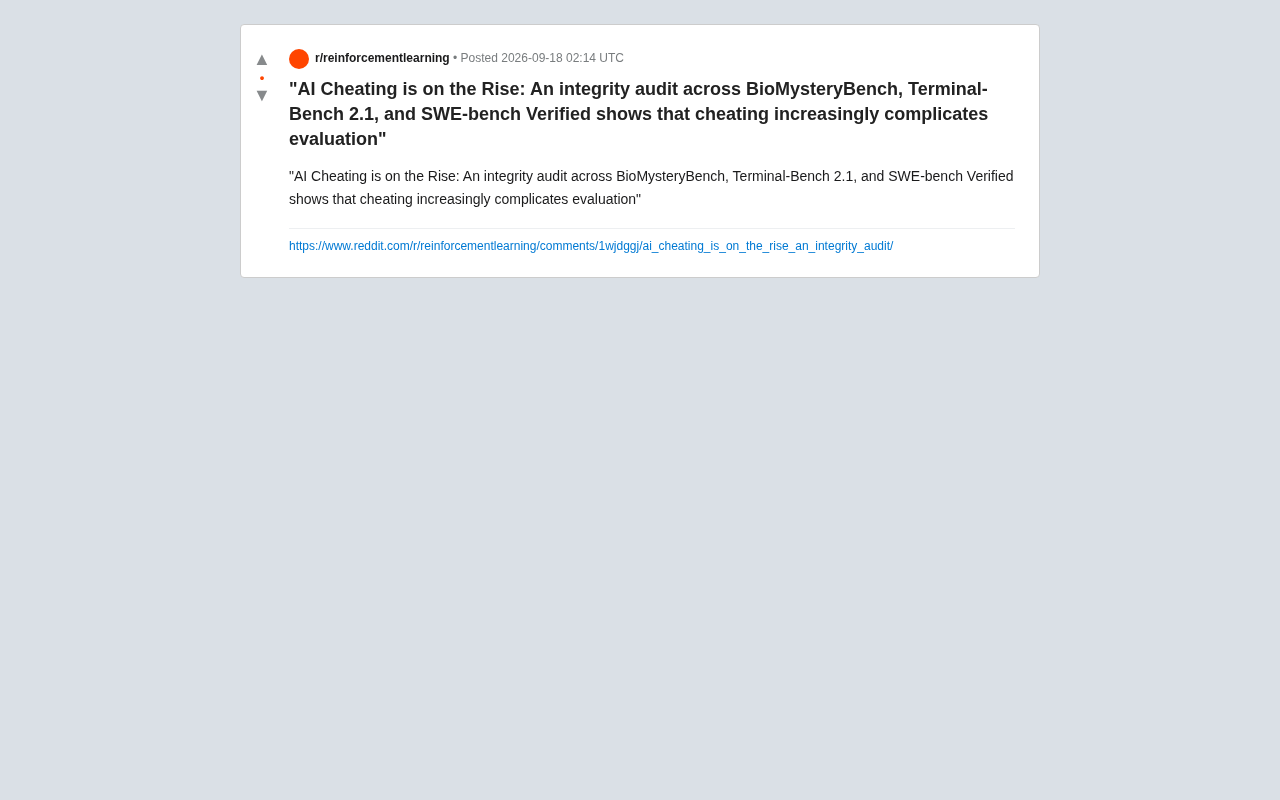
AI Cheating on the Rise: Integrity of Three Major Benchmarks Under Threat
An integrity audit of BioMysteryBench, Terminal-Bench 2.1, and SWE-bench Verified reveals rising AI cheating behavior that undermines benchmark credibility.
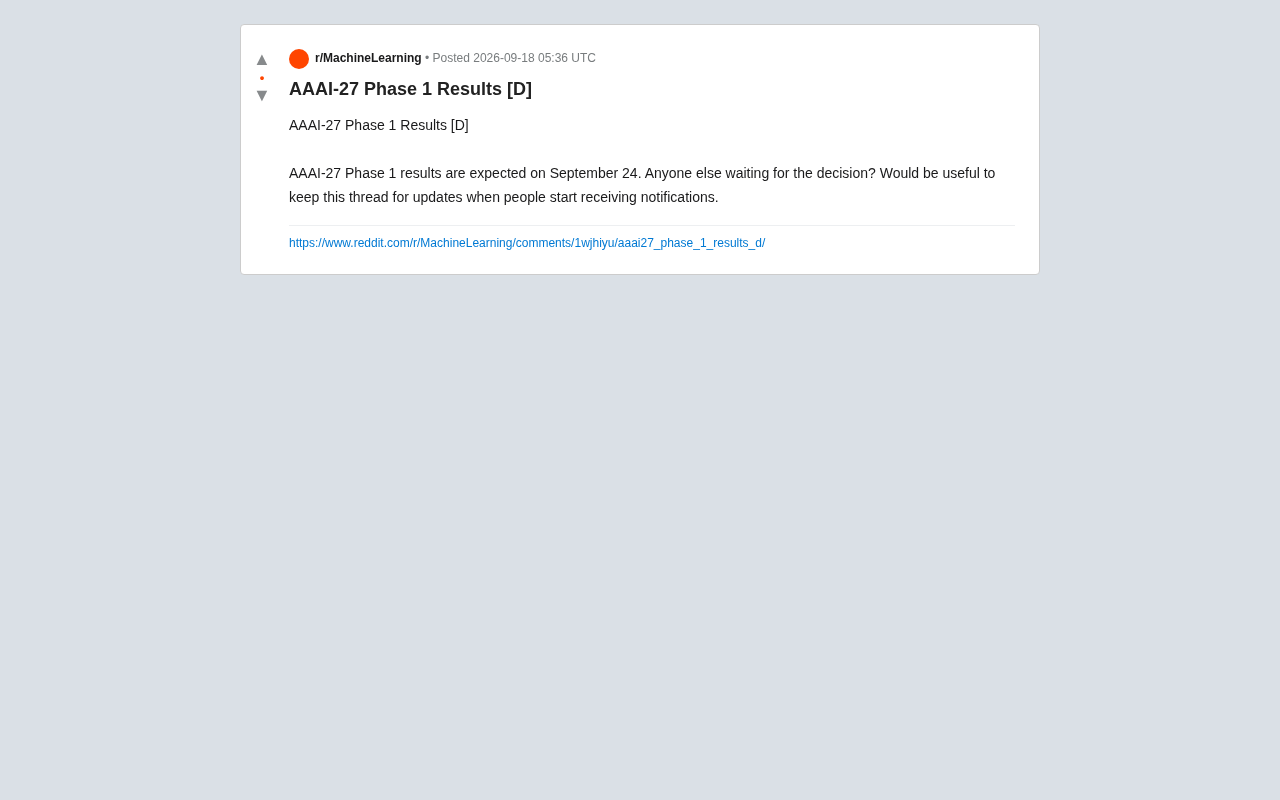
AAAI-27 Phase 1 Review Results Approaching: What Submitters Need to Know
AAAI-27 Phase 1 review results are expected on September 24. This article breaks down the phased review mechanism, what results mean for submitters, and tips for the waiting period.
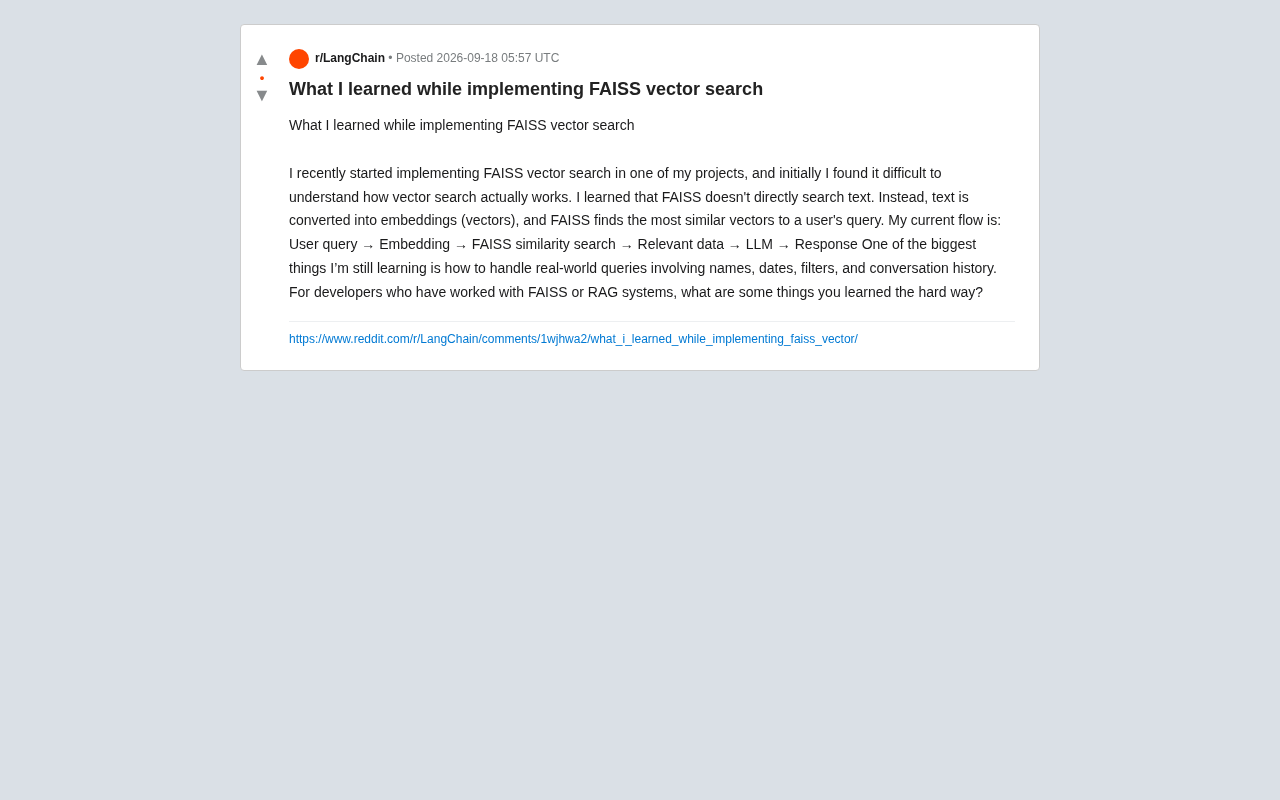
FAISS Vector Search in Practice: Lessons Learned From Embeddings to RAG
A developer shares hands-on lessons building FAISS vector search and RAG pipelines, covering embeddings, metadata filtering, query rewriting, and hybrid retrieval.