Optimizely Compromised: How Were Malicious Scripts Injected into the Websites of Zoom, GitLab, and Other Major Brands?

Optimizely was compromised, and attackers used its scripts to deliver malicious code to websites including Zoom and GitLab, exposing third-party script supply chain risks.
The security blog Report URI disclosed that Optimizely, the well-known A/B testing and experimentation platform, was compromised. Attackers used its widely embedded scripts to deliver malicious code to visitors of top global brand websites including Zoom and GitLab. The incident did not directly breach these websites but targeted a third-party service they all rely on, making it a typical supply chain attack. Optimizely scripts run in users' browsers with the same permissions as the host website; once the distribution channel is tainted, every website that embeds the script loads malicious payloads without users noticing. Discussion on Hacker News focused on third-party script governance, the effectiveness of protections like CSP and SRI, and the transparency of incident disclosure. The article recommends that developers inventory third-party dependencies, enable Subresource Integrity verification, deploy Content Security Policy, and incorporate vendors into security incident response plans.
When you browse the official websites of Zoom or GitLab, you probably don't think about the third-party scripts running behind the scenes quietly steering you toward malware. According to the security blog Report URI, Optimizely, the well-known A/B testing and experimentation platform, was compromised, and attackers used its scripts to inject malicious code into the websites of top global brands including Zoom and GitLab. The incident quickly sparked heated discussion on Hacker News, garnering 255 points and 103 comments.
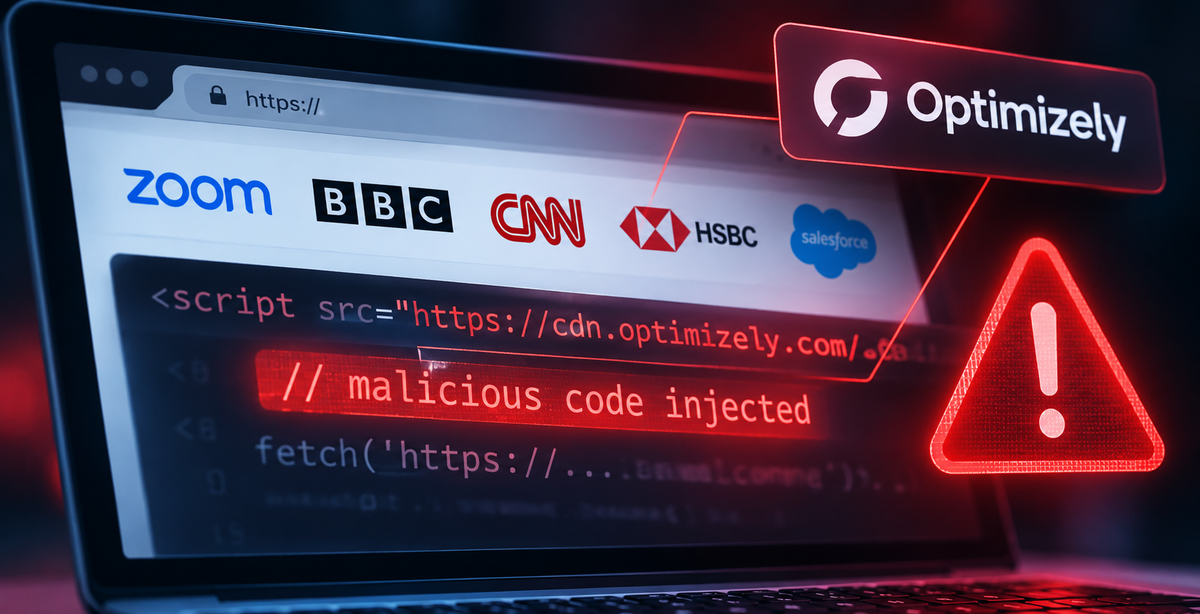
Incident Recap: Third-Party Scripts as an Attack Springboard
According to the Report URI article titled "World's Largest Brands Infected with Malware via Optimizely," the attackers did not directly breach the servers of Zoom or GitLab. Instead, they targeted Optimizely, which they all rely on. Optimizely is a widely used experimentation platform that allows enterprises to inject JavaScript scripts for A/B testing, personalized recommendations, and feature flags. Once the script distribution channel of Optimizely is tainted, every website that embeds the script will load malicious code without users noticing.
This supply chain attack pattern is not new, but the brands involved this time are extremely well-known, and the attack surface spans numerous websites, highlighting the fragility of third-party dependencies in the security chain. In the Hacker News discussion, many developers expressed concern about this "outsourcing of trust."
How the Attack Works: Script Injection and Supply Chain Risk
How Third-Party Scripts Work
The typical deployment of Optimizely involves inserting a script tag provided by Optimizely into the webpage HTML. This script loads more resources from Optimizely's CDN and executes experimentation logic. Because the script runs directly in the user's browser, it has the same permissions as the website itself—it can read cookies, modify page content, and make network requests.
Once attackers gain control of Optimizely's script distribution, they can push arbitrary JavaScript code to all host websites. This code can steal user data, redirect to phishing pages, or, as in this incident, load malware. The Report URI article states that attackers used Optimizely's scripts to deliver malicious payloads to visitors.
Subresource Integrity (SRI) is a browser security mechanism that allows web pages to attach a cryptographic hash (such as SHA-256, SHA-384, or SHA-512) to <script> or <link> tags. After loading an external resource, the browser computes its hash and compares it with the value declared in the tag, executing or applying the resource only if they match. SRI can effectively defend against scenarios where a CDN is tampered with or a third-party script is maliciously replaced, because even if an attacker controls the distribution server, they cannot make the browser accept modified code without knowing the original hash. However, SRI requires the resource content to be fixed, making it difficult to implement for dynamically generated or frequently updated scripts (such as experimentation platforms like Optimizely). It usually needs to be used in conjunction with versioned URLs or build-time hash injection.
Content Security Policy (CSP), on the other hand, declares through an HTTP response header (Content-Security-Policy) which sources of scripts, styles, images, and other resources the page is allowed to load. For example, script-src 'self' https://cdn.example.com only allows scripts from the same origin and the specified CDN to execute. CSP also supports nonce and hash mechanisms to precisely control the execution of inline scripts. A properly configured CSP can greatly reduce the attack surface after a third-party script is compromised—even if malicious code is injected, the browser will block it from loading as long as its source is not on the whitelist. However, CSP deployment requires cataloging all external dependencies, and overly permissive whitelists (such as allowing unsafe-inline or too many domains) will weaken the protection.
Why Large Brands Are Not Immune
Companies like Zoom and GitLab typically have very strict security protections, but their trust in third-party services is a necessary business choice. Third-party code such as A/B testing platforms, analytics tools, and advertising scripts is ubiquitous on modern websites, and website owners find it difficult to audit every line of external code. Attackers exploit this trust gap to amplify the leverage of supply chain attacks—compromising one service provider can affect thousands of websites.
Supply chain attacks refer to attackers not directly attacking the final target, but instead breaching third-party vendors, open-source components, software update channels, or service providers that the target relies on, using the chain of trust to deliver malicious code "legitimately" into the target environment. In the web context, common supply chain attack vectors include third-party JavaScript libraries, CDNs, analytics tools, advertising scripts, and A/B testing platforms. These attacks are characterized by extremely strong leverage: compromising one widely embedded service provider can simultaneously affect thousands of host websites, each of which typically considers that third party trustworthy. Because the malicious code comes from a trusted domain, traditional domain reputation filtering and some perimeter defenses struggle to detect it. Defending against supply chain attacks requires defense-in-depth measures, including dependency inventory management, integrity verification, the principle of least privilege, vendor security assessments, and rapid incident response and notification mechanisms.
Industry Reaction and Discussion Focus
Among the 103 comments on Hacker News, the discussion mainly centered on several aspects: first, questions about Optimizely's security practices; second, reflection on third-party script governance; and third, concern about the transparency of incident disclosure. Some commenters noted that such incidents once again prove the importance of protective measures like Content Security Policy (CSP) and Subresource Integrity (SRI), while also acknowledging that fully locking down third-party scripts is not easy in practice.
Another noteworthy perspective is that the attackers chose to strike through an experimentation platform like Optimizely, indicating that attackers are looking for "trusted and widely embedded" intermediary layers. Compared with directly attacking target websites, attacking the intermediary layer is not only cheaper but also bypasses some of the target websites' security monitoring.
Implications for Developers: How to Reduce Third-Party Script Risk
Although the full technical details and scope of impact of this incident await further disclosure, security experts have already put forward several actionable recommendations in the discussion. First, website operators should inventory all third-party scripts, assess their necessity and security track record, and reduce unnecessary dependencies. Second, enable Subresource Integrity (SRI) verification for critical third-party scripts to ensure that the loaded code has not been tampered with. Third, deploy Content Security Policy (CSP) to restrict the sources from which scripts can be loaded and executed.
In addition, for platforms like Optimizely, users should closely monitor their security advisories and promptly rotate any potentially exposed keys or configurations. The Report URI article also reminds brands to incorporate third-party vendors into their own security incident response plans and to clarify notification and collaboration mechanisms.
Conclusion: Supply Chain Security Requires Continuous Vigilance
The Optimizely compromise is not an isolated case but another warning about the supply chain risk of third-party scripts. From Zoom to GitLab, even the websites of these industry benchmark companies cannot avoid being exploited, and small and medium-sized websites face even higher risks. For developers and security teams, while trusting third-party services, they must establish corresponding verification and isolation mechanisms to minimize the impact when an attack occurs.
(This article is based on the Report URI blog post and Hacker News discussion; incident details are subject to official disclosure.)
Related articles
Google Stitch Skills: Connecting Coding Agents to the Design Workflow
Google Stitch Skills is an Agent Skills library following the open standard, adding a design-to-code workflow to the Stitch MCP Server. This article breaks down its three skill groups, SKILL.md directory structure, installation paths, and dependency pitfalls.

40.5-Inch Color E-Paper Art Frame: An Art Display You Charge Once a Year
The Ink Poster Tella 40.5-inch color e-paper art frame uses the E Ink Spectra 6 full-color solution: A1 format, no backlight, no noise, about one charge a year, 2,000+ licensed artworks built in, and automatic adaptation of phone photos.

Jingle Jam Memories: RT's Awkward First Encounter with Lewis
RT shares his awkward first Jingle Jam experience: unexpectedly pushed into the studio, meeting Lewis and Yogg's cast, and Toddy appearing in armor.