Opus 5.5 vs GPT-6 Astra: Same Prompt, Two AI-Generated Films — Does Quality Trump Speed?

Same prompt, two AI films: Opus 5.5 took 3.6× longer than Astra and swept a 5-person blind test.
Bilibili creator Skill Labs gave Claude Code (Opus 5.5) and Codex (GPT-6 Astra) the same prompt to generate a 90-second Hong Kong night film with no external assets and no human intervention. Over three rounds, Opus took 4h12m total vs. Astra's 1h9m — roughly 3.6× slower — due to its read-first, screenshot-heavy, rebuild-when-needed workflow (63 screenshots vs. Astra's 13). Five blind testers unanimously preferred Opus, citing superior detail and cinematography. Opus also delivered frame-accurate audio sync; Astra added unsolicited UI elements and dialogue. Verdict: Opus for quality, Astra for speed.
One Prompt, Two Models, Two 90-Second Films
This is a genuinely compelling AI coding model showdown. Bilibili creator Skill Labs gave the exact same prompt to two models and had each write code to generate a 90-second short film — Claude Code's Opus 5.5 on the left, Codex's GPT-6 Astra on the right. The rules were strict: images, 3D models, fonts, and audio all had to be generated from scratch — nothing pulled from external sources. Both models ran at their maximum reasoning settings with zero human confirmation prompts throughout.
The film's theme centered on Hong Kong at night, featuring four scenes: "Encircling the Harbor," "Tram," "Neon Signs," and "Dulin." Each model ran independently in its own isolated directory, and the full experiment was repeated across three rounds to minimize interference.
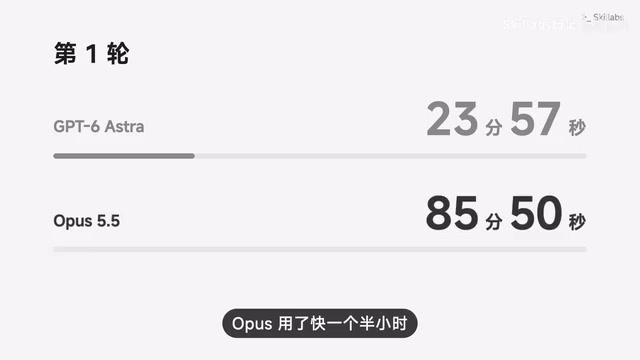
4 Hours 12 Minutes vs 1 Hour 9 Minutes: A Massive Gap
Across three rounds, the time difference was striking: Opus 5.5 took a cumulative 4 hours and 12 minutes, while Astra finished in just 1 hour and 9 minutes — roughly 3.6 times longer for Opus.
The gap was apparent from round one. Astra wrapped up in about 20 minutes; Opus took nearly an hour and a half. What's fascinating is where that time went: Opus spent the first 9 minutes not writing code at all, but reading through the source code of the 3D library and checking which Chinese fonts were installed locally. After that came another half hour of deliberation before it wrote the entire film's code in one go — followed by over a dozen rounds of iterative refinement, each time taking screenshots to review the output.
The numbers tell the story clearly: Opus reviewed 63 screenshots throughout the process; Astra looked at just 13. This "look-then-revise" workflow is the core reason the timeline ballooned so dramatically.
Claude Code is Anthropic's developer-focused AI coding assistant, with Opus 5.5 as its flagship reasoning-tier model — designed for complex tasks and capable of strong multi-step planning. Codex is OpenAI's code generation platform, and GPT-6 Astra ("Astra" being an experimental codename) represents its latest generation model. Running both at maximum reasoning settings means each model draws on more compute for chain-of-thought reasoning — a longer internal deliberation before responding — which typically improves output quality on complex coding tasks but significantly increases response time. Notably, Opus's habit of reading source code before writing reflects a meaningful difference in Tool Use capability: rather than relying purely on training knowledge, the model proactively calls file-reading tools to survey its environment first. This strategy reduces errors caused by environment mismatches, but at the cost of a longer upfront "thinking" phase.
Round Two — Rebuild vs. Touch-Up
For round two, the creator sent a single message asking both models to review their work against the original seven requirements one by one. Faced with the neon sign scene, the two models took completely different approaches.
Opus scrapped the scene entirely and rebuilt it as a series of individual sign close-ups. Astra, by contrast, fixed minor issues like subtitles still fading in during a pause — the composition remained completely unchanged. Astra finished in under half an hour; Opus again spent about an hour and a half.

Worth noting: the behind-the-scenes breakdown of Opus's workflow shown in the video wasn't Opus volunteering the information — the creator had it parse its own logs after the fact. Since Opus was a competitor in this test, self-evaluation would hardly be impartial.
Five Friends, Blind Test, Unanimous Winner
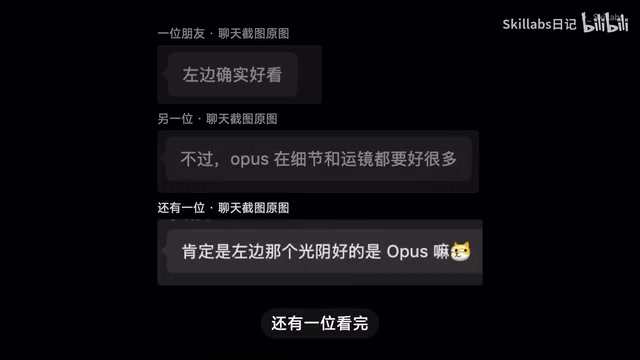
The most convincing verdict came from a third-party blind test. The creator recorded the two round-three films side by side and sent the footage to five friends, without telling them which model made which. The result: all five chose the Opus version on the left.
Some said "the left one just looks better." Others were more specific: "Opus is noticeably better on details and camera work." One person even correctly guessed which side was Opus just from watching.
The differences showed up across multiple details. The prompt asked for "cinematic black bars" — Opus delivered clean, pure-black widescreen letterboxing. Astra, meanwhile, packed an entire media player interface into those bars: title card, coordinates, progress bar, button prompts — none of which were requested, and across all three rounds, Astra never removed them. At the end, Astra also took creative liberty and added an unsolicited closing line: "A city of lights, a sleepless night."
Sound Design: Frame-by-Frame Calculation vs. Everything Gets a Sound
Audio is where the gap was most audible. Both films used minor-key scores with similar moods — the difference was in how sound effects were handled.
Astra's approach: if something should make noise, it does. Trams and ferries got sound where expected. Opus, on the other hand, computed sound effects frame by frame against the visuals: every wheel axle clicking over a rail joint, the electrical hum tracking specifically with the "Golden Dragon" sign and not others, each element sounding independently — plus two added thunderclaps synced to two flashes of lightning inserted into the frame.
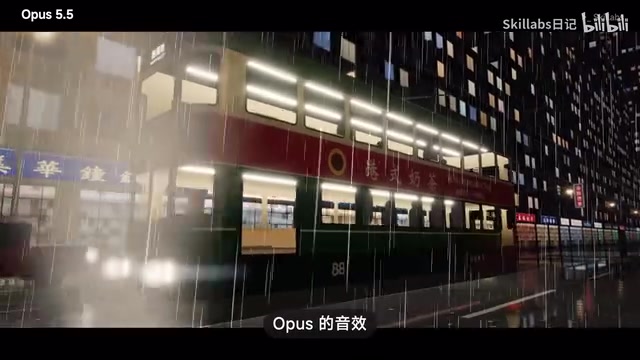
Both films ran at a full 60 fps with zero console errors. On a technical completion level, both passed — what separated them was the depth of detail work.
The two models' approaches to sound generation reveal different paths in AI creative work: procedural generation versus hardcoded configuration. Frame-accurate audio sync (as Opus did) requires the model to parse the video timeline, calculate precise timestamps for each visual event, and programmatically bind audio clips to those moments — essentially data-driven audio-visual synchronization, similar to "trigger" logic in professional audio software. Astra's approach is closer to scene-type rule matching: detect a "tram scene," apply the tram sound package. Simpler logic, but coarser control. Audio-visual sync errors within two frames sit near the threshold of human perception (roughly 20–30 milliseconds), and Opus's frame-level calculation compressed errors into that range — a genuinely rare achievement in a fully automated AI workflow.
Slow and Steady vs. Speed Above All
This head-to-head doesn't deliver a clean, universal verdict — it surfaces a more practical question you'll have to answer for yourself.
Opus 5.5's strength is its thoroughness: read the source first, self-review with screenshots, scrap and rebuild when something's wrong. The payoff is a unanimous blind-test win, more polished cinematography, and tighter audio work. The cost is staggering time — over an hour per round, with no real opportunity for human input while it runs.
Astra wins on efficiency: deliverables in minutes, clean error-free builds, but a tendency to fill in gaps on its own terms (unsolicited UI overlays, added dialogue) and noticeably shallower attention to detail.
The creator's recommendation cuts right to it: give Opus the films that need to impress someone; give Astra the jobs where the clock is ticking. Which you reach for depends on whether your workload is more "needs to be done fast" or "needs to look good."
Related articles

Amphibious Transforming Drone: Beyond 100x Power Savings, What Are the Real Needs?
Is the amphibious transforming drone just a gimmick? Starting from the 100x power difference of the M4 Morphobot, explore real application scenarios and thesis topic ideas, analyzing boundary conditions where pure drones and pure ground robots both fail.

Warhound Raises $200 Million: Genetically Engineered "War Dogs" Paired with Anduril Gear
Warhound raises $200M, backed by Ben Lamm and Palmer Luckey, to genetically engineer dogs for military and law enforcement use and equip them with Anduril gear. This article analyzes its technology direction, funding logic, and ethical controversy.

Claude API Comes to Google Cloud: IAM Integration and SDK Access Guide
Anthropic hosts the full Claude API on Google Cloud with IAM-controlled permissions and unified billing. This guide covers the Vertex AI and Anthropic-hosted entry points, IAM role configuration, and SDK access.