Opyt: Turn Your X and Substack Follows into a Personal Knowledge Base
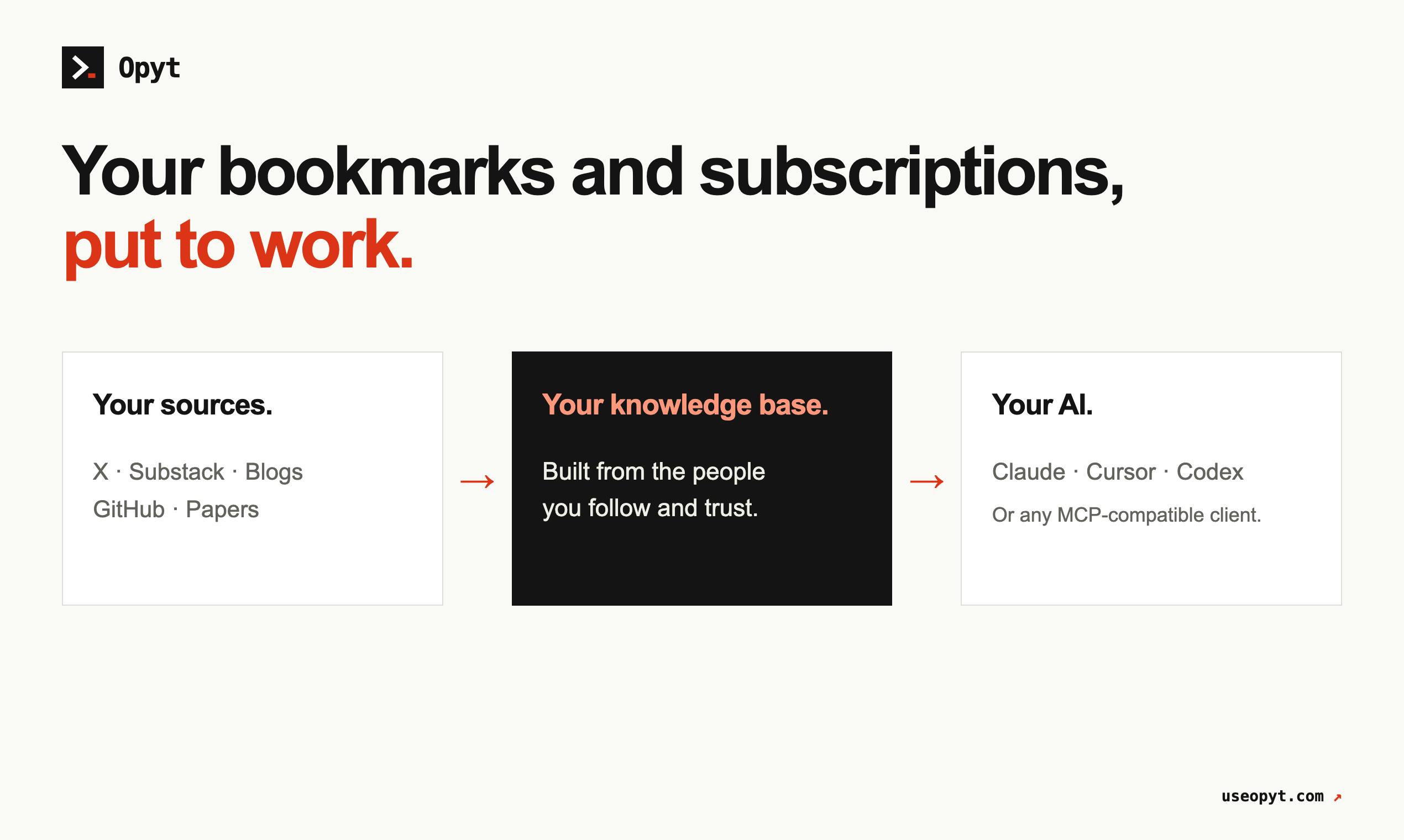
Opyt is an open-source tool that turns your X and Substack saves into an AI-powered personal knowledge base.
Opyt is a free, open-source personal knowledge management tool that aggregates content from X bookmarks, Substack subscriptions, GitHub, and arXiv into a structured, searchable knowledge base. Unlike typical read-it-later apps, it actively reads collected topics, generates follow-up questions, and surfaces related new content in a continuous loop. It runs locally under the MIT license with no cloud requirement, and can serve as context for large language models. Created by David Maimon, it earned 75 upvotes on Product Hunt and is best suited for researchers and heavy information consumers.
In an age of information overload, we bookmark tweets on X (formerly Twitter), subscribe to Substack newsletters, star GitHub repos, and track arXiv papers — yet rarely go back to actually absorb any of it. Our saved collections slowly become information graveyards. The open-source tool Opyt aims to solve exactly this problem: it transforms the people and topics you're already following into a personal knowledge base you can continuously search, explore, and dig into.
What Is Opyt
Opyt's core idea is straightforward: you're already doing the work of filtering information — bookmarking, subscribing, starring — but the value generated by those actions isn't being put to good use. Opyt aggregates these scattered information sources and structures them into a cohesive knowledge base.
You can point it at multiple data sources: bookmarks on X, Substack subscriptions, personal blogs, GitHub repositories, and even academic papers on arXiv. Opyt crawls the historical archives of these sources — not just the latest few posts — building a more complete body of content over time.
The project was created by David Maimon and launched on Product Hunt across categories including Open Source, Twitter, GitHub, and Search, earning 75 upvotes and ranking 16th for the day.
Active Exploration: It Asks Its Own Questions
What sets Opyt apart from typical read-it-later tools is its proactiveness. According to the official description, Opyt reads a topic through, then writes its own follow-up questions based on the content, and continuously seeks out new works that extend beyond what you've already collected.
This means it doesn't passively store whatever you throw at it — it acts more like a research assistant, actively expanding the knowledge frontier around topics you care about. Once you've built up a collection in a given area, it can help you discover "what's new in this space," so you don't miss key developments amid the noise.
This "read → question → retrieve" loop essentially embeds AI-powered retrieval augmentation into your personal information management workflow.
This design is closely related to Retrieval-Augmented Generation (RAG), one of the dominant architectures in modern AI applications. Rather than having a large language model rely solely on knowledge baked in during training, RAG dynamically retrieves external documents at inference time and feeds them as context to the model — making responses more relevant to specific domains or recent information. Opyt's "read → question → retrieve" cycle applies this same thinking to personal knowledge management: the knowledge base acts as a vector database, while AI handles semantic understanding, generates follow-up questions, and drives new retrieval rounds. For users, this means the knowledge base isn't a static archive — it's a dynamic map that grows automatically around your topics of interest.
Open Source, Free, and Local-First
Opyt has several features that appeal to users who care about privacy and cost:
- Completely free: No paywalls.
- MIT License: One of the most permissive open-source licenses, allowing free use, modification, and commercial use.
- Local storage: Your knowledge base can stay local — your data doesn't have to go to the cloud.
For users who don't want their reading habits and saved content controlled by third-party platforms, the local-first design is a meaningful advantage. The MIT license also means the developer community can freely build on and customize the tool.
The official description also mentions "let your AI read it all," suggesting the knowledge base can serve as context for AI models — you can feed your entire curated collection to a large language model and have it answer questions based on your hand-picked sources, rather than relying on generic internet training data.
Local-first is a growing design philosophy in software: user data should be stored on the user's own device by default, with cloud sync as an option rather than a requirement — preserving offline availability, responsiveness, and data sovereignty. By contrast, most SaaS knowledge management tools (like Notion or Readwise) host user data on cloud servers, putting access at risk if a subscription lapses. Opyt's local-first approach, combined with the MIT open-source license, means that even if the project stops being maintained, users retain full ownership of their data and code — no vendor lock-in. This is especially important for researchers who need to maintain knowledge assets over the long term.
Who Is It For
Based on its feature set, Opyt is best suited for heavy information consumers and research-oriented users:
- Researchers and analysts who need to track developments in specific fields over time;
- Knowledge workers who have accumulated large collections of X bookmarks and Substack subscriptions but struggle to make use of them;
- Technical users who value open source, care about data autonomy, and are comfortable self-hosting tools.
If you only browse casually, Opyt might feel like overkill. But if you're already systematically accumulating information across multiple platforms, its aggregation and active exploration capabilities can genuinely transform the "save and forget" trap into a usable knowledge asset.
Summary
Opyt represents an evolution in personal knowledge management tools: moving beyond simple storage and tagging to integrate AI-powered retrieval and questioning — letting the tool actively help you extend your understanding. Add in its free, MIT-licensed, local-first positioning, and it holds real appeal for privacy-conscious power users.
That said, as an early-stage project that just launched on Product Hunt, its actual crawling performance, the quality of its AI-generated questions, and the reliability of various platform integrations still need real-world validation. For interested users, the open-source nature at least means you can self-host and try it with minimal risk.
Related articles

WAN 2.1 Physics Motion LoRA Benchmark: Rankings and Methodology for 11 Models Tested
A Reddit user benchmarked 11 physics-motion LoRAs on WAN 2.1 using optical flow analysis. Only 3 worked meaningfully; 4 scored below the no-LoRA baseline. Full rankings and methodology inside.
Lucid Partners with Bolt to Target European Robotaxi Market
Lucid Motors has signed a letter of intent with European mobility platform Bolt to explore Robotaxi services in Europe, though no vehicle orders have been placed yet.
AI Assistants Enter the "Phone Call" Era: Instinct and Meta Muse Add Voice Task Execution
AI assistants Instinct and Meta Muse now make phone calls on your behalf — booking restaurants, canceling subscriptions — marking a leap from chat tools to real-world agents.