Oracle Plans $20 Billion Stock and Bond Financing to Boost AI Infrastructure
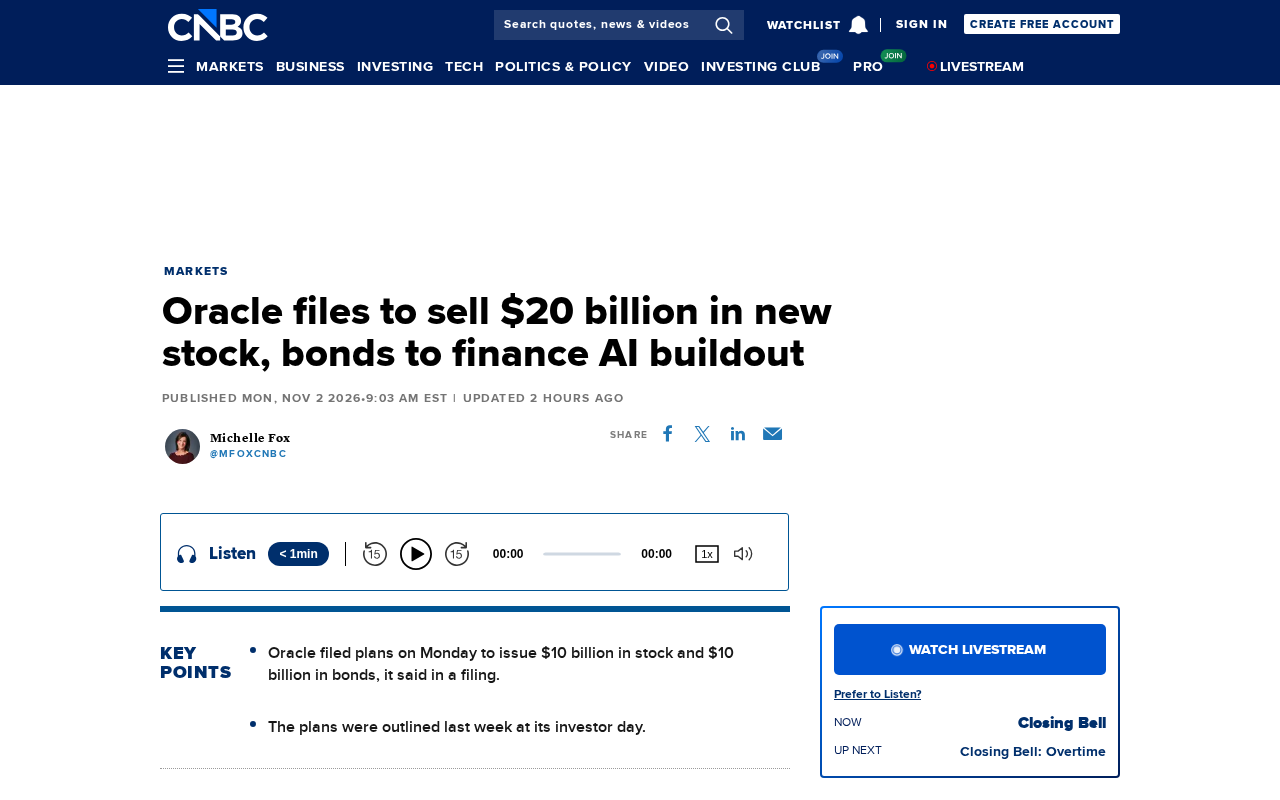
Oracle plans $20 billion stock and bond financing to boost AI infrastructure and leapfrog competitors.
Oracle has filed to raise up to $20 billion through new stock and bond issuance, all earmarked for AI infrastructure. This highlights its ambition to accelerate transformation in cloud and AI, and reflects the escalating arms race among tech giants over computing power. The article analyzes that the stock-bond combination aims to balance large-scale capex and financial leverage, improving equity structure while securing long-term funds at lower rates. Oracle lags behind AWS, Azure, and Google Cloud in cloud infrastructure share, but surging AI computing demand offers a leapfrog opportunity. Challenges include technical ecosystem, energy supply, and short-term profit pressure. The $20 billion scale may prompt other cloud vendors to follow, further intensifying AI infrastructure competition.
Oracle Plans $20 Billion Stock and Bond Financing to Boost AI Infrastructure
Amid an intensifying race in AI infrastructure, database giant Oracle has taken an aggressive step. According to a discussion on the Hacker News community, Oracle has filed documents to raise up to $20 billion through the issuance of new shares and bonds to support its AI infrastructure buildout. This move not only highlights Oracle's ambitions in cloud computing and AI but also reflects the escalating arms race among tech giants over computing resources.
Financing Scale and Use: $20 Billion Entirely for AI Infrastructure
According to disclosed information, Oracle plans to issue securities including both stocks and bonds, totaling $20 billion. Although the specific timetable and pricing details have not been announced, the use of funds is clear—all will be used for the construction and expansion of AI infrastructure.
This financing scale is unusual in Oracle's history. As a company long known for enterprise software and database businesses, Oracle has been accelerating its transition to cloud computing and AI infrastructure in recent years. This large-scale financing means the company hopes to expand data centers, purchase computing hardware, and build infrastructure capable of supporting large-scale AI model training and inference at a faster pace.
From an industry perspective, the demand for computing power from large AI models is growing exponentially, and training and deploying advanced models require massive GPU clusters and supporting energy and cooling systems. Oracle's choice to raise funds through a combination of equity and debt can reduce pressure on a single financing channel and also take advantage of the current capital market's enthusiasm for AI concepts to obtain relatively favorable financing terms.
Why a Combination of Stock and Bonds? Considerations Behind the Financial Strategy
Oracle's choice to issue both stocks and bonds, rather than relying solely on one financing tool, is backed by multiple financial considerations.
Issuing stocks can increase the company's equity capital, improve the asset-liability structure, and avoid excessive debt growth; while issuing bonds can take advantage of the current relatively stable interest rate environment to obtain long-term funds at a lower cost. The combination can meet the needs of large-scale capital expenditures while maintaining financial flexibility.
For Oracle, AI infrastructure is a capital-intensive investment with a long payback period. Financing through a combination of stocks and bonds can provide stable funding support for long-term projects without significantly increasing financial leverage. This strategy is not uncommon in capital expenditure financing for large tech companies, but the scale of Oracle's financing this time has still attracted widespread market attention.
According to discussions on Hacker News, some community members are cautious about Oracle's move, believing that large-scale financing may dilute existing shareholders' equity and also reflects that the cost pressure of AI infrastructure construction is far greater than expected. However, others believe that in the context of continued strong demand for AI computing power, early layout of infrastructure is a necessary move to maintain competitiveness.
The trade-off between equity dilution and financial leverage is key background for understanding Oracle's financing strategy. Issuing new shares increases total share capital, and the shareholding ratio of original shareholders decreases accordingly—so-called "dilution"; while issuing bonds creates liabilities, requiring regular interest payments and repayment of principal at maturity, pushing up the debt-to-asset ratio. Companies usually seek a balance between the two: when stock prices are high and the market has a high recognition of the growth story, the "cost" of issuing additional shares is relatively low; when interest rates are low, the interest burden of issuing bonds is lighter. Oracle's choice to proceed with both stocks and bonds is essentially to diversify financing risks in an uncertain market environment while preserving room for future financing.
Capital-intensive industries refer to industries that require continuous investment in large amounts of fixed assets (such as data centers, servers, power facilities) to maintain operations and growth. Typical characteristics of such industries are huge upfront investment, long payback periods, and significant economies of scale. AI infrastructure is a typical capital-intensive field, with the construction cost of a single large data center reaching billions of dollars and requiring continuous procurement of expensive hardware such as GPUs. This explains why Oracle needs external financing rather than relying solely on operating cash flow to support expansion.
AI Infrastructure Race: Can Oracle Catch Up?
Oracle has long lagged behind top players such as Amazon AWS, Microsoft Azure, and Google Cloud in the cloud infrastructure market. But in the AI era, the competitive landscape has new variables—enterprise demand for cloud platforms that can efficiently run AI workloads has surged, providing Oracle with an opportunity to leapfrog.
In recent years, Oracle has actively expanded AI computing services through its OCI (Oracle Cloud Infrastructure) business and established partnerships with multiple AI companies. This $20 billion financing plan can be seen as a signal of Oracle's increased bet on AI infrastructure. The company hopes to attract more AI developers and enterprise customers by building data centers and computing clusters on a large scale.
However, challenges cannot be ignored. Competition in AI infrastructure is not just a contest of capital investment but also involves technical ecosystems, customer relationships, energy supply, and other dimensions. Oracle needs to simultaneously efforts in hardware procurement, talent reserves, and software ecosystem development to truly convert funds into competitiveness. In addition, large-scale capital expenditures may put pressure on the company's short-term profitability, and investors need to weigh growth against returns.
OCI (Oracle Cloud Infrastructure) is Oracle's public cloud infrastructure platform, providing basic cloud services such as computing, storage, and networking, and is Oracle's core product benchmarked against AWS, Azure, and Google Cloud. OCI's differentiated positioning emphasizes high-performance networking (such as RDMA low-latency interconnection) and native optimization for enterprise database workloads, and in recent years has focused on support for NVIDIA GPU clusters to meet large model training needs. Understanding OCI's market position helps judge where Oracle's $20 billion financing will go—this funding is likely to be used to expand OCI's data center capacity and GPU computing pools.
The logic of "leapfrogging" in the AI computing market deserves additional note: the cloud infrastructure market has obvious first-mover advantages and scale barriers, and top vendors have formed huge customer stickiness and global node coverage through years of accumulation. But in the AI era, the demand structure has changed—customers' thirst for GPU computing power exceeds demand for general cloud services, and supply is severely insufficient. This supply-demand mismatch provides a window of opportunity for vendors with lagging market share: as long as they can quickly deliver usable AI computing power, they may be able to win incremental customers from top vendors. Oracle's bet is based on this logic, but how long the window lasts depends on the speed of computing supply expansion across the industry.
Market Reaction and Industry Impact
Although discussion on Hacker News is limited (25 points, 3 comments), the significance of Oracle's financing plan cannot be underestimated. The $20 billion financing scale is a heavyweight move in the current AI investment boom and may trigger a chain reaction—other cloud service providers and tech companies may follow suit and increase investment in AI infrastructure, further intensifying competition for computing resources.
From the capital market perspective, Oracle's move also tests investors' acceptance of the AI infrastructure investment story. If the financing is completed smoothly and receives positive market feedback, it may encourage more traditional tech companies to bet on AI through stock and bond financing. Conversely, if the market reaction is lukewarm, it may prompt companies to reassess the pace and scale of AI investment.
For the entire AI industry, Oracle's financing plan is a microcosm of intensifying competition at the infrastructure layer. As more and more capital flows into the AI infrastructure field, issues such as the supply landscape of computing resources, the sustainability of energy consumption, and industry concentration will become topics worthy of continuous attention for some time to come.
Related articles
 Tech Frontiers
Stylome Bot Slammed as Useless Junk: Why Do AI Detection Tools Keep Failing?
Reddit users test the Stylome AI detection bot: Gemini-rewritten text judged human-written, consistently low confidence. An analysis of AI text detection's technical dilemmas, privacy concerns, and credibility crisis in community governance.
 Tech Frontiers
When AI Becomes a Productivity Divide: Clarity or "AI Psychosis"?
A civil engineer's deep use of agentic AI boosted efficiency but bred contempt for peers who refuse to learn. Is this clarity or AI psychosis? An analysis of the cognitive and psychological challenges behind the AI productivity divide.
 Tech Frontiers
Opus 5.5 Benchmark Scores Climb, Community Says Its "Weights Are Blessed"
Reddit community discusses Opus 5.5's rising scores on the Benchmaxxing Bench, with users describing its performance as "weights are blessed." This article interprets the community reaction and cautions against conflating benchmark scores with real capability.