Orato: On-Device AI Speaking Coach That Delivers Quantified Feedback in 30 Seconds
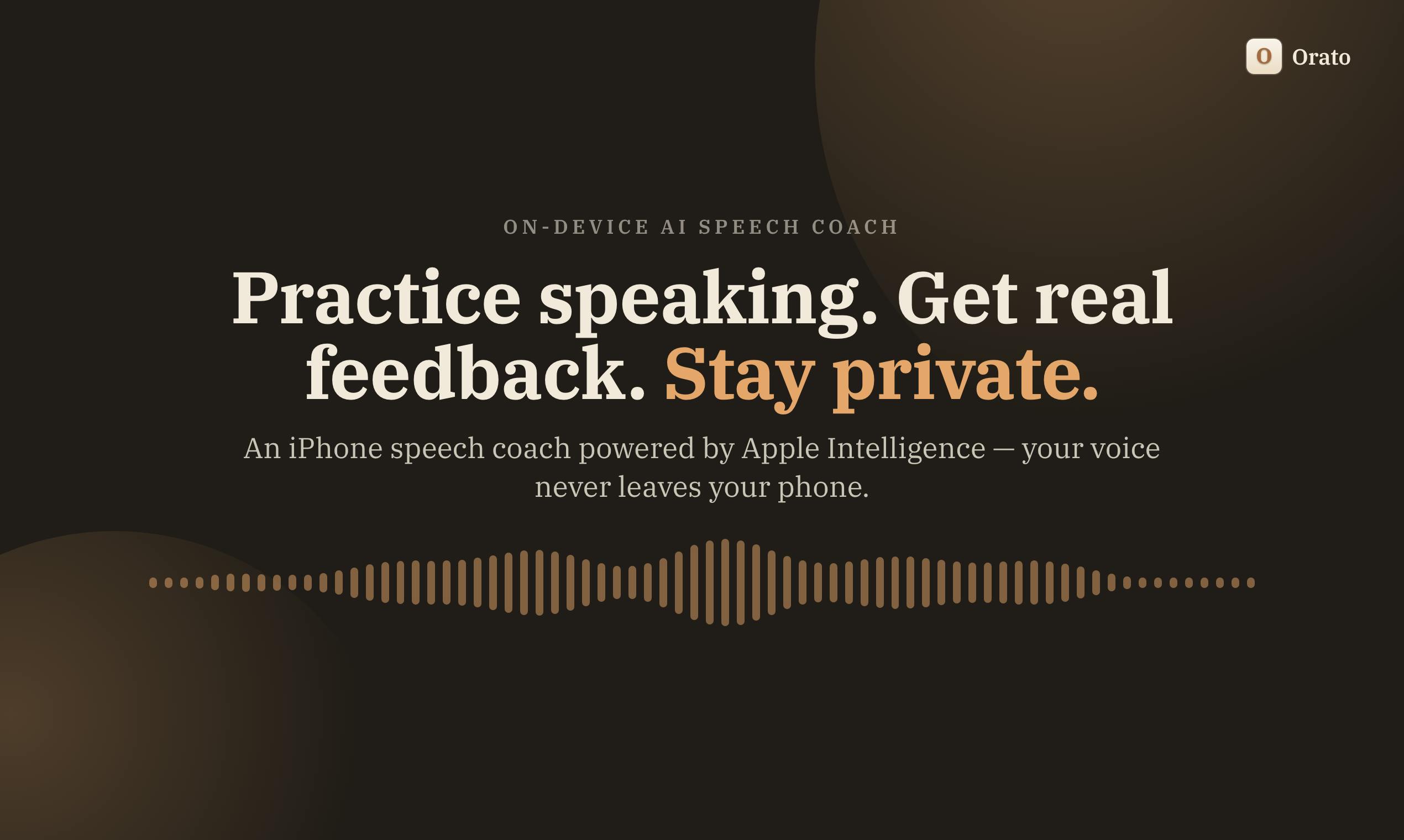
Orato is an on-device AI speaking app that gives quantified, 4-dimension feedback on your 30-second practice sessions.
Orato is a speaking practice app that recently appeared on Product Hunt, built around short 30-to-90-second drills scored across four dimensions: pacing, fluency, vocabulary, and coherence. Its standout feature is full speech transcription with filler words and long pauses flagged, turning vague impressions into concrete, reviewable data. Built on Apple Intelligence, it runs entirely on-device with no account required and no audio uploaded to the cloud — balancing privacy with convenience. Positioned as a "speaking gym" rather than a language learning tool, it's a strong example of the on-device AI application trend.
An AI Tool Built Specifically for Speaking Practice
Public speaking, interview prep, everyday communication — oral expression is a hidden pain point for almost every professional. Traditional solutions either require expensive personal coaches or repeated practice in front of others, both of which come with high psychological barriers. Orato, an app that recently launched on Product Hunt and climbed to #8 on the daily chart (earning 100 upvotes), aims to fill this gap with on-device AI.
Orato's core concept is refreshingly direct: Practice speaking with AI. It breaks speaking practice into bite-sized, executable tasks, giving users instant, quantified feedback from short 30-to-90-second sessions.

A Closer Look at Orato's Speaking Training Flow
Pick a Topic, Start Talking, Get Scored on Four Dimensions
Orato's workflow is designed to be extremely lightweight. Users pick a topic from the built-in drill library, then speak into their device for 30 to 90 seconds. Afterward, the system scores the performance across four dimensions:
- Pacing: Whether you're speaking too fast or too slow;
- Fluency: How smoothly you express yourself, and whether you frequently stumble or pause;
- Vocabulary: The diversity and precision of the words you use;
- Coherence: How well-organized and logical your content is.
These four dimensions cover the key indicators of spoken communication quality. Rather than vague feedback like "that sounded good or bad," quantified scores help users identify exactly where they're weakest so they can improve with focus.
Speech Transcription for Review: Every Filler Word Exposed
One of Orato's standout features is that it generates a complete speech transcript. Every filler word (like "um," "uh," or "you know") and every overly long pause is clearly flagged in the transcript, giving users something concrete to review.
The value of this design is that it transforms "I feel like I didn't speak well" into "here's specifically where I didn't speak well." Many people don't realize how frequently they use filler words until they see them densely marked on a transcript — a visceral, eye-opening experience that drives sustained improvement.
On-Device AI: Privacy and Convenience in One
Orato's most noteworthy technical decision is that it runs entirely on-device on iPhones that support Apple Intelligence — no account registration required, and voice data never leaves the device.
For a speaking practice app that continuously captures user audio, this matters enormously. Voice data is deeply personal, and on-device processing means your practice recordings and transcripts never leave your phone, fundamentally eliminating the risk of privacy leaks. The no-account design also dramatically lowers the barrier to entry — just download and go, with no tedious sign-up flow.
This reflects a clear emerging trend: as Apple Intelligence and various on-device small models mature, more and more AI applications are moving inference to local devices, delivering near-real-time responses while protecting user privacy. Orato is a textbook example of this wave of "on-device AI application development."
Product Positioning and Competitive Landscape
In terms of positioning, Orato sits at the intersection of Product Hunt's "Productivity," "Education," and "Artificial Intelligence" categories. Its target users are individual learners who want to improve their public speaking, interview performance, or everyday communication skills.
Unlike language learning apps (such as Duolingo, which focuses on foreign language vocabulary acquisition), Orato is squarely focused on honing expression technique itself. It's more like a portable, always-available "speaking gym": just one or two minutes per session to complete a drill and receive quantified feedback.
Of course, as a newly launched product, Orato raises a few questions worth watching:
- Validity of AI scoring: Whether the algorithms for metrics like pacing and fluency are accurate enough to genuinely reflect how human listeners perceive a speaker remains to be validated at scale over time;
- Ceiling on training depth: AI scoring can help users improve foundational speaking skills, but higher-order qualities like persuasiveness and emotional resonance are currently difficult for AI to fully assess;
- Platform compatibility limitations: The full on-device experience currently requires an Apple Intelligence-compatible iPhone, meaning users on older devices or Android are temporarily unable to access its core advantages.
Conclusion: A Low-Barrier AI Speaking Practice Option
Orato's value doesn't lie in any technological breakthrough — it lies in making "practicing how you speak" low-barrier, quantifiable, reviewable, and privacy-preserving. It zeroes in on a real and widespread need, and uses mature on-device AI technology to meet it.
For users who dread practicing in front of others but want to systematically improve their verbal communication, an AI speaking coach that is "judgment-free and always available" might just be the right place to start.
Related articles
Open-Source Python SDK: Measuring AI Agent Reliability with SRE Principles
Agent Reliability is an open-source Python SDK that applies SRE's SLO and error budget concepts to AI Agent evaluation, with PASS/FAIL/UNKNOWN states, CI assertions, and zero forced dependencies.
MiniMax RefMod: A Complete Guide to Training-Free Reusable Identity Workflows
MiniMax RefMod offers training-free reusable identity workflows for image, video, and audio generation. Includes Runpod template and tutorial for quick setup.

Invalid Source Material Notice
The source material provided lacks substantive information and is unrelated to AI/tech topics, making it impossible to produce a complete professional article.