OrbACE Framework: Integrating Electronic Structure Descriptors to Improve Machine Learning Potential Accuracy
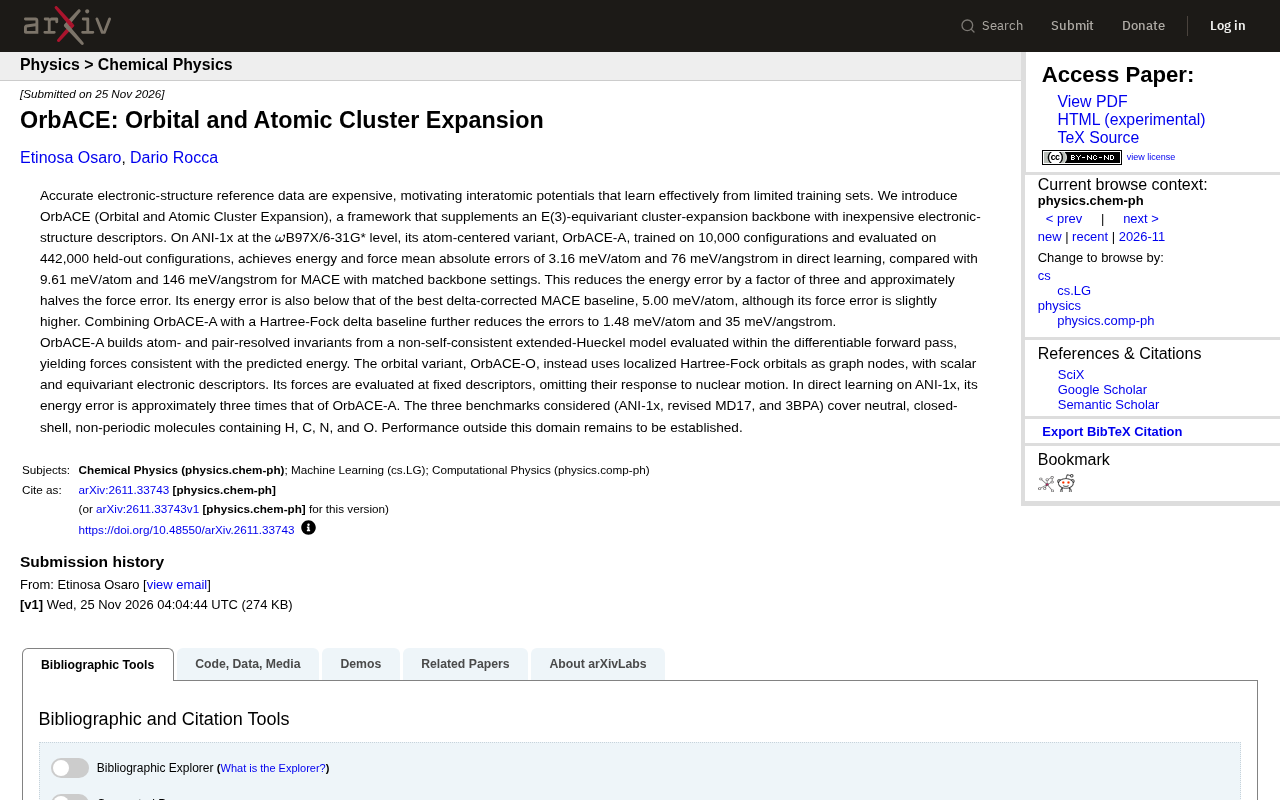
OrbACE integrates cheap electronic structure descriptors into equivariant cluster expansion, significantly improving MLIP accuracy with limited data.
The OrbACE framework combines low-cost electronic structure descriptors with an E(3)-equivariant cluster expansion backbone, computing forces differentiably to approximate high-accuracy reference methods with limited training data. On ANI-1x, its atom-centered variant OrbACE-A trained on only 10,000 configurations achieves energy and force errors of 3.16 meV/atom and 76 meV/Å, far outperforming MACE (9.61 meV/atom, 146 meV/Å) with the same backbone. Another variant, OrbACE-O, uses localized Hartree-Fock orbitals but fixes descriptors during force evaluation, yielding about three times the error of OrbACE-A, highlighting the importance of force-energy consistency. Combined with a Hartree-Fock delta baseline, OrbACE-A's errors drop further to 1.48 meV/atom and 35 meV/Å. Current validation is limited to neutral closed-shell small molecules; extension to periodic systems and reaction paths is a future direction.
Machine learning interatomic potentials (MLIPs) aim to approximate high-accuracy electronic structure methods at lower computational cost, but training data is expensive and limited. The recently proposed OrbACE (Orbital and Atomic Cluster Expansion) framework combines an E(3)-equivariant cluster expansion backbone with inexpensive electronic structure descriptors, achieving significantly better accuracy than purely geometric models on limited training sets.

Core Idea: Enhancing Cluster Expansion with Inexpensive Electronic Structure Information
Traditional MLIPs mainly rely on geometric descriptors of the local atomic environment (such as distances and angles). OrbACE takes a different approach: on top of an E(3)-equivariant cluster expansion backbone network, it supplements descriptors from low-cost electronic structure calculations. These descriptors are computed within a differentiable forward pass, ensuring forces and energies remain consistent.
The paper validates the framework on the ANI-1x dataset. Using ωB97X/6-31G* as reference, OrbACE's atom-centered variant OrbACE-A is trained on 10,000 configurations and evaluated on 442,000 held-out configurations, directly learning energies and forces with mean absolute errors of 3.16 meV/atom and 76 meV/Å, respectively. By comparison, under the same backbone settings, MACE yields errors of 9.61 meV/atom and 146 meV/Å—OrbACE-A reduces energy error to about one-third and force error by roughly half.
Even compared with the best delta-corrected MACE baseline (energy error 5.00 meV/atom), OrbACE-A still achieves lower energy error, although its force error is slightly higher. When OrbACE-A is combined with a Hartree-Fock delta baseline, errors drop further to 1.48 meV/atom and 35 meV/Å.
E(3) equivariance means the model is equivariant to translation, rotation, and reflection operations in 3D space: when the input configuration is rotated or translated, the model's scalar outputs (such as energy) remain unchanged, while vector outputs (such as forces) rotate accordingly. This property ensures physical consistency of predictions and prevents the model from re-learning spatial symmetries from data, thereby significantly improving sample efficiency. Cluster expansion is a systematic method that expands system properties as a sum of contributions from local atomic clusters; its equivariant version constructs higher-order equivariant features through tensor products, enabling the model to naturally express many-body interactions. OrbACE combines both: it uses equivariant cluster expansion as the backbone and injects electronic structure descriptors, gaining both symmetry priors and quantum chemical information.
Delta learning is a residual modeling strategy: first compute energies and forces with a low-cost baseline method (such as Hartree-Fock or semi-empirical methods), then train a machine learning model to predict only the difference between the high-accuracy reference method and the baseline. Since the difference is usually much smaller and smoother than absolute energies, the model can achieve higher accuracy with limited data. In MLIPs, delta correction is often combined with physical baselines; in this paper, combining OrbACE-A with a Hartree-Fock delta baseline reduces the error from 3.16 to 1.48 meV/atom, exactly demonstrating the effectiveness of this strategy.
Two Variants: OrbACE-A and OrbACE-O
OrbACE-A constructs atom and pair invariant descriptors using the non-self-consistent extended Hückel model, which is evaluated in a differentiable forward pass, so forces are consistent with predicted energies. OrbACE-O, in contrast, uses localized Hartree-Fock orbitals as graph nodes with scalar and equivariant electronic descriptors, but its forces are evaluated with fixed descriptors, ignoring the response of descriptors to nuclear motion.
Direct learning results on ANI-1x show that OrbACE-O's energy error is about three times that of OrbACE-A. This gap suggests that maintaining force-energy consistency is crucial for accuracy.
The non-self-consistent extended Hückel model is a semi-empirical quantum chemistry method that considers only valence electrons, describes interactions between atomic orbitals with a parameterized Hamiltonian matrix, and obtains the electronic structure through a single diagonalization without iteratively solving the self-consistent field. Its computational cost is extremely low and it is differentiable with respect to nuclear coordinates, making it suitable for embedding in a differentiable forward pass. OrbACE-A uses this model to rapidly generate electronic descriptors at the atomic and pair levels, allowing forces to be obtained strictly consistently with energies via automatic differentiation—one of the key reasons its accuracy surpasses OrbACE-O, which evaluates forces with fixed descriptors.
Benchmark Scope and Limitations
The paper considers three benchmarks: ANI-1x, the revised MD17, and 3BPA, covering neutral, closed-shell, non-periodic molecules containing H, C, N, and O. These tests demonstrate OrbACE's potential on common small organic molecules, but the authors explicitly note that its performance in other domains (such as periodic systems, open-shell molecules, and systems containing other elements) remains to be verified.
Multi-Source Cross-Validation and Consistent Conclusions
According to independent analyses by Bilibili UP host "AI4Science Frontier" and the YouTube channel "Machine Learning for Molecules," both videos emphasize that OrbACE's core contribution lies in integrating quantum chemical descriptors into equivariant networks in a differentiable manner, rather than relying on more complex backbone architectures. Both sources agree that OrbACE-A's energy error is significantly lower than the baseline MACE, and that its potential is even greater when combined with delta learning. Regarding OrbACE-O's approximate treatment of force evaluation, both point out that this may be the main reason for its lower accuracy, but neither denies its value as an exploration direction.
Potential Impact and Future Directions
OrbACE demonstrates the feasibility of "geometry + electronic" hybrid descriptors, which is especially suitable for data-scarce scenarios. Its design of differentiable electronic structure descriptors provides new ideas for building more physically consistent MLIPs. However, current validation is limited to small molecules, and extension to periodic materials and reaction paths will be the key next step.
As MLIPs are widely applied in materials discovery and drug design, methods like OrbACE that integrate physical priors are expected to reduce reliance on expensive reference data and promote the adoption of high-accuracy simulations.
Related articles
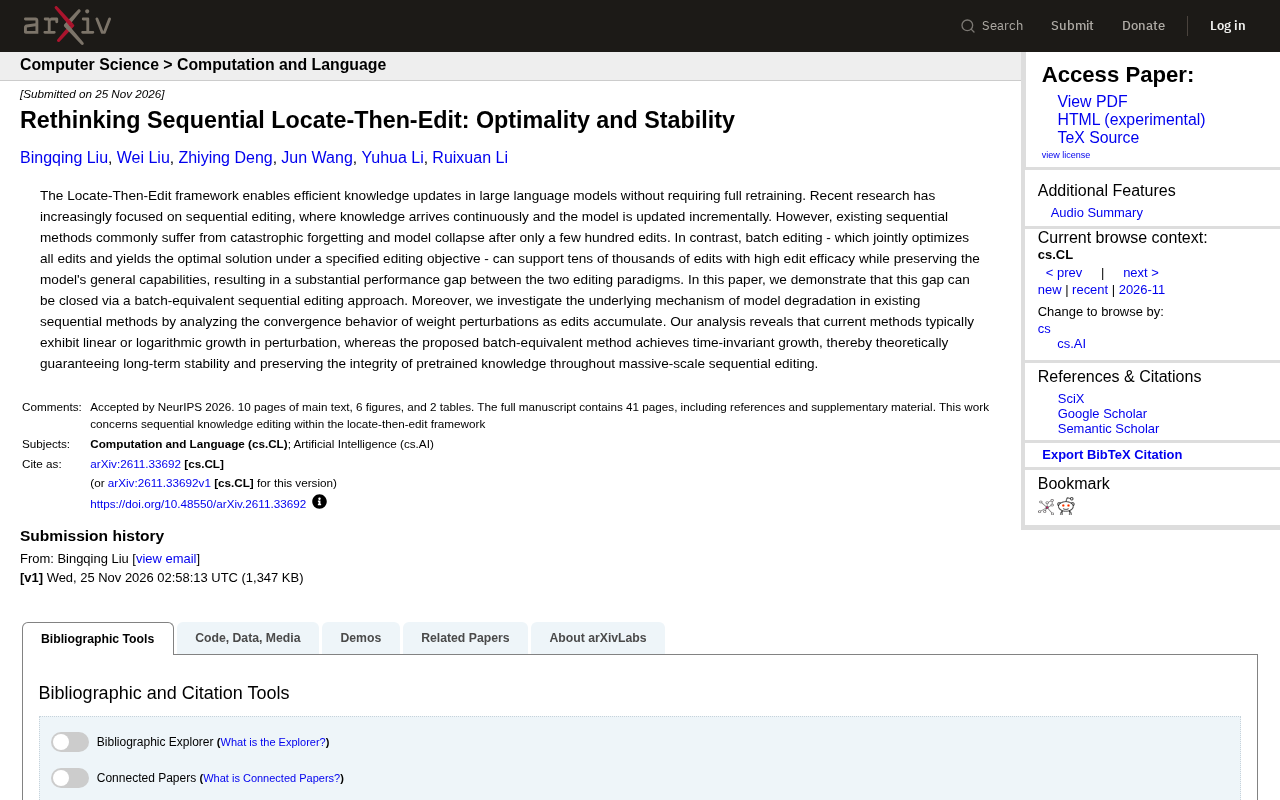
Sequential Editing Without Catastrophic Forgetting: Batch-Equivalent Method Enables Stable LLM Knowledge Updates
Paper revisits sequential Locate-Then-Edit: batch editing supports tens of thousands of edits while sequential editing collapses after hundreds. Proposes batch-equivalent method.

S2S: Sparse-to-Sparse Feature Learning Enables Cross-Layer Analysis and Steering
S2S proposes sparse-to-sparse feature learning with layer-by-layer prediction and output-distribution anchoring, achieving stronger adjacent-layer correspondence across eight language models and separating steering effects from reconstruction effects.
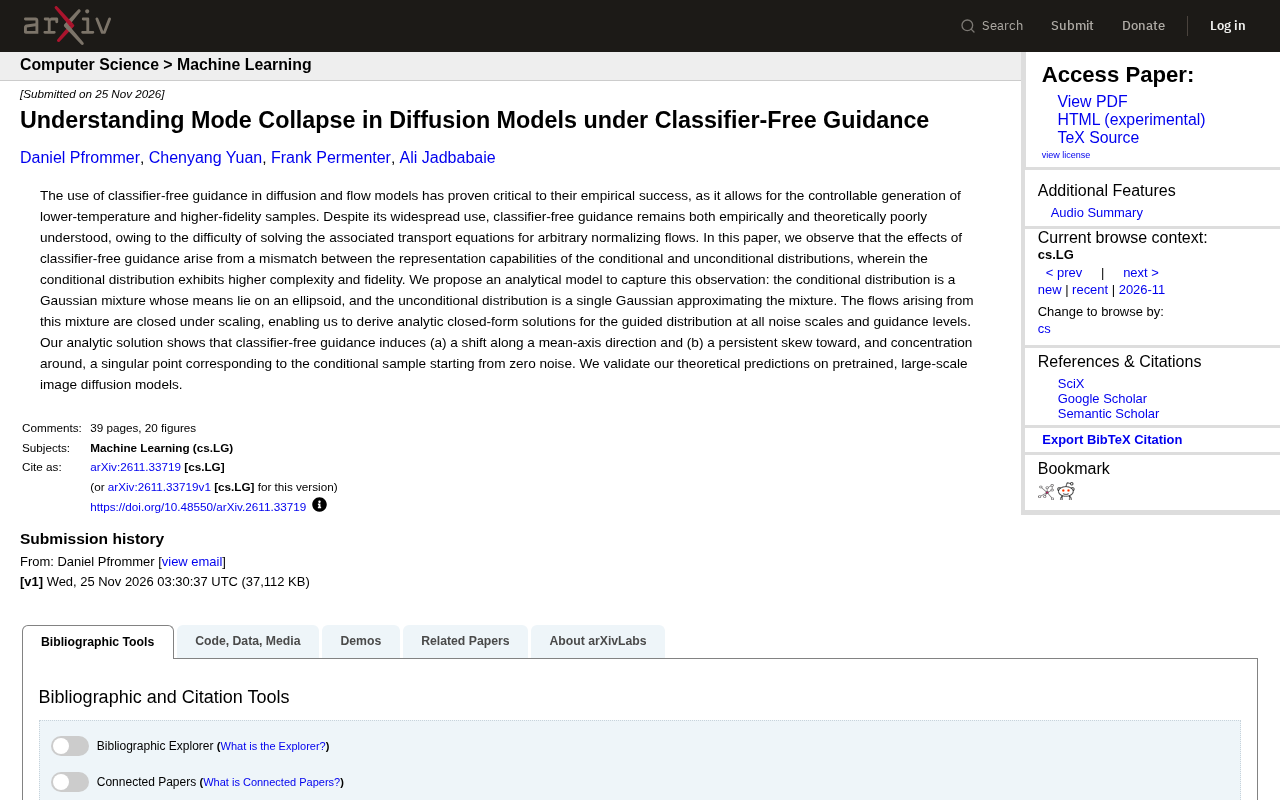
A New Explanation for Diffusion Model Mode Collapse: Representation Mismatch Under Classifier-Free Guidance
A new paper proposes an analytical model revealing the mechanism of mode collapse in diffusion models under classifier-free guidance: representation mismatch between conditional and unconditional distributions causes mean shifts and singular point clustering, verified on large-scale image models.