S2S: Sparse-to-Sparse Feature Learning Enables Cross-Layer Analysis and Steering

S2S explicitly trains layer-by-layer sparse features to predict the next layer, enhancing cross-layer correspondence and separating intervention effects.
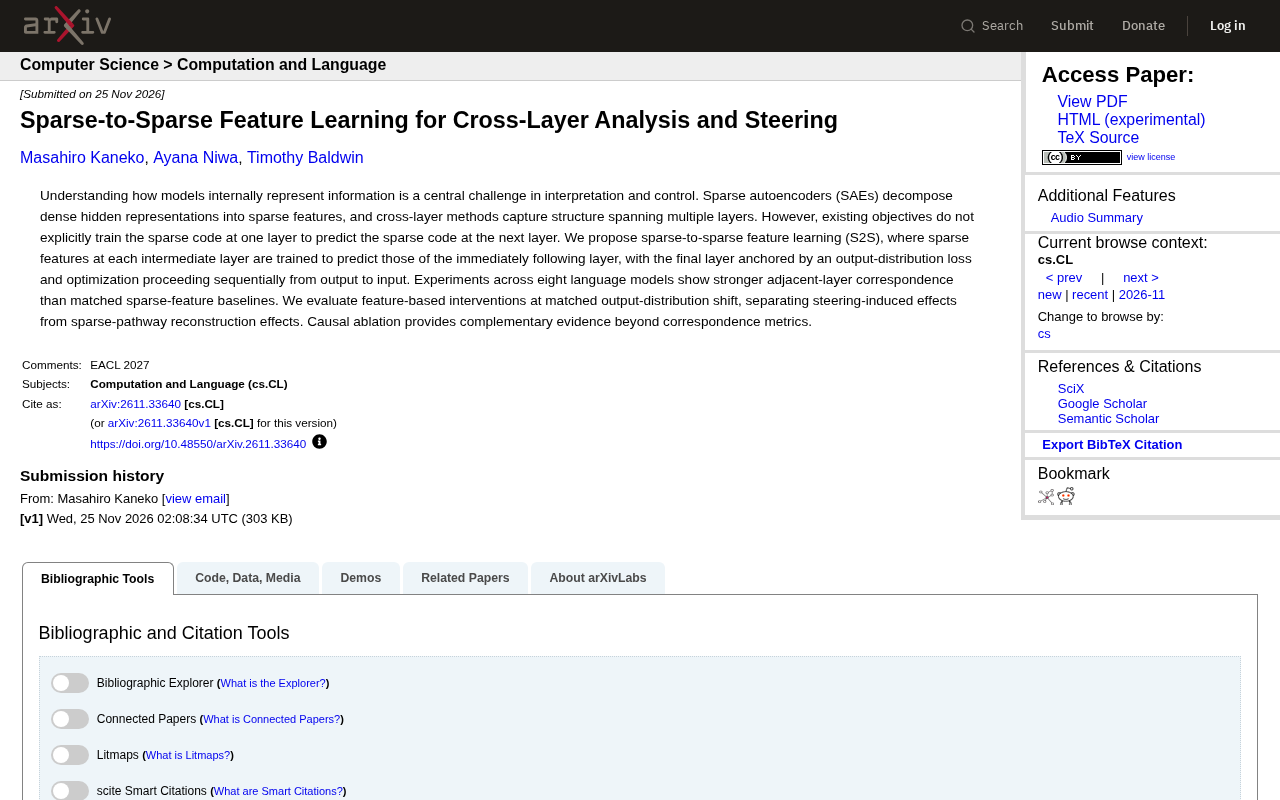
Sparse autoencoders (SAEs) can decompose dense hidden representations into sparse features, but existing methods do not explicitly train the sparse codes of one layer to predict the next layer. A recent study proposes Sparse-to-Sparse feature learning (S2S), which, through layer-by-layer prediction and output-distribution anchoring, achieves stronger adjacent-layer correspondence across eight language models. By matching output-distribution shifts during evaluation, S2S separates steering-induced causal effects from sparse-path reconstruction effects, and validates feature interventions through causal ablation.
Sparse autoencoders (SAEs) can decompose dense hidden representations into sparse features, but existing methods do not explicitly train the sparse codes of one layer to predict the sparse codes of the next layer. A recent study proposes Sparse-to-Sparse feature learning (S2S), which, through layer-by-layer prediction and output-distribution anchoring, achieves stronger adjacent-layer correspondence across eight language models and provides a new tool for causal analysis of feature interventions.
Why Does Cross-Layer Sparse Feature Learning Matter?
Understanding how information is represented inside a model is a core challenge for interpretation and control. Sparse autoencoders (SAEs) have become a mainstream tool for decomposing dense hidden representations, breaking activation vectors into sparse, interpretable features. However, a model's computation unfolds across layers, and analyzing the features of a single layer in isolation loses information about inter-layer structure.
Existing cross-layer methods can capture multi-layer structure, but their objective functions do not explicitly require the sparse codes of one layer to predict the sparse codes of the next layer. In other words, the sparse feature correspondence between layers is "emergent" rather than "trained." The authors of S2S argue that such an explicit prediction objective can yield tighter cross-layer correspondence, thereby improving the reliability of feature interventions.
Sparse autoencoders (SAEs) are an unsupervised learning method designed to decompose dense activation vectors in neural networks into high-dimensional sparse representations. Their basic structure consists of an encoder that maps input activations to sparse codes, and a decoder that attempts to reconstruct the original activations from the sparse codes. The training objective usually includes a reconstruction loss and a sparsity penalty (such as L1 regularization), encouraging only a few dimensions in the code to be non-zero. In interpretability research, SAEs are used to extract interpretable features from inside a model, where each sparse dimension often corresponds to a human-understandable concept. However, standard SAEs are trained independently on each layer and do not account for the flow of information in inter-layer computation, making it difficult to capture how features evolve and combine across layers.
The Core Design of S2S: Layer-by-Layer Prediction and Output Anchoring
The training objective of S2S is direct: the sparse features of each intermediate layer are trained to predict the sparse features of the immediately following layer. The final layer is anchored by an output-distribution loss, ensuring that the sparse features do not drift away from the model's actual output behavior. Optimization proceeds sequentially from the output layer toward the input layer; this back-to-front order means that each layer's prediction target is built on top of the already-optimized features of the next layer.
Compared with matched sparse-feature baselines, S2S exhibits stronger adjacent-layer correspondence across eight language models. This means that the sparse features learned by S2S have better consistency across layers, laying the foundation for subsequent cross-layer analysis and intervention.
Output-distribution anchoring is a key mechanism in S2S training. Specifically, the sparse features of the final layer are required to predict the model's output distribution (such as the probability distribution over the next token), typically implemented via cross-entropy loss or KL divergence. This ensures that the sparse codes not only compress the hidden representations but also retain information relevant to the model's actual behavior. Without such anchoring, the sparse features might optimize only the reconstruction objective and deviate from the model's predictive function, causing intervention experiments to fail. Output-distribution anchoring tightly couples the sparse features with the model's output behavior, providing a semantic basis for cross-layer prediction so that the prediction targets of intermediate layers do not drift away from the model's actual computation.
Separating Steering Effects from Reconstruction Effects
Feature intervention is an important means of explaining model behavior, but the output changes induced by intervention may conflate two effects: the causal effect caused by the steering itself, and the side effects brought by sparse-path reconstruction. S2S evaluates feature-based interventions under matched output-distribution shifts, thereby separating the steering-induced effect from the sparse-path reconstruction effect.
This evaluation approach is stricter than correspondence metrics alone. High correspondence does not imply effective intervention; only causal ablation experiments can provide complementary evidence. The authors of S2S validated the effectiveness of feature interventions through causal ablation, showing that cross-layer sparse features not only "appear" to correspond but also play a real role at the causal level.
Causal ablation is an experimental method used to verify the causal importance of features. In SAE analysis, one typically observes changes in model outputs by activating or suppressing specific sparse features. However, simple ablation may simultaneously alter the reconstruction error of the sparse path, introducing confounding effects. The causal ablation adopted by S2S is performed under matched output-distribution shifts: first, the change in output distribution caused by the intervention is measured, and then the intervention strength is adjusted so that the output shift matches the baseline, thereby isolating the pure steering effect. This method draws on the matching idea from causal inference, requiring the intervention group and the control group to be comparable on key confounding variables, so as to more accurately estimate the causal contribution of features to model behavior.
Implications for Interpretability Research
The value of S2S lies in transforming cross-layer analysis from "post-hoc observation" into a "training objective." Traditional SAE analysis often trains SAEs on each layer first and then compares feature similarity after the fact; S2S instead directly uses inter-layer prediction as a training signal, so that the sparse features are aligned with inter-layer structure during training.
This idea is also meaningful for model steering. If sparse features have stronger causal consistency across layers, then interventions based on these features are more likely to produce predictable effects. S2S's experiments on eight language models support this direction, but cross-layer sparse feature learning still faces challenges, such as how to balance the prediction objective with the reconstruction objective, and how to scale to more layers and larger models.
Conclusion
S2S proposes an explicit cross-layer sparse feature learning objective that, through layer-by-layer prediction and output anchoring, achieves stronger adjacent-layer correspondence across multiple language models, and uses causal ablation to separate steering effects from reconstruction effects. This work provides a new training paradigm for cross-layer interpretability and feature intervention, and is worth further exploration by researchers interested in interpretability, model steering, and sparse representations.
One-line Summary
S2S explicitly trains layer-by-layer sparse features to predict the next layer, enhancing cross-layer correspondence and separating intervention effects.
Paragraph Summary
Sparse autoencoders (SAEs) can decompose dense hidden representations into sparse features, but existing methods do not explicitly train the sparse codes of one layer to predict the next layer. A recent study proposes Sparse-to-Sparse feature learning (S2S), which, through layer-by-layer prediction and output-distribution anchoring, achieves stronger adjacent-layer correspondence across eight language models. S2S optimizes sequentially from the output layer toward the input layer; the sparse features of each intermediate layer are trained to predict the sparse features of the immediately following layer, and the final layer is anchored by an output-distribution loss. When evaluating interventions, S2S separates the causal effect induced by steering from the sparse-path reconstruction effect by matching output-distribution shifts, and validates the effectiveness of feature interventions through causal ablation. This work transforms cross-layer analysis from "post-hoc observation" into a "training objective," providing a new training paradigm for cross-layer interpretability and feature intervention.
Related articles

Sequential Editing Without Catastrophic Forgetting: Batch-Equivalent Method Enables Stable LLM Knowledge Updates
Paper revisits sequential Locate-Then-Edit: batch editing supports tens of thousands of edits while sequential editing collapses after hundreds. Proposes batch-equivalent method.

OrbACE Framework: Integrating Electronic Structure Descriptors to Improve Machine Learning Potential Accuracy
OrbACE combines E(3)-equivariant cluster expansion with cheap electronic structure descriptors, achieving one-third the energy error of MACE and half the force error on ANI-1x, offering a high-accuracy MLIP solution for data-scarce scenarios.
A New Explanation for Diffusion Model Mode Collapse: Representation Mismatch Under Classifier-Free Guidance
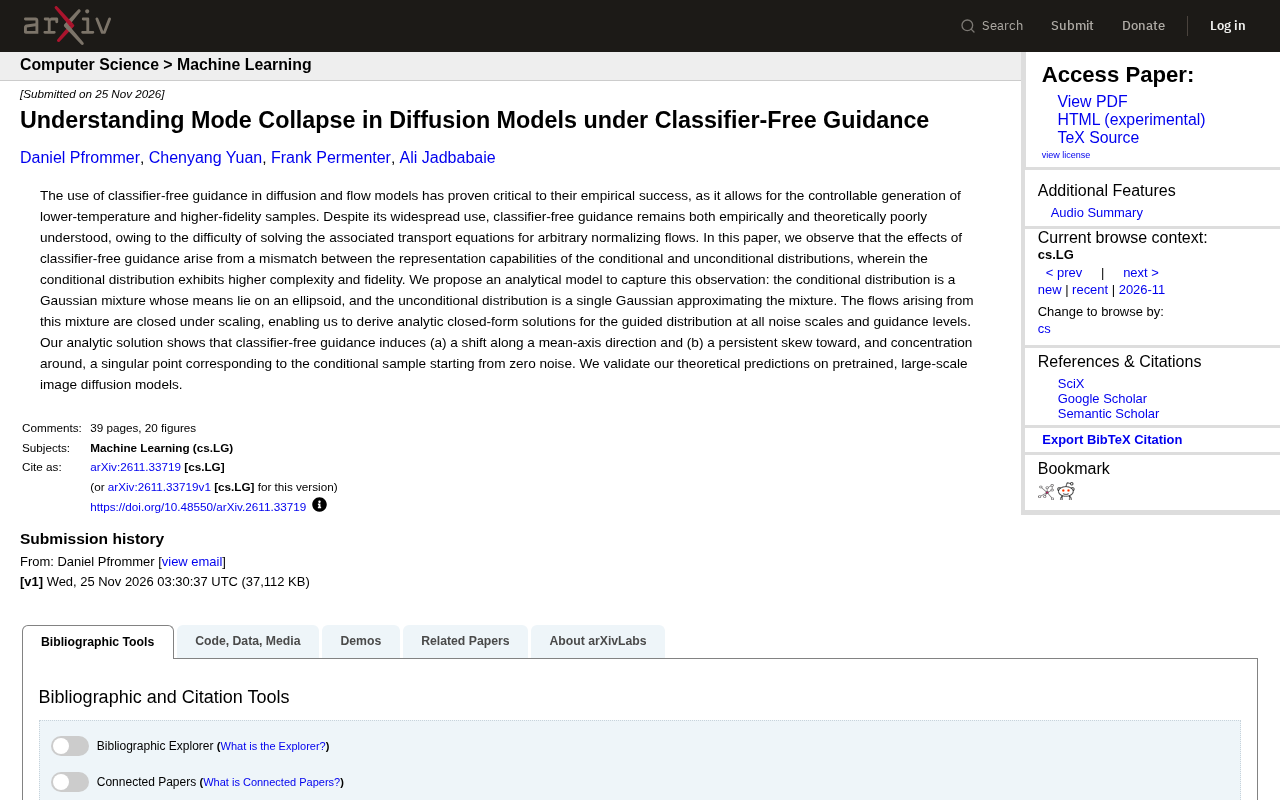
A new paper proposes an analytical model revealing the mechanism of mode collapse in diffusion models under classifier-free guidance: representation mismatch between conditional and unconditional distributions causes mean shifts and singular point clustering, verified on large-scale image models.