Orca: An Open-Source ADE (Agent Development Environment) for Parallel AI Programming

Orca is an open-source ADE that orchestrates parallel AI coding agents across desktop, mobile, and VPS.
Orca is an open-source Agent Development Environment (ADE) by stablyai that has rapidly gained over 42,000 GitHub Stars. Unlike traditional IDEs, Orca manages a fleet of parallel AI coding agents, supporting any coding agent with a BYO subscription model. It offers desktop, mobile, and VPS deployment, enabling 24/7 autonomous task execution. Built with TypeScript for cross-platform coverage, Orca represents a paradigm shift from assisted coding to delegated, parallel AI programming.
What Is Orca
In a landscape flooded with AI programming tools, an open-source project called Orca is rapidly gaining traction. Developed by stablyai, the project has amassed over 42,000 Stars on GitHub in a remarkably short time, with 881 new Stars added in a single day alone—a clear indicator of intense interest from the developer community.
Orca positions itself as an ADE (Agent Development Environment). Unlike a traditional IDE (Integrated Development Environment), an ADE isn't designed to provide code-editing assistance to a single developer. Instead, it's built to manage and orchestrate a "fleet of parallel agents." This positioning captures a pivotal shift in the AI programming paradigm—from "a single assistant helping a human write code" to "multiple autonomous agents completing tasks in parallel."
To appreciate the significance of ADE, it helps to revisit the design philosophy behind traditional IDEs. Classic IDEs like VS Code and IntelliJ IDEA are fundamentally centered around the human developer, offering tools such as syntax highlighting, auto-completion, and debuggers to boost individual coding efficiency. An ADE, by contrast, treats the agent as a first-class citizen. The core problem it solves is no longer "how to help a person write code" but rather "how to manage, orchestrate, and monitor multiple autonomously running AI agents." This encompasses task allocation, context sharing, conflict detection, result merging, and a host of other capabilities that simply don't exist in traditional IDEs. From this perspective, the relationship between ADE and IDE isn't a simple upgrade—it's a paradigm reconstruction of the development environment.
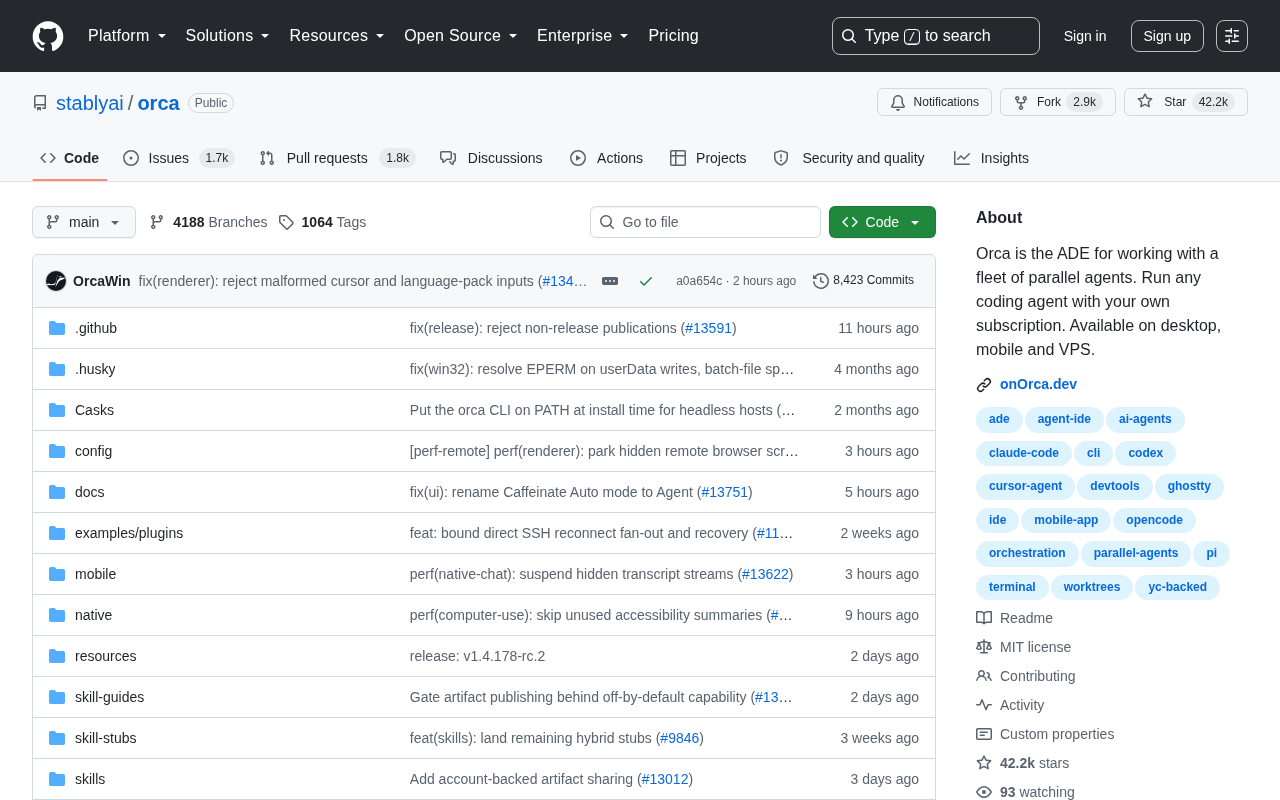
Core Features: A Parallel Fleet of Agents
Run Any Coding Agent
Orca's greatest highlight is its openness. The project explicitly states: "Run any coding agent with your own subscription"—meaning users can connect any coding agent and power it using their own subscription accounts. This means Orca isn't locked into any single model or service provider. Instead, it serves as a unified orchestration layer, allowing coding agents driven by Claude, GPT, and other models to collaborate within the same environment.
For developers, this "BYO Subscription" (Bring Your Own Subscription) model offers significant cost and flexibility advantages: no extra middleman fees to the platform, direct reuse of existing API quotas or subscription credits, and avoidance of vendor lock-in risks. The BYO model is becoming increasingly popular in cloud computing and AI tooling. Currently, many AI programming platforms (such as Cursor and Windsurf) use their own subscription models, where users pay the platform, which in turn calls the underlying LLM APIs. While this simplifies the user experience, it also introduces markup costs and vendor lock-in risks. Orca's BYO Subscription model lets users directly use the API credits they've purchased from model providers like OpenAI or Anthropic, with the platform serving purely as an orchestration layer that stays out of the billing chain. For teams with heavy API usage, the cost savings are especially significant.
Parallel Collaboration, Not Serial Execution
Traditional AI programming assistants tend to work serially—you make a request, it responds, and then you move on to the next step. Orca emphasizes a "fleet of parallel agents," where multiple agents can simultaneously work on different task branches.
This parallel architecture is particularly valuable for large-scale projects. Imagine a scenario: one agent is refactoring the backend API, another is simultaneously writing frontend components, and a third is focused on generating test cases. They each progress independently, and the developer reviews and merges results within Orca's unified environment, dramatically boosting overall development throughput.
It's worth noting that parallel agent architectures face unique technical challenges. In traditional software engineering, classic problems with parallel processing include Race Conditions and Deadlocks. In the AI agent context, analogous issues manifest as: multiple agents simultaneously modifying the same region of the same file, or one agent's output being an input dependency for another. Solving these problems typically requires introducing task dependency graphs (DAGs), file-level locking mechanisms, or Git branch-based isolation strategies that let each agent work in an independent sandbox, with results ultimately integrated through a mechanism similar to Git Merge. This is also an important technical dimension for evaluating the maturity of an ADE product.
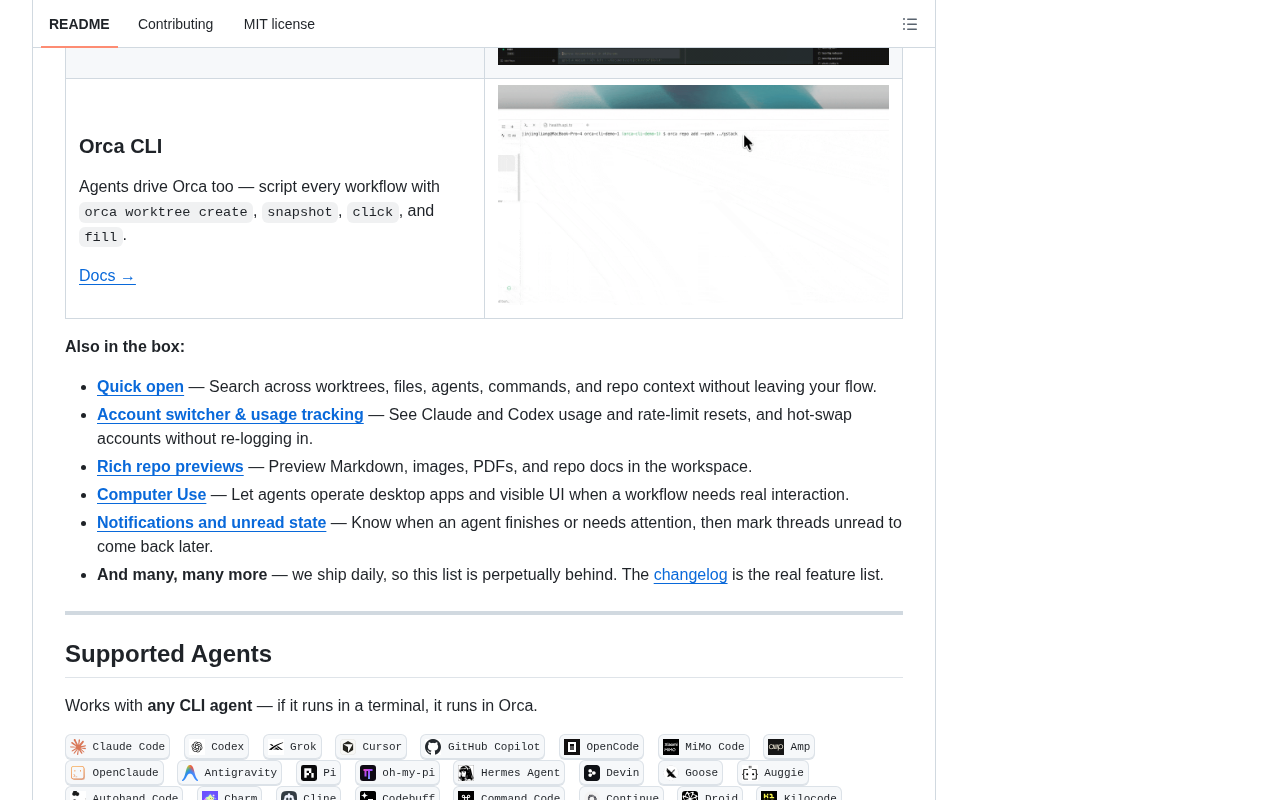
Full Platform Coverage: Desktop, Mobile, and VPS Deployment
Another key differentiator for Orca is its cross-platform availability. The project offers three deployment modes: desktop, mobile, and VPS (Virtual Private Server).
This design is notably forward-thinking:
- Desktop meets developers' needs for deep editing and debugging in their local environment;
- Mobile means developers can check on agent progress anytime, anywhere, approve critical decisions, or even trigger tasks during their commute;
- VPS deployment enables the agent fleet to be hosted on cloud servers for continuous operation, achieving truly "unattended" long-running task execution.
The VPS deployment mode deserves particular attention. A VPS (Virtual Private Server) is a cloud computing resource that sits between shared hosting and dedicated servers, giving users full control over a virtualized environment. Deploying AI coding agents on a VPS means these agents can run independently of the developer's local machine, unaffected by shutdowns, network disconnections, or other local factors. This gives rise to an entirely new work rhythm: developers issue a batch of task instructions before the end of the workday, agents continue executing overnight or over the weekend, and developers review the results the next morning. This model is a natural extension of the CI/CD (Continuous Integration/Continuous Deployment) philosophy in DevOps, except the scope of automation now extends from building and deployment to code writing itself.
When agents can autonomously push tasks forward 24/7 on a server, the new paradigm of "asynchronous programming" truly materializes—developers shift from being "real-time operators" to "task supervisors."
Technology Choices and Ecosystem Positioning
Orca uses TypeScript as its primary development language, which aligns well with the tech stacks of frontend and full-stack developers and facilitates code reuse across desktop (e.g., Electron/Tauri-based), web, and mobile platforms. TypeScript's type system also provides better maintainability when building complex agent orchestration logic.
The choice of TypeScript has deeper technical rationale as well. TypeScript, a superset of JavaScript developed by Microsoft, adds a static type system on top of the original dynamic typing and has become the de facto standard for modern web development. In the desktop application space, the TypeScript ecosystem offers two major frameworks: Electron and Tauri. Electron is widely used by well-known applications like VS Code, Slack, and Discord, while Tauri is known for significantly smaller bundle sizes (typically 10x smaller than Electron) and lower memory consumption. On the mobile side, frameworks like React Native also allow TypeScript code to run cross-platform. This enables the Orca team to cover desktop, web, and mobile with a single core codebase, dramatically reducing multi-platform development and maintenance costs—which also explains how Orca can deliver on its promise of full platform coverage.
In terms of ecosystem positioning, Orca operates in the same space as a wave of recently emerging "agent orchestration tools," but its conceptual abstraction of "ADE" and its product narrative of a "parallel fleet" set it apart from its peers. The community metrics of 42,146 Stars and 2,943 Forks also confirm that this direction addresses a genuine pain point for developers.
Trend Signals Worth Watching
Orca's rise is essentially a microcosm of the evolution of AI programming tools. Several important trends can be gleaned from it:
First, programming is shifting from "assistance" to "delegation." Early tools like code completion were fundamentally about "assisting humans." ADE platforms like Orca aim to let humans "delegate" complete tasks to agents that execute autonomously.
Looking back at the evolution of AI programming tools, three distinct phases emerge. The first phase was "code completion," represented by GitHub Copilot launched in 2021, where AI predicts and completes subsequent code as the developer types—essentially line-level or function-level auto-completion. The second phase was "conversational programming," represented by chat interfaces from LLMs like ChatGPT and Claude, where developers describe requirements in natural language and AI generates complete code blocks, though human guidance and review are still needed at each step. The third phase is the "delegated programming" that Orca represents, where developers only need to define high-level goals and constraints, and agents autonomously plan execution paths, write code, run tests, and fix bugs until the task is complete. The essence of this evolution is a continuous increase in the granularity of human participation in the development loop—from line-by-line involvement, to function-by-function involvement, to task-by-task involvement.
Second, parallelization is becoming the next efficiency breakthrough. As the capabilities of individual agents approach saturation, scheduling multiple agents in parallel to boost output becomes the natural next step.
Third, openness and decoupling are universal demands from the community. The "bring your own subscription, run any agent" design responds to developers' wariness of vendor lock-in and represents a natural advantage of open-source projects over closed-source products.
Conclusion
As an open-source Agent Development Environment, Orca has quickly won over the developer community with its clear product positioning, open architecture design, and full platform coverage. The "parallel agent collaboration" paradigm it represents may well be one of the key forms of future software development workflows.
For teams and individuals looking to explore new AI-driven development models, Orca is undoubtedly a project worth closely following—and even trying hands-on. That said, its real-world stability and the maturity of its multi-agent coordination still need to be further validated in production projects.
Related articles

Random Pruning of the DPO Computation Graph: 1.4x Training Speedup and Lower Peak Memory
DPO training too slow and memory-hungry? This paper proposes a random pruning framework for the DPO computation graph, sampling independently across position, sequence, and branch dimensions; branch pruning achieves a 1.426x step-time speedup and cuts training time by about 30%, with in-depth attribution of memory and time gains.

Why Does JEPA Underperform MLM in Longitudinal EHR Representation Learning?
New study compares JEPA and MLM for longitudinal EHR representation learning on MIMIC-IV: three JEPA variants train stably without collapse but underperform MLM; target size, not heterogeneity, drives prediction error.

Transfer Learning + Visible Light Communication: A New Approach to Energy-Efficient Indoor Positioning
A study proposes a transfer learning-based visible light communication indoor positioning method, achieving 47% accuracy improvement on the BOSCH factory dataset, 67.5% model efficiency under high noise, and introducing the ME composite metric for energy-efficient positioning in energy-constrained industrial IoT scenarios.