OrchSLM: Probing the Dynamics of Small Language Model Orchestration
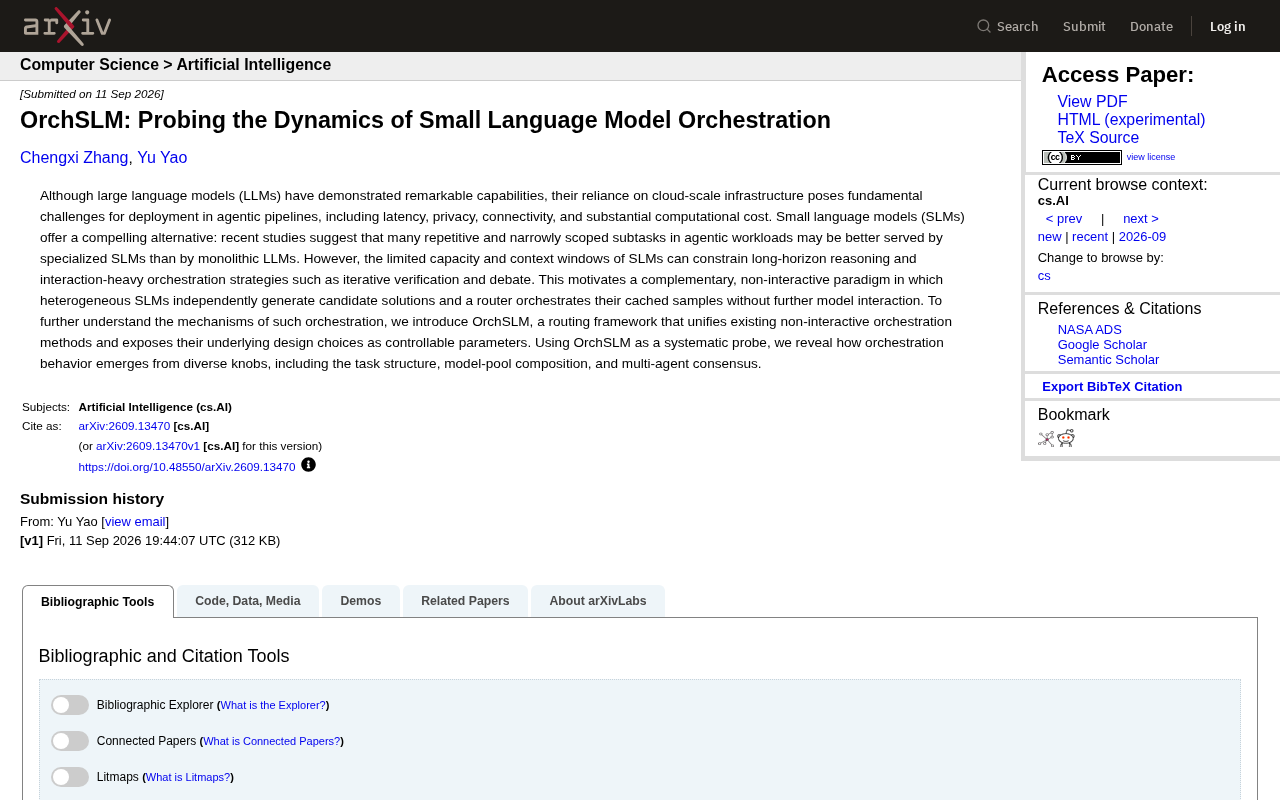
OrchSLM provides a unified framework to systematically probe key design factors in multi-SLM non-interactive orchestration.
OrchSLM is an analytical framework for orchestrating small language models (SLMs) in agentic systems. To address the high latency, cost, and privacy issues of LLMs while working around SLMs' limited context windows, it proposes a non-interactive paradigm: multiple heterogeneous SLMs independently generate candidate answers, which a lightweight router then orchestrates — bypassing the need for long-range interaction. The framework unifies existing non-interactive methods under a common parameterized view, exposing implicit design choices as controllable knobs and revealing how task structure, model-pool composition, and multi-agent consensus collectively shape orchestration behavior. Its core value lies in providing a quantifiable analytical tool rather than a specific optimal algorithm.
Why Small Language Models Need "Collaborative Orchestration"
Large language models (LLMs) have demonstrated impressive capabilities in reasoning and generation tasks, but their dependence on large-scale cloud infrastructure creates a set of structural challenges in real-world deployment: high latency, privacy risks, connectivity requirements, and significant compute costs. These issues become even more pronounced in agentic pipelines, where models are invoked repeatedly and frequently.
Small language models (SLMs) have emerged as an attractive alternative. Recent research suggests that the many repetitive, narrow-scope subtasks common in agentic workloads may actually be better handled by specialized SLMs than by a single large, monolithic LLM. In other words, rather than using a sledgehammer for every small task, a team of focused, specialized models working in concert may be a better fit.
That said, SLMs have relatively limited capacity and context windows, which directly constrains their performance on long-chain reasoning and orchestration strategies that rely on frequent interaction — such as iterative verification or multi-model debate. This tension is exactly what the OrchSLM research aims to address head-on.
Agentic pipelines are task-execution systems composed of multiple autonomous decision-making steps chained together, typically involving planning, tool calls, self-reflection, and result verification. Unlike single-turn question answering, these systems often require a model to be called dozens or even hundreds of times within a single task. If each call requires accessing a remote LLM API, the accumulated network latency and token costs quickly become prohibitive. Consider an agent that iteratively refines code: each revision cycle may trigger multiple model calls, causing cloud LLM costs to grow exponentially. It is precisely this "high-frequency invocation" characteristic that gives locally deployed, specialized SLMs a structural advantage in agentic scenarios — not merely as a "slightly weaker but cheaper" compromise.
Non-Interactive Orchestration: An Alternative Technical Path
Given the ceiling on SLMs' interactive capabilities, the research proposes a complementary non-interactive paradigm. The core idea is straightforward: have multiple heterogeneous SLMs each independently generate candidate responses, then let a router orchestrate these pre-cached outputs — with no further interaction between models required.
This design elegantly sidesteps SLMs' weaknesses in long-range interaction. Since small models struggle to support complex back-and-forth collaboration like iterative verification or debate, the approach simply lets them "each write their own answer" and delegates all coordination to a lightweight routing layer. This reduces the demands on any individual model's context window and keeps the overall inference overhead manageable.
From an engineering perspective, the value of this approach lies in decoupling "model capability" from "orchestration logic" — models are only responsible for producing candidate answers, while how those answers are selected and combined is determined by an external mechanism.
In contrast to the non-interactive paradigm, interactive orchestration strategies include approaches like multi-model debate and iterative verification. In multi-model debate, multiple models read each other's outputs and revise their answers across multiple rounds, gradually converging toward a better solution; in iterative verification, one model generates an answer that is then reviewed by another model, in a repeating loop. These methods have been validated on LLMs for improving reasoning quality, but they require models to maintain long multi-turn dialogue contexts within a single task — placing high demands on context window length and per-call compute. These are precisely the two main bottlenecks for SLMs. The non-interactive paradigm avoids this dependency by fully decoupling "generation" from "selection."
The OrchSLM Framework: Turning Design Choices into Controllable Knobs
To systematically understand how such orchestration mechanisms work, the researchers propose OrchSLM — a routing framework. Its role is not to introduce yet another new orchestration method, but to serve as a unified analytical tool.
OrchSLM integrates a variety of existing non-interactive orchestration methods under a single framework and explicitly exposes the implicit design choices embedded within them as controllable parameters. This means that "hidden decisions" previously scattered across different methods are transformed into individually adjustable, comparable, and measurable knobs.
This approach carries significant methodological value. Different orchestration strategies have historically been difficult to compare directly, because they differ in their assumptions and implementation details. By providing a unified, parameterized perspective, OrchSLM allows researchers to explore the effects of different design choices within the same coordinate system — turning the vague question of "why does orchestration work?" into something empirically investigable.
Three Key Factors That Shape Orchestration Behavior
Using OrchSLM as a systematic probe, the research reveals how orchestration behavior "emerges" from adjustments along multiple dimensions. The paper highlights three key factors:
Task Structure
The nature of the task itself — whether it involves simple classification or multi-step reasoning — significantly influences which orchestration strategy is most effective. Tasks with different structures exhibit varying sensitivity to candidate diversity and routing decisions.
Model-Pool Composition
How the set of SLMs participating in orchestration is assembled is equally important. Whether you choose models with similar capability levels or deliberately introduce heterogeneous, complementary models leads to different synergistic effects.
Multi-Agent Consensus
Once multiple models have independently produced candidate answers, how "consensus" is reached among those answers — simple majority voting versus weighted aggregation — directly determines the quality of the final output.
These three dimensions together form the "parameter space" of orchestration behavior, and OrchSLM's contribution lies precisely in enabling observation of how orchestration performance varies as these knobs are adjusted.
Multi-agent consensus mechanisms can be implemented at multiple levels of sophistication. The simplest is majority voting, which directly selects the most frequently occurring answer — common in mathematical reasoning tasks (e.g., the self-consistency method). More complex schemes include confidence-weighted voting, scoring candidate answers with a small verifier model and selecting the highest-scoring one, and training dedicated aggregation models to fuse multiple candidate outputs. Different consensus mechanisms vary in how much they depend on "candidate answer diversity": majority voting relies on enough models producing the same correct answer, while verifier-based approaches depend more heavily on the reliability of the verifier itself. This also implies an interaction effect between model-pool composition strategy and consensus mechanism — exactly the kind of cross-dimensional relationship that a unified framework like OrchSLM is designed to help researchers systematically measure.
Research Significance and Outlook
The value of OrchSLM lies more in analysis and understanding than in proposing a specific, better-performing solution. As SLMs are increasingly viewed as important building blocks of agentic systems, effectively orchestrating multiple small models is becoming an unavoidable engineering and research challenge.
This work moves a domain previously reliant on experience and intuition toward something more quantifiable and comparable. For developers looking to deploy agentic systems on edge devices, in privacy-sensitive settings, or under cost constraints, understanding "which design knobs genuinely affect orchestration performance" is more practically valuable than blindly stacking models.
It is worth noting that, as a preprint newly published on arXiv, the paper's abstract primarily covers motivation, framework positioning, and research directions. Specific experimental findings and quantitative results require reading the full paper. But even from the analytical perspective it introduces alone, OrchSLM provides a noteworthy research tool for the emerging direction of small model collaboration.
Related articles
Building an AI Sci-Fi Short with LTX + MiniMax H3: Restrained Cinematography in ComfyUI
Sci-fi short REMAINDER uses LTX, MiniMax H3, and ComfyUI with restrained cinematography and flat aesthetics to solve visual consistency in AI filmmaking.
LangChain Deep Agents vs. MDA: Clearing Up the Confusion for Developers
What's the difference between LangChain's Deep Agents and MDA (Managed Deep Agents)? We break down create_deep_agent vs. define_deep_agent and help developers choose.
Why Is AI Agent Development So Fragmented? The Real Causes and How to Work Around Them
Why does AI Agent development feel so fragmented? Logic scattered across prompts, configs, and frameworks makes portability nearly impossible. Here's why — and how to cope.