OrderMint: Turn Customer Chats into Orders with Local AI

Open-source OrderMint uses local Qwen3-8B to turn DM orders into structured drafts, invoiced after human review.
OrderMint is a Hacktoberfest Side Hustle track entry that solves the pain of small merchants manually organizing orders from WhatsApp and Instagram DMs. It runs Qwen3-8B locally via Ollama to extract products, quantities, and notes from unstructured customer messages, then applies deterministic validation, catalog matching, and manual seller review to generate printable invoices. The stack is React+Vite, Node.js+Express, and better-sqlite3. The core design keeps AI from being the sole authority over business data — the model only understands messages, while validation and human confirmation provide the safety net. The hosted frontend currently has deployment issues; it can be run locally from GitHub source.
Small merchants take orders every day through WhatsApp and Instagram DMs, manually organizing products, quantities, and calculating totals — time-consuming and error-prone. Developer ohm-7643 submitted OrderMint to the second week of the Hacktoberfest open-source AI challenge (Side Hustle track), attempting to solve this pain point with a locally-run open-source model: turning unstructured customer messages into structured order drafts that sellers review before generating invoices.
What problem does it solve
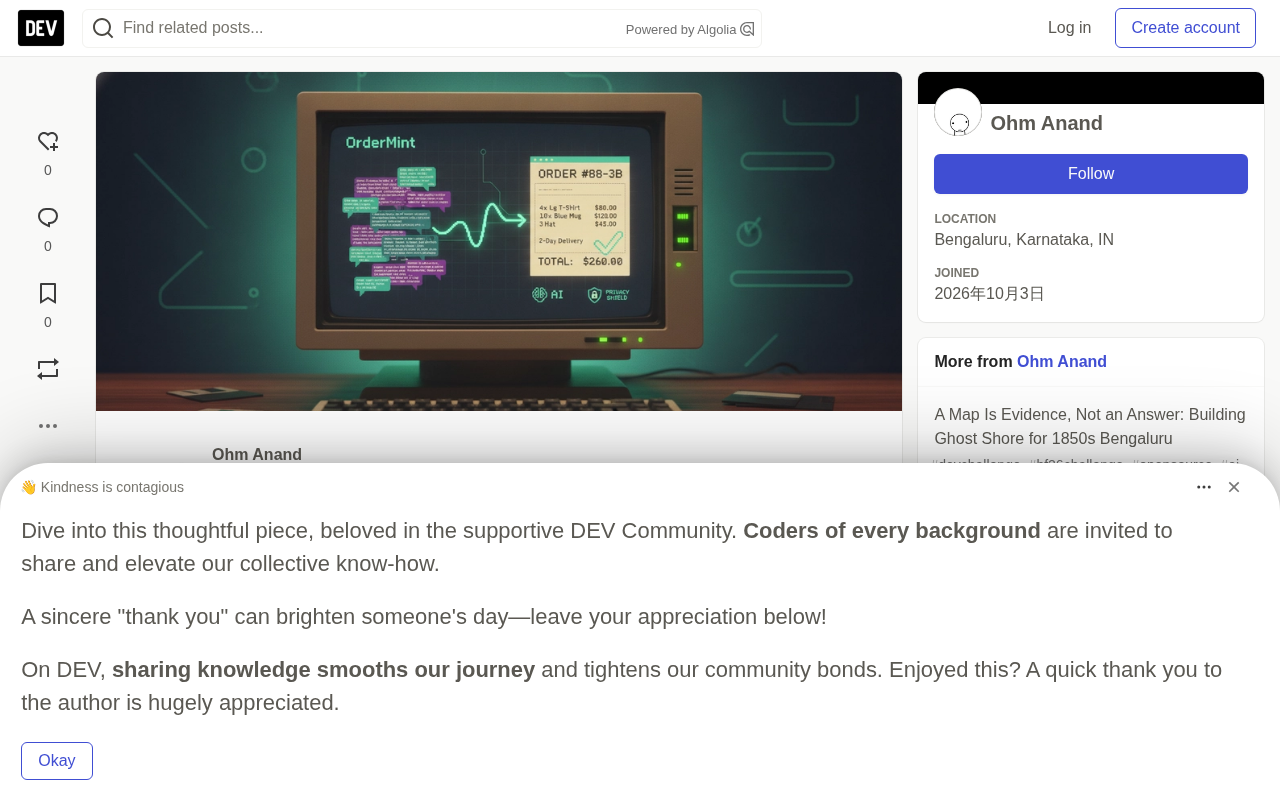
Home bakers, private chefs, cloud kitchens, and Instagram sellers have highly fragmented order channels. Customers typically send something like "I want two chocolate cakes, pick up Friday," and the seller must identify the product, check inventory, calculate the amount, then hand-write or separately enter an invoice. OrderMint breaks this process into three steps: AI-assisted extraction of products, quantities, and notes; deterministic matching and validation against the product catalog; and manual seller review before approving the order.
The project's positioning is clear — it doesn't replace the seller's decision-making, but automates the repetitive labor of "reading messages." The core features listed by the author include AI extraction, catalog matching, human review, SQLite order persistence, printable invoices and daily order summaries, plus fallback logic when the model is unavailable.
Technical architecture and key design trade-offs
The tech stack isn't complex: React + Vite on the frontend, Node.js + Express on the backend, better-sqlite3 for the database, and AI inference running Qwen3-8B — an open-weight model — locally via Ollama.
What's really worth noting is one of the author's design decisions: not letting the AI model be the sole authority for business-critical data. The model is only responsible for "understanding" customer messages; its output goes through deterministic validation at the application layer, then is compared against the product catalog, and finally approved by the seller through manual review. This approach makes sense in scenarios with low tolerance for error, such as orders, inventory, and amounts — LLMs may fabricate quantities or miss products, but validation logic and human confirmation provide a safety net. The author also added automated tests and synthetic order evaluation cases to verify behavior.
Another detail is the controllability that local inference brings. For student developers with limited resources, running open-source models with Ollama means they don't have to build the entire product around a paid closed-source API, and they can experiment more freely with the inference environment.
Ollama is an open-source framework for running large models locally, offering a Docker-like command-line experience that lets developers pull and run open-weight models such as Llama, Qwen, and Mistral on their own laptop or workstation with a single command, and call them through a local HTTP API. It automatically handles model quantization, VRAM/memory allocation, and adaptation to backend inference engines (such as llama.cpp), significantly lowering the barrier to local deployment. For OrderMint, Ollama means model inference never leaves the user's device, avoiding API costs and network latency while also sidestepping privacy concerns about uploading customer chat logs to the cloud.
Qwen3-8B is an open-weight model released by Alibaba's Tongyi Qianwen team. With 8B parameters, it can run quantized on consumer-grade hardware, has strong Chinese comprehension, and is well-suited for handling Chinese or mixed Chinese-English customer messages. Compared with closed-source APIs, open weights allow developers to freely download, deploy offline, and fine-tune, but inference quality depends on local compute, and developers must handle model version management and capability evaluation themselves. OrderMint's choice of it is a trade-off among cost, privacy, and extraction accuracy.
Deterministic validation refers to a business rule-checking layer that doesn't rely on probabilistic models and produces reproducible results. In OrderMint, this might include: checking whether extracted product names exist in the catalog, whether quantities are positive integers, whether the total equals unit price times quantity, whether date formats are valid, etc. Unlike LLM output, these rules produce consistent results on every run, making testing and auditing easier. Positioning the LLM as an "information extractor" rather than a "decision-maker," then using deterministic code as the gatekeeper, is a common "probabilistic component + deterministic shell" architecture in current LLM application engineering — especially suited for zero-tolerance scenarios like amounts and inventory.
Demo status and honest boundaries
Worth noting: the author explicitly states in the original post that the frontend hosted on Render currently has deployment issues and the online interface may fail to load properly. The author chose to be transparent rather than present a broken demo as a working feature. What can currently be verified is the source code and setup instructions in the GitHub repository. This matters for evaluating the project — it's a solid engineering exploration, but not yet a ready-to-use finished product.
The business logic of this kind of tool
OrderMint targets small sellers who "don't want to adopt an expensive, complex system." These users are highly price-sensitive and have low order volumes, but their pain points are real. The author's next steps also center on validation: fixing the frontend deployment, finding real small merchants to test the workflow, using real feedback to improve extraction accuracy, and assessing whether the time saved is enough to support a paid product.
From a broader perspective, this project is a sample of open-source local AI landing in a vertical niche: it doesn't need the full capabilities of a general-purpose LLM, just reliable completion of one repetitive task within a specific workflow, with engineering measures to compensate for the model's unreliability.
FAQ
Is OrderMint usable now? The hosted frontend has deployment issues, and the author is fixing them. You can currently view the source code on the GitHub repository and set it up to run locally.
Does it depend on cloud APIs? No. AI inference runs Qwen3-8B locally via Ollama, with fallback logic when the model is unavailable.
Does the AI directly generate the final order? No. The AI only extracts information; after that there's deterministic validation and catalog matching, and the seller gives final manual approval.
Related articles

Chain of Thought Isn't Just for AI: How Humans Can Use CoT to Improve Thinking Quality
Chain of Thought isn't just a prompt trick for large models. Starting from a Hacker News discussion, this article analyzes why CoT works for human thinking too, breaks down actionable ways to transfer it, and highlights the key differences between human CoT and machine CoT.
Cloudflare Teams Up with OpenAI: Closi…
Cloudflare Teams Up with OpenAI: Closing the Loop from Vulnerability Discovery to Defense with AI
Cloudflare uses OpenAI Daybreak to investigate security vulnerabilities and generate reviewable remediation plans, while developers use Codex to boost coding efficiency and quality.

Orca Multi-Agent Orchestration in Practice: A Guide to Parallel Collaboration with Claude and Codex
Orca is Stable AI's free open-source agent workbench supporting 34 agents like Claude Code and Codex in parallel. Learn its Git worktree isolation, multi-model orchestration, and mobile management.