Origins of BSD Unix: A Comic Interpretation of the Birth of an Open Source Pioneer

F/OSS Comics tells the origin of BSD Unix through comics, sparking community interest in open source history.
Episode 13 of the F/OSS Comics series retells the origin of BSD Unix in comic form, earning 189 points and 24 comments on Hacker News and reflecting developers' continued interest in open source history. The article traces BSD's journey from a collection of Berkeley's supplements and modifications to AT&T Unix to spawning FreeBSD, OpenBSD, and NetBSD and influencing the macOS底层, and discusses the balance comic storytelling strikes between lowering the barrier to understanding and delving into technical details. It also notes that community discussion focuses on historical accuracy and the philosophical divergence between the BSD license and the GPL, emphasizing that understanding this history helps contemporary developers recognize the value orientations of open source licenses and the continuity of system design choices.
Introduction: When Comics Meet Unix History
In the long river of tech history, the birth of BSD Unix is an easily simplified yet crucial node. Episode 13 of the F/OSS Comics series turns its attention to the origins of BSD Unix, retelling this history in comic form. This episode earned 189 points and 24 comments on Hacker News, demonstrating the developer community's continued interest in open source software history.
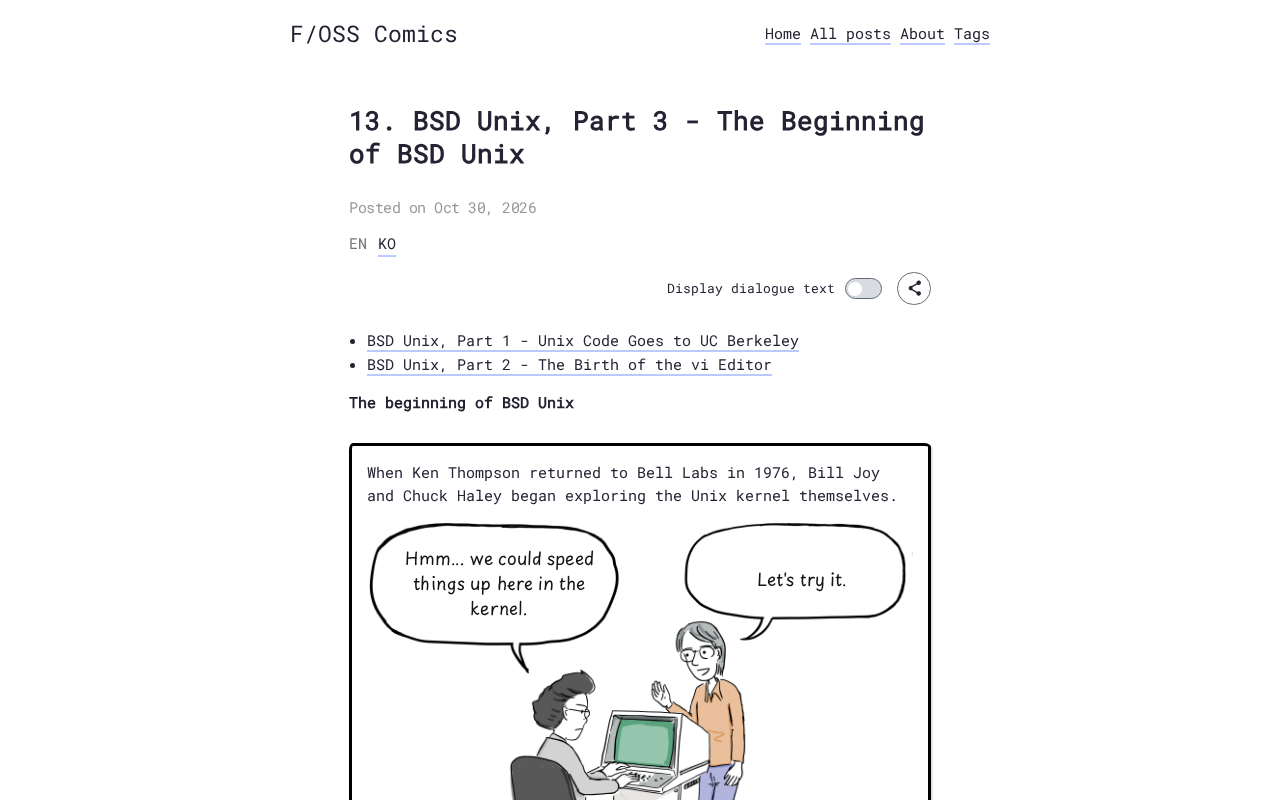
The F/OSS Comics series: F/OSS Comics is a creative project that tells the history of Free and Open Source Software (F/OSS) through comics. Through visual storytelling, it transforms complex technological evolution, personal relationships, and community events into accessible comic stories, aiming to lower the barrier for the public to understand open source history. The series has attracted attention in developer communities such as Hacker News and has become a complementary form of technical history communication thanks to its unique expressive approach.
The Historical Coordinates of BSD Unix
To understand the starting point of BSD Unix, one needs to return to the period of Unix's spread after its birth at Bell Labs. UC Berkeley, as a major academic institution, became a key node for the outward distribution of Unix source code. BSD (Berkeley Software Distribution) was initially not an independent operating system but rather a collection of supplements and modifications to AT&T Unix, gradually accumulated by Berkeley students and researchers.
This process embodied the prototype of early open source collaboration: code flowed freely in the academic environment, and patches and improvements were jointly maintained by multiple people. The reason the BSD branch of Unix matters is that it later spawned still-active systems such as FreeBSD, OpenBSD, and NetBSD, and profoundly influenced the underlying architecture of macOS. F/OSS Comics chose to narrate this history through comics, lowering the barrier to understanding and enabling developers who are not history specialists to quickly build a cognitive framework.
The divergence between the BSD license and the GPL: The BSD license is a permissive open source license that allows users to modify and distribute code, and even to keep derivative works closed source, requiring only that the copyright notice be retained. The GPL (GNU General Public License), by contrast, is copyleft and requires derivative works to be open-sourced under the same license. This philosophical divergence stems from different understandings of "software freedom": the BSD camp emphasizes free use of code and commercial friendliness, while the GPL camp emphasizes protecting user freedom and preventing code from being privatized. This divergence has profoundly shaped the landscape of the subsequent open source ecosystem and is also a focal point often mentioned in Hacker News discussions.
The underlying connection between macOS and BSD: The underlying core of macOS, Darwin, is based on code from BSD-derived systems (such as FreeBSD and NetBSD), and its kernel XNU in particular combines the Mach microkernel with BSD components. One reason Apple adopted BSD code is the permissiveness of the BSD license, which allows it to keep modified code closed source without having to disclose it. This means BSD's technological legacy has indirectly affected hundreds of millions of ordinary users, even though most of them are unaware of it.
The Value and Limitations of Comic Storytelling
The F/OSS Comics series tells the history of Free and Open Source Software (F/OSS) in a visual way, which is a differentiated attempt in technical content creation. The comic form excels at presenting personal relationships and timelines of key events, but limited by length, it struggles to delve into technical details. For readers who want to understand the technical evolution of BSD Unix, comics can serve as an entry point, but further study of original documents and code repositories is still needed afterward.
The discussion on Hacker News (24 comments) also reflects differences in the community's focus regarding historical narratives: some comments concentrate on the accuracy of historical facts, while others extend to discuss the philosophical divergence between the BSD license and the GPL. This discussion itself forms part of open source culture—every retelling of history triggers renewed reflection on current practices.
Implications for Contemporary Developers
The origin story of BSD Unix reminds us that many conventions of the modern open source ecosystem were not designed out of thin air but gradually formed under specific historical conditions. The permissive environment of academic institutions, the culture of code sharing, and the later divergence of licenses can all be traced back to BSD's early practices.
For today's developers, understanding this history helps them more clearly recognize the value orientations behind different open source licenses, and better understand why certain system design choices persist for decades. Content like F/OSS Comics provides the technical community with a lightweight entry point to history and is well worth following.
Related articles

Cloudflare Open-Sources AI Code Security Audit Tool, Hits 60K Stars
Cloudflare open-sources Security Audit, giving AI coding agents free security auditing. Three-step workflow: app mapping, multi-agent adversarial bug hunting, and three-tier classified reports—born from an internal vulnerability hunting system, with nearly 60K stars.

GPT-6 Astra's Weight-Reading Trick: Only for Small Networks, Practical Value Comes from Writing Code
GPT-6 Astra can read network weights directly, but without tools it is limited to small networks of ~170K weights. Fixing QUEN 3.5 0.8b's reasoning loop required Python and 50 batches; game identification took nearly an hour. This article maps the capability's boundaries and two security reminders.

GPT-6 Astra Rewrites Qwen Weights: 7.9% to 48.1% — Did It Learn Math or Just Learn to Stop?
MIT researchers used GPT-6 Astra to edit Qwen's weights directly, raising math scores from 7.9% to 48.1% with no training. But reproductions show the gain mainly comes from fixing loops and teaching the model to stop, not new math ability.